Pest Control · 31 min read · Updated 1 November 2026
Small Brown Bugs in the House: UK Identification Guide
Small brown bugs in the house are usually food beetles if you find them in the kitchen, and bed bugs, carpet beetle larvae or fleas if you find them around beds and floors. Check where it is, its size and how it moves. Most pantry insects clear with a thorough clear-out and no spray.
By the Bestone pest control team · Contact us
Key takeaways
- Where you find it tells you most. In dry food, it is usually a biscuit beetle, flour beetle, weevil or booklouse. On a bed, think bed bug first.
- Pantry insects are a nuisance, not a health emergency. Surrey Heath Borough Council says beetles and weevils in dried food do not carry disease, but the food should still go in an outside bin.
- Clearing the source does most of the work: empty the cupboard, bin infested food, vacuum the crevices, wash, dry and restock in sealed containers. Skip the insecticide in food cupboards.
- Three of the ten need a different approach. Do not treat bed bugs yourself, do not spray pharaoh ants, and treat any cockroach nymph as a sign of breeding.
- Not sure what you have? Our pest inspection starts from £60, and the price is confirmed in writing before booking.
On this page
- Key takeaways
- Small brown bugs in the house: the quick answer
- Ten small brown bugs, and what each one means
- How to identify a small brown bug in five minutes
- How big is it? Sizes and common lookalikes
- Small brown bugs in the pantry: biscuit beetles
- Small brown bugs in flour: flour beetles
- Bugs in rice or pasta with a long snout: grain and rice weevils
- A bigger brown beetle near the loft or bacon: larder beetles
- Tiny pale brown bugs on damp packets and walls: booklice
- How to clear a kitchen cupboard infestation, step by step
- Is food with bugs in it safe, and can you freeze the rest?
- Small brown bugs in bed: bed bugs, carpet beetle larvae or fleas?
- Found on or near the bed: how to tell them apart
- Small brown bugs in the kitchen at night: cockroach nymphs and pharaoh ants
- Small brown bugs in house all of a sudden: why now?
- Sprays, traps and home remedies: what to use and when to call someone
- What works for pantry insects
- Renting in London: who deals with it?
- What we do, and what it costs
- Our starting prices for small brown bugs
- Common questions
Small brown bugs in the house: the quick answer
Small brown bugs in the house fall into two groups, and the place you found them usually tells you which. Bugs in or near dry food are almost always stored food insects: biscuit beetles, flour beetles, grain weevils, larder beetles or booklice. They are unpleasant but rarely urgent. Bugs on a bed, a carpet or a pet's blanket are a different matter, because bed bugs and fleas feed on blood and need a planned treatment.
Two kitchen visitors break the rule. Cockroach nymphs and pharaoh ants both look like tiny brown specks near food, and both need more than a clean cupboard. That is why it pays to identify the insect before you buy anything.
The table below covers all ten. If you only do one thing today, catch one on clear tape and photograph it beside a ruler. Everything else follows from that.
Ten small brown bugs, and what each one means
| Insect | Size | Where it appears | Why it is there | Does it matter? | What to do |
|---|---|---|---|---|---|
| Biscuit beetle | 2 to 4 mm | Food cupboards, windowsills, fireplaces | Old flour, spices, biscuits, pet food | Spoils food; not harmful to health | Find the source, clear the cupboard |
| Flour beetle | 3 to 4 mm | In flour and cereal | Arrived in a packet; warm kitchen | Spoils food; can taint flour | Bin the food, clear the cupboard |
| Grain or rice weevil | 2 to 6 mm | Whole grains, rice, pasta, birdseed | Developed inside the grain | Spoils food; rice weevils do not bite | Bin it, tell the shop if new |
| Larder beetle | 7 to 10 mm | Larders, lofts, near old nests | Dried meat scraps, dead mice or birds | A sign of something dead nearby | Find and remove the source |
| Booklice | 1 to 2 mm | Damp packets, new plaster, bathrooms | Mould from damp or condensation | Harmless; points to damp | Dry the area, fix the moisture |
| Carpet beetle larva | 4 to 8 mm | Carpet edges, wardrobes, under beds | Wool, fluff, feathers, old nests | Damages natural fibres | Vacuum edges, find the source |
| Bed bug | About 5 mm | Mattress seams, bed frames, skirting | Carried in on luggage or furniture | Bites; will not clear on its own | Do not move things; get help |
| Cockroach nymph | Smaller than adults | Warm spots near sinks and cookers | Food and water; breeding nearby | A hygiene risk; suggests breeding | Check for droppings; get advice |
| Pharaoh ant | Under 2 mm | Worktops and cupboards in heated flats | Indoor colonies in warm, damp spots | Hard to clear; do not spray | Get them identified, use bait |
| Flea | About 2 mm | Pet beds, rugs, floorboards | Pets, or pupae left in an empty home | Bites people and pets | Treat pets and home together |
Figures from the Natural History Museum, English Heritage, the NHS, BPCA advice in PPC magazine, and the councils listed in Sources. Some vary; see below.
How to identify a small brown bug in five minutes
You do not need to be an entomologist. You need a torch, some clear tape, a ruler and your phone. Press tape onto the insect, stick it to white paper and photograph it next to the ruler, with the flash off if it causes glare. Take a second photo of where you found it. A phone camera zoomed in fully will show a weevil's snout or a beetle's hairs better than most eyes.
Then answer four questions in order: where was it, how long is it, does it have a long snout, and how does it move? A beetle walks steadily and may fly to a window. A booklouse runs fast across a surface. A flea vanishes. A bed bug crawls slowly and keeps to seams. A cockroach nymph bolts for a gap when you put the light on.
One sighting tells you little, so note the date and room each time for a few days. Three biscuit beetles on one windowsill in a week and one beetle a day inside a cupboard point to different places to search. The chart below follows the same logic. If two rows seem to fit, check the size chart in the next section, then read that insect's own section.
- 1. Food: bin it, then clear the whole cupboard
- 2. Larder beetle: look for a dead mouse, bird or old nest
- 3. Bedroom: check for bed bugs before moving anything
- 4. Floors: check pets, pet beds and rugs for fleas
- 5. Kitchen: do not spray nymphs or trails before asking
How big is it? Sizes and common lookalikes
Published sizes vary a little between sources, and insects vary too. Booklice are a good example: English Heritage gives 1 mm for the common species, while Dover District Council and North Lanarkshire Council say 1 to 2 mm. Grain weevils are a wider case. The University of Florida gives 3 to 4 mm and the museum pest site What's Eating Your Collection gives 5 to 6 mm, so we show the whole range.
Three lookalikes cause most mix-ups. The furniture beetle, or woodworm, resembles a biscuit beetle, but the Natural History Museum says it is larger and darker, with antennae shorter than its legs. English Heritage adds that it is less hairy and has a humped thorax. This matters because biscuit beetles do not eat wood, so spotting one is no reason to book a woodworm survey. If you do find small round holes and fine dust in timber, look at woodworm treatment instead.
The golden spider beetle is another. The Natural History Museum describes it as 3 to 4.5 mm and covered in silky golden hair, living in dark, moist store rooms, attics and cellars, often near old bird nests. It is treated like a pantry beetle: clear old food, reduce crevices and keep cupboards dry.
If your insects are dark rather than brown, or they are the size of a full stop on a windowsill or in a plant pot, read our guide to tiny black bugs in the house. If they are grey, tapered and silvery, you want the silverfish guide.
- 1. Booklice: use a hand lens or phone zoom to see any detail
- 2. Biscuit beetle: the usual size for a pantry insect
- 3. Bed bug: about twice the length of many pantry beetles
- 4. Larder beetle: the largest here, and easy to see
Small brown bugs in the pantry: biscuit beetles
If you have small brown bugs in a pantry or cupboard, or walking on a kitchen windowsill, start with the biscuit beetle. It is also called the bread beetle and, in America, the drugstore beetle. The Natural History Museum gives 2 to 4 mm and a reddish-brown colour; English Heritage calls it an oval, hairy beetle of 2 to 3 mm, with parallel lines along the wing cases.
Adults are often the first thing you notice, because they fly well in warm rooms and head for light. English Heritage says fresh adults on windowsills are one sign of an active infestation. Adur & Worthing Councils say the adults do not feed. The larvae do the damage, chewing through most packaging, and BPCA advice in PPC magazine says they can even get through foil. Emerging adults leave neat round holes in packets that look like woodworm holes.
Their menu is long: flour, biscuits, cake mix, cereal, spices, soup powder, milk powder, pet chews and dried pet food. The Natural History Museum says infestations often start in rarely used dried food such as flour or spices, so the jar of paprika at the back of the shelf deserves more suspicion than today's bread. Adults wandering near a fireplace or vent with no food nearby may be coming from an old bird or wasp nest in the loft.
Sources differ on how fast they breed. Bromley Council's leaflet suggests two generations a year in the UK, while the Natural History Museum says one a year below 15°C, two at moderate temperatures and five or more above 23°C. A warm flat with the heating on could sit at the fast end of that scale.
Our recommendation is simple: search for the source and remove it. The Natural History Museum says clearing old food should eliminate an infestation, and Adur & Worthing say domestic cases are usually mild, and often die out once the food has gone. Oldham Council is less relaxed, saying they can be hard to clear without professional help and more than one treatment may be needed. In practice, do one thorough clear-out, then get help if adults are still appearing after about three months.
Small brown bugs in flour: flour beetles
Small brown bugs in flour are most often flour beetles. BPCA advice in PPC magazine gives adults as about 3 to 4 mm and reddish-brown, with the rust-red and confused flour beetles being the two common species, and easily mistaken for each other. The larvae are yellow-brown, reach about 6 mm and move actively. You may first notice them moving on the surface of the flour.
They usually arrive in a packet rather than through a window. Bromley Council says flour beetles are widespread in UK bakeries and flour mills, and that they can arrive in delivered flour. Warmth then does the rest. The same leaflet says they prefer about 30°C and do not breed below 18°C, while BPCA advice says they can produce up to five generations a year, and that adults can live for more than a year. A bag kept above a cooker or beside a boiler is at far more risk than one in a cool larder.
Check the smell as well as the look. Bromley says the confused flour beetle produces chemicals that give flour a sour smell and make it unfit for baking. If a cake has tasted oddly sharp from a bag that looks fine, tip the flour onto a dark tray and look closely.
Do not try to rescue infested flour. Eggs stick to flour particles, so a sieve leaves some behind. Bin it, then check everything that was stored near it, particularly semolina, cake mixes, breadcrumbs and cereals.
Bugs in rice or pasta with a long snout: grain and rice weevils
People call all pantry insects weevils, but BPCA advice says the name belongs only to beetles with a long, pointed snout. If you can see that snout, you have a true weevil. If you cannot, it is probably a biscuit or flour beetle, and the same clear-out applies.
The grain weevil is the one Haringey Council and Bromley Council both name as a UK pest. The University of Florida describes it as shiny reddish-brown, about 3 to 4 mm and unable to fly, while What's Eating Your Collection calls it dark brown, almost black, and notes distinctive bent antennae. The rice weevil is smaller. Waltham Forest Council gives 2 to 3 mm, dull reddish-brown to black, with four pale spots on the wing cases, and says it can fly and is attracted to light.
Weevils are unusual because the young grow inside the grain. The University of Florida says eggs, larvae and pupae are all completed inside kernels and are rarely seen, so a bag can look clean when you buy it. Waltham Forest says a rice weevil generation takes around 28 days, and that although they are not often found in homes, they do turn up in beans, birdseed, sunflower seeds and, to a lesser degree, macaroni and spaghetti.
That last point catches people out. A big bag of birdseed in a kitchen cupboard or under the stairs is a common place to check, along with any whole wheat, barley or rice bought in bulk. Bin affected food. If the bag is new, take it back to the shop, as BPCA advice suggests, and keep the receipt. Keep bird food in a sealed tin away from your own dry goods.
A bigger brown beetle near the loft or bacon: larder beetles
The larder beetle is the giant of this group. BPCA advice gives 7 to 10 mm, and NatureSpot about 8 mm. It is dark, oval and has a pale band across the front of the wing cases, usually with six dark spots inside it. NatureSpot says it is widespread and fairly common in England and Wales, and can breed all year indoors. The larvae are brown and bristly, and grow to 10 to 12 mm.
Despite the name, a larder beetle in a modern home has often come from somewhere other than the larder. Both adults and larvae scavenge animal matter: ham, bacon and cheese scraps, but also dead mice, dead birds and old nests. BPCA advice is to check lofts, eaves and neglected corners for corpses or nests.
So treat this beetle as a clue. A few in a bedroom below the loft, or near a chimney breast, can mean a dead animal in a void. Look behind the fridge and under kitchen units too, in case a mouse has died there. If you find droppings, read mouse droppings and then how to get rid of mice. If you can smell something but cannot reach it, ask about dead pest removal, because spraying beetles while the source stays in place will not solve it.
If you do find an old nest, be careful. GOV.UK says it is illegal to deliberately take, harm or destroy a nest while it is being used or built. Leave any nest that may be active alone and ask for advice. BPCA advice also notes that larvae sometimes tunnel into soft wood to pupate, so check any timber next to the source.
Tiny pale brown bugs on damp packets and walls: booklice
Booklice are tiny, wingless and easy to miss until there are hundreds. English Heritage describes them as translucent, pale grey or fawn; BPCA advice says cream or light brown; Dover says grey or brown. The giveaway is movement: a scatter of pale dots that run quickly across a shelf, a packet or a bathroom tile.
They eat microscopic mould, so they follow moisture. BPCA advice lists new plaster still drying out, condensation from poor ventilation and leaking pipes as the usual causes, and says they are common in brand-new houses and clean homes. English Heritage calls them a useful indicator of damp. Dover adds that they favour creases in packaging for flour, sugar, semolina and milk powder inside fitted kitchen cupboards, and that numbers can rise in warm weather, so they are often noticed in autumn.
Are they harmful? BPCA advice says they do not bite or spread disease, and Dover calls them harmless. On damage, sources differ. BPCA advice says they do not harm possessions, whereas English Heritage says large numbers can scratch paper and books in warm, damp stores. For a home, the practical answer is that they are a signal, not a threat, although a box of old papers in a damp cupboard is worth moving.
Councils disagree about spray. Oxford City Council suggests a crawling insect spray in emptied cupboards, while Dover says not to use insecticide because it may contaminate food. We side with Dover and BPCA advice for homes: Oxford itself says the most effective control is to change the area from damp to dry.
- Throw away affected food, and wipe away any visible mould.
- Clean the cupboard with a dry cloth or vacuum, as Dover advises, then empty the vacuum into an outside bin.
- Dry the cupboard fully before restocking. Dover suggests a hair dryer or similar warm air blower.
- Run an extractor fan or open a window when cooking, and move food away from outside walls and kettles.
- Look for the source: a leaking waste pipe under the sink, a wet wall or new plaster. A dehumidifier may help while it dries.
- Store flour, rice, cereal and pasta in tightly sealed containers, as North Lanarkshire Council advises.
How to clear a kitchen cupboard infestation, step by step
This method works for biscuit beetles, flour beetles, weevils and most other pantry insects. It follows Surrey Heath Borough Council, Rutgers University and Purdue University, which all put thorough cleaning ahead of chemicals. Allow an hour or two per cupboard, and do the job in one go. A half-finished clear-out leaves survivors with a clean cupboard and new food.
You will need strong bin bags, a vacuum with a crevice tool, a torch, hot soapy water, clean cloths and containers with tight lids. Do the cupboards either side at the same time, because Purdue notes that these insects crawl around shelves and walls looking for somewhere to pupate.
- Step 1, empty: take everything out of the cupboard and put it on a table. Include tins, jars and shelf liners, and do not forget the back corners.
- Step 2, sort: hold each packet up to the light and check the folds and seams. Look for live insects, small round holes, fine dust, webbing and grubs. Include spices, stock cubes, dried fruit, nuts, pulses, cake mixes, gravy powder, pet food and birdseed.
- Step 3, bin: put anything infested into a strong bag, seal it and take it straight to an outside bin, as Bromley Council and Surrey Heath advise. If in doubt about an open packet on the same shelf, bin that too. Food is cheaper than doing this twice.
- Step 4, vacuum: use the crevice tool along every joint, in shelf pin holes, under the hinge plates and in the gap at the back. Then empty the vacuum into an outside bin at once, so nothing can crawl back out.
- Step 5, wash: remove and throw away any shelf lining, as Rutgers advises, then wash all surfaces with soap and hot water, as Purdue advises. You do not need bleach. If you do use a cleaner, never mix it with other products.
- Step 6, dry: leave the doors open until the wood is fully dry. This matters most for booklice, and it also removes the damp that makes insects multiply faster.
- Step 7, seal: restock using glass, heavy plastic or metal containers with tight, screw-on lids. Purdue warns that ordinary metal kitchen canisters are generally not tight enough, and Rutgers warns that original packets can be chewed through.
- Step 8, watch: check the same shelves once a week for three months. Coventry City Council says biscuit beetle larvae feed for about two months, so a later wave of adults is possible even after a good clean.
- 1. Joints between shelves, sides and back: vacuum along each one
- 2. Shelf pin holes: use the crevice tool
- 3. Shelf liners: lift them out and throw them away
- 4. Folds in packets: favoured hiding places, so check every crease
Is food with bugs in it safe, and can you freeze the rest?
Finding beetles in a cereal you have already eaten from is horrible, but try not to panic. Surrey Heath Borough Council says beetles and weevils in dried foods are not a public health risk and do not carry disease. Rutgers University says eating them will not harm you. If you feel unwell after eating anything, get medical advice as you normally would, and mention what you ate. The council and university statements are general, and we cannot give health advice about you.
That does not make the food acceptable. Bromley Council notes that larvae, adults and insect fragments physically contaminate food. Bin it. Cockroaches and pharaoh ants are different from pantry beetles here: Epsom & Ewell Borough Council says pharaoh ants can carry harmful germs picked up from places such as drains and dressings. Throw out any food they have walked over, and clean the surface.
If a sealed product was infested when you opened it, keep the packet, receipt and a photo. Take it back to the shop first. If you bought it from a shop or restaurant and you are concerned about hygiene, the Food Standards Agency's report a food problem service on GOV.UK says to contact your local authority's food safety team. Scotland has its own contact through Food Standards Scotland. Expect to be asked how long the food has been at home, because insects can get into a sealed packet in your cupboard as well as at the factory.
Freezing is useful for sealed items you want to keep but do not fully trust, such as expensive spices, bags of rice or nuts from the same shelf. Rutgers University says three to four days at -18°C (0°F) will kill larvae and adults. Waltham Forest Council says several weeks. English Heritage's freezing guideline, written for objects and not for food, asks for 14 days at -18°C to -20°C, and notes that dense items can take at least 24 hours just to reach temperature.
Our advice is to go by the size of the pack. Give a small sealed pack at least four days and a large bag of rice or flour two weeks, in a freezer bag, and check it when it comes out. Rutgers points out that dead insects remain in the food, so sift through it first. Do not freeze something full of insects to save it. Bin it.
Best before dates can mislead. GOV.UK says dried foods such as pasta and rice carry a best before date, which is about quality, and that food past that date is generally still safe. So an old packet is not necessarily unsafe. But old packets are exactly where infestations begin, so sort through dry goods every few months, use the oldest first and buy smaller bags if you bake only occasionally.
Small brown bugs in bed: bed bugs, carpet beetle larvae or fleas?
Small brown bugs in bed need a closer look than anything in the kitchen, because the answer changes what you do next. Start with the mattress seams, using a torch. The NHS describes bedbugs as dark yellow, red or brown and around 5 mm, and lists blood spots and small brown droppings on bedding or furniture as signs. Lambeth Council adds that young bed bugs are nearly colourless and turn brownish as they grow, so pale specks in a seam should not be ignored.
If you find them, stop. Do not sleep elsewhere, carry the mattress through the home or start spraying. The NHS says DIY methods are unlikely to clear them fully, so go to how to get rid of bed bugs and speak to your council or a bed bug treatment provider. Our bed bugs vs fleas guide covers the bites.
Hairy little larvae under the bed, on a wool blanket or along the carpet edge are more likely carpet beetles. The Natural History Museum describes varied carpet beetle larvae, or woolly bears, as 4 to 4.5 mm, and brown carpet beetle larvae as up to 8 mm, banded and torpedo-shaped with tail tufts. They do not feed on you. See carpet beetles in the UK for treatment. A small brown insect that leaps off the sheet is a flea: Adur & Worthing Councils give about 2 mm and dark brown. Start with how to get rid of fleas.
Booklice can also show up on a mattress or bed base stored against a damp wall. If the insects are pale, tiny and fast, and you have no bites, check for condensation behind the bed before anything else.
Found on or near the bed: how to tell them apart
| Check | Bed bug | Carpet beetle larva | Flea | Booklouse |
|---|---|---|---|---|
| Look | Flat, oval, reddish-brown | Hairy or banded, like a tiny caterpillar | Narrow, dark brown | Pale, soft, tiny |
| Movement | Crawls, hides in seams | Slow, keeps away from light | Jumps | Runs quickly |
| Other signs | Blood spots, dark droppings | Shed husks, clean holes in wool | Pets scratching, specks in fur | Damp, mould, condensation |
| Bites? | Yes, usually on exposed skin | No | Yes, usually below the knee | No |
| First move | Leave everything in place | Vacuum the edges | Treat pets with vet advice | Dry the area |
Bites alone do not prove any insect. See a pharmacist or GP about symptoms, following NHS advice.
Small brown bugs in the kitchen at night: cockroach nymphs and pharaoh ants
Small brown bugs in a kitchen that appear after dark, or on worktops instead of in food, need a different kind of attention. These two are not a housekeeping problem you can clean away in an afternoon, and the wrong product can make things worse.
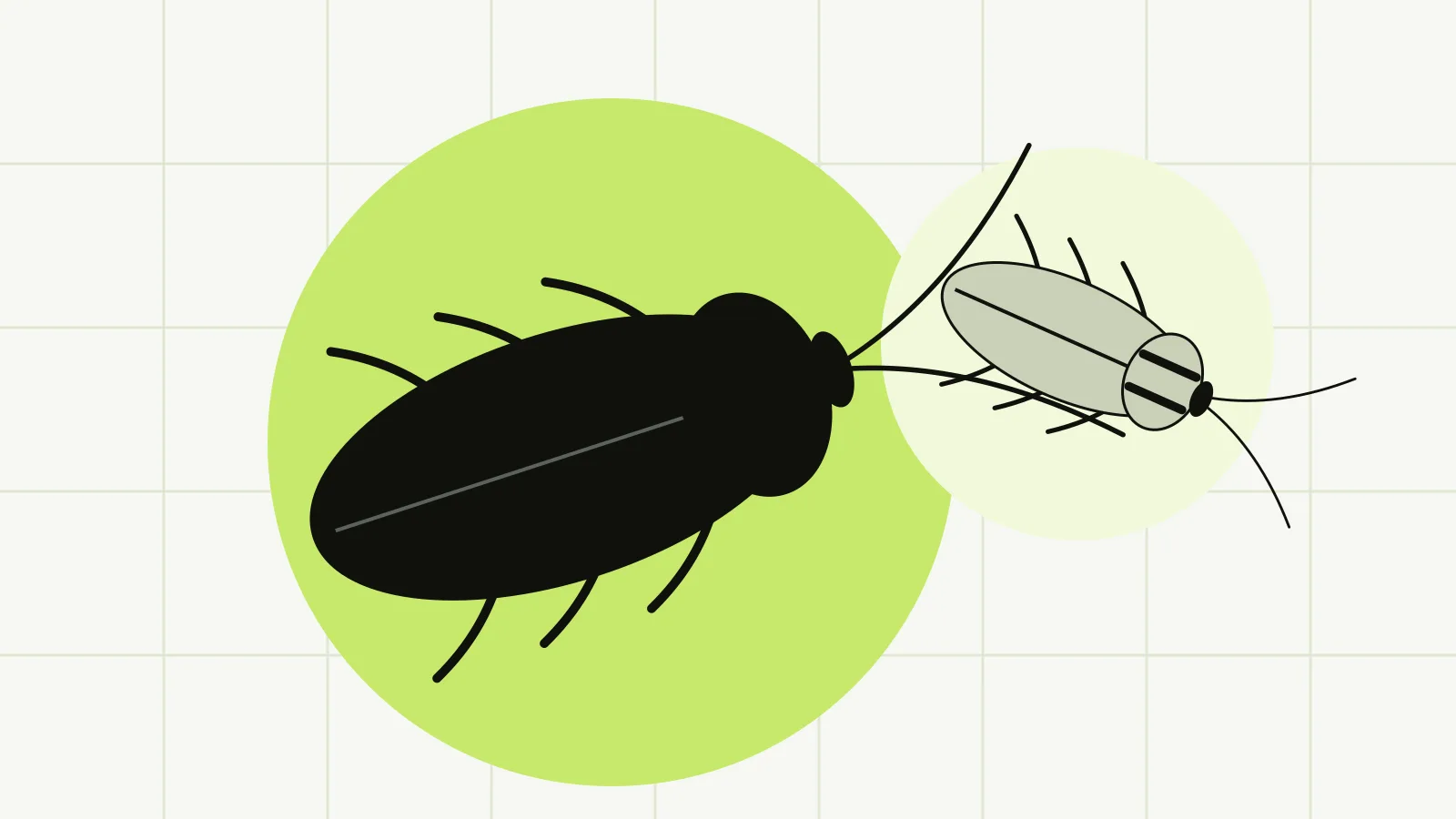
Cockroach nymphs are the young. Oxford City Council says they look like smaller versions of adults, and Penn State University adds that German cockroach nymphs lack wings. They hide in warm cracks near sinks, cookers and dishwashers, and run when a light goes on. Look for droppings like black pepper and brown egg cases, which Oxford compares to a small kidney bean. A nymph is a young insect that hatched nearby, so treat it as evidence of breeding, not a stray. Our cockroach guide and German cockroach guide cover identification and bait, and cockroach control starts from £119.
Pharaoh ants are tiny. Redbridge Council describes them as yellow-brown and generally under 2 mm, trailing across work surfaces, kitchen fittings and food cupboards. Epsom & Ewell says they have adapted to large heated buildings such as hospitals, hotels and flats, which is why London blocks see them more than a house with a garden. If you see a fine moving line of pale ants, do not spray. BPCA advice says to avoid residual treatments because control depends on baiting, and that colonies can split and spread. The ant guide explains the difference between these and ordinary black garden ants, and pharaoh ant control is priced for two visits.
Small brown bugs in house all of a sudden: why now?
Small brown bugs in the house all of a sudden rarely means they have just arrived. Most of these insects spend weeks hidden as eggs and larvae, then appear as adults together. What changed is what you can see. Ask what has happened in the last two or three months, and check these causes in order.
- A warm spell or the heating going on: the Natural History Museum says biscuit beetles pass through many more generations above 23°C, and Dover says booklice rise quickly in warm weather.
- A new packet of food: Bromley Council says flour beetles can arrive in delivered flour, and weevils develop unseen in grain.
- A forgotten packet: a split bag of pet biscuits behind the bin or an old jar of spices can feed insects for months.
- An old nest or dead animal: bird and wasp nests in lofts can release biscuit beetles, carpet beetles and larder beetles into the rooms below.
- New damp: a leak, new plaster or a drying rack in a poorly ventilated room can bring booklice within weeks. BPCA advice says they reach adulthood in about two weeks.
- A recent move or holiday: Adur & Worthing Councils say flea pupae can wait in an empty home for months. Luggage and second-hand furniture are the routes the NHS warns about for bed bugs.
- A neighbour's problem: in flats, cockroaches, pharaoh ants and bed bugs can travel through shared walls and ducts. Ask your managing agent if others have reported anything.
Sprays, traps and home remedies: what to use and when to call someone
Our rule for food cupboards is clean first and spray rarely. Official advice is split. Surrey Heath Borough Council and Dover say not to use insecticide because it could contaminate food. Oxford City Council and BPCA advice allow a labelled spray on emptied cupboards. Bromley says to treat cupboards with a suitable insecticide, ideally through a contractor. Purdue University says routine use in pantries and cabinets is not recommended, and gives little extra control without a thorough clean. Since the cleaning does the real work, and you store food there, we would leave spray out unless a professional recommends it.
If you do use one, HSE says to read the label before you buy and again before use, and to follow it exactly. Oxford's condition is sensible: the cupboard must be free of food and dry first, with food stored in containers afterwards so it does not touch treated surfaces.
Call a professional in four situations: you suspect bed bugs, cockroaches or pharaoh ants; adults are still appearing three months after a thorough clear-out; insects are spreading to other rooms; or you run a food business, where our commercial pest control guide explains what changes. The table below gives our view on each option.
What works for pantry insects
| Option | Best for | Our view |
|---|---|---|
| Clear-out and sealed storage | All pantry beetles, weevils | Do this first. It removes the food and usually solves it |
| Freezing sealed food | Items worth saving | Useful, but not for food that visibly has insects |
| Drying and ventilation | Booklice | The real fix. Spray does not stop the damp |
| Pheromone traps | Finding where insects are | A monitoring aid. Bromley lists them as support, not a cure |
| Crawling insect spray | Empty, dry cupboards only | Councils disagree. Leave it out at home unless advised |
| Bay leaves, cloves and similar | Prevention | None of the sources we opened recommends them |
| Spray on ants or nymphs | Nothing here | Avoid. Pharaoh ants need bait, and cockroaches need a plan |
| Professional inspection | Anything unidentified or recurring | Worth it when the clear-out has not worked |
Renting in London: who deals with it?
Citizens Advice says tenants may be responsible if they caused an infestation, and landlords probably are if the tenancy says so, if failure to repair caused it, or if it makes the home unsafe. Landlords usually only become responsible once they know, so report it promptly in writing and include your photos. Under Awaab's Law, Citizens Advice says council and housing association landlords must make an emergency hazard safe within 24 hours.
Applied to small brown bugs, that usually works out as follows. Biscuit beetles in your own food are normally yours to clear, because they came from your food. Booklice caused by a leak, failed extractor or rising damp are worth reporting, because the repair is what ends them. Bed bugs, cockroaches and pharaoh ants in flats are harder to pin down, so tell your landlord or agent early and ask whether other flats are affected.
Council help varies. Haringey Council lists food pests such as biscuit beetles and grain weevils among its services, Coventry City Council says it does not treat biscuit beetles, and Redbridge Council's fee page does not list stored food insects at all. Check your own council's pest page, and ask about fees before you book. If you are moving out, keep any treatment record and see our end of tenancy cleaning checklist. Landlords who need a clean after a damp problem can look at our cleaning services.
What we do, and what it costs
You do not need to know the insect before you contact us. Send a photo with a ruler in shot, and tell us the rooms, your postcode and when you first saw them. If the insect is clearly a pantry beetle and the clear-out above is likely to solve it, we will say so. If it is unclear or keeps returning, a pest inspection reviews the signs and likely routes in, and any follow-on work is discussed before it is booked.
Prices below are our current starting rates, and the price, visits and inclusions are confirmed in writing before booking. Insects without their own rate, such as biscuit beetles, are quoted after we know the extent; our general packages for a one-bed property are in the table. For comparison, Redbridge Council charges £230 for cockroaches, £200 for fleas, £325 for bed bugs in up to three rooms and £260 for pharaoh ants, and our Ilford pest control page compares council and private fees line by line. The cost guide explains what moves a quote up or down, and our prices page has the full list.
We are based on Clements Road in Ilford, cover London and carry public liability insurance. Our phone lines are open Monday to Saturday, 8am to 8pm. Packages include follow-up and proofing advice, and a safety report. Written guarantees run for 1 month on 2-visit packages and 3 months on 3-visit packages. For everything else we treat, see all pest control services.
Our starting prices for small brown bugs
| Service | Starting price | What it covers |
|---|---|---|
| Pest inspection | From £60 | Signs and entry routes reviewed |
| Flea treatment | From £89 | Initial inspection and targeted treatment |
| Cockroach control | From £119 | Initial inspection and targeted treatment |
| Bed bug treatment | From £149 | One room; +£45 per extra room, +£79 per follow-up visit |
| Carpet beetle treatment | From £149 | Initial standard visit; rooms and further visits quoted |
| Pharaoh ant treatment | From £179 | Two treatment visits; follow-up timing confirmed at booking |
| General pest, 1-bed, 2 visits | From £160 | Follow-up visit and 1-month written guarantee |
| General pest, 1-bed, 3 visits | From £210 | Proofing recommendations and 3-month written guarantee |
Rates from our current price list. Your price is confirmed in writing before booking.
Common questions
What are the tiny brown bugs in my kitchen?
In a food cupboard, the likeliest are biscuit beetles, flour beetles, weevils or booklice. On worktops at night they may be cockroach nymphs, and a thin moving line suggests pharaoh ants. Use the ten-insect identifier table to narrow it down.
Why do I have small brown bugs in my house all of a sudden?
Usually a generation has just finished developing out of sight, so the adults appear together. Warm weather, a new bag of food, an old bird nest or a recently damp room are the common triggers. Our section on why they appear suddenly goes through each one.
What are the small brown bugs in my bed?
Check for bed bugs first: flat, oval insects around 5 mm with dark spots along the mattress seams. Hairy larvae near the bed are more likely carpet beetles, and anything that jumps is a flea. If the signs point to bed bugs, read how to get rid of bed bugs before you move anything.
Can I sieve bugs out of flour and still use it?
We would not. Sieving takes out adults, but eggs stick to flour particles and fragments stay behind, and flour beetles can leave a sour smell that spoils baking. Bin the bag outside, then follow our cupboard clearing method.
Are biscuit beetles harmful?
The Natural History Museum says they are not harmful to health, and they do not eat wood despite looking like woodworm. The harm is to your food, because larvae chew through most packaging. If they keep appearing after a clear-out, book a pest inspection.
Do small brown pantry bugs bite?
Waltham Forest Council says rice weevils do not bite, and BPCA advice says the same of booklice. Biscuit and flour beetles feed on food, not people. If you are waking up with itchy marks, compare bed bugs and fleas instead.
Do booklice mean I have damp?
Usually, yes. English Heritage calls booklice a useful sign of damp problems, and a few in a new build may simply mean the plaster is still drying. Find the moisture source first, then read our guide to silverfish and damp, because the same conditions suit both.
How do I know if a small brown bug is a baby cockroach?
Nymphs look like small, wingless adults with long antennae, and they run for cover when a light goes on. Look for droppings like black pepper and brown egg cases nearby. Finding young ones suggests breeding, so see cockroaches in the UK and act early.
How much does it cost to get small brown bugs identified?
Our pest inspection starts from £60, and you can often start by sending a clear photo with a ruler in shot. Treatment prices depend on the insect, and we confirm everything in writing before booking. See all our prices.
Sources
Figures differ a little between sources, so ranges are given where they do. Sources reviewed on 1 November 2026.
- Natural History Museum: bread or biscuit beetle identification guidenhm.ac.uk(opens in a new tab)
- Natural History Museum: carpet beetles identification guidenhm.ac.uk(opens in a new tab)
- Natural History Museum: golden spider beetle identification guidenhm.ac.uk(opens in a new tab)
- English Heritage: biscuit beetle, pest fact sheet 7english-heritage.org.uk(opens in a new tab)
- English Heritage: booklice, pest fact sheet 9english-heritage.org.uk(opens in a new tab)
- English Heritage: guideline for insect pest management in historic propertiesenglish-heritage.org.uk(opens in a new tab)
- English Heritage: freezing guidelines for controlling an insect pest infestationenglish-heritage.org.uk(opens in a new tab)
- GOV.UK: report a food problem (Food Standards Agency)gov.uk(opens in a new tab)
- GOV.UK: best before and use-by datesgov.uk(opens in a new tab)
- GOV.UK: wild birds, protection, surveys and licencesgov.uk(opens in a new tab)
- NHS: bedbugsnhs.uk(opens in a new tab)
- HSE: using pesticides in the garden and homehse.gov.uk(opens in a new tab)
- Citizens Advice: if there are pests or vermin in your rented homecitizensadvice.org.uk(opens in a new tab)
- Bromley Council: pest control in a food business, stored product insectsbromley.gov.uk(opens in a new tab)
- Surrey Heath Borough Council: common food complaintssurreyheath.gov.uk(opens in a new tab)
- Waltham Forest Council: rice weevil fact sheetwalthamforest.gov.uk(opens in a new tab)
- Adur & Worthing Councils: biscuit beetlesadur-worthing.gov.uk(opens in a new tab)
- Adur & Worthing Councils: fleasadur-worthing.gov.uk(opens in a new tab)
- Oldham Council: biscuit beetlesoldham.gov.uk(opens in a new tab)
- Coventry City Council: biscuit beetlecoventry.gov.uk(opens in a new tab)
- Oxford City Council: beetlesoxford.gov.uk(opens in a new tab)
- Oxford City Council: bookliceoxford.gov.uk(opens in a new tab)
- Oxford City Council: cockroachesoxford.gov.uk(opens in a new tab)
- Dover District Council: psocids (booklice)dover.gov.uk(opens in a new tab)
- North Lanarkshire Council: booklice (psocids)northlanarkshire.gov.uk(opens in a new tab)
- Lambeth Council: bed bugslambeth.gov.uk(opens in a new tab)
- Redbridge Council: pharaoh's antsredbridge.gov.uk(opens in a new tab)
- Redbridge Council: pest control feesredbridge.gov.uk(opens in a new tab)
- Epsom & Ewell Borough Council: antsepsom-ewell.gov.uk(opens in a new tab)
- Haringey Council: other pest control servicesharingey.gov.uk(opens in a new tab)
- BPCA advice in PPC magazine: flour beetlesppconline.org(opens in a new tab)
- BPCA advice in PPC magazine: biscuit beetlesppconline.org(opens in a new tab)
- BPCA advice in PPC magazine: weevilsppconline.org(opens in a new tab)
- BPCA advice in PPC magazine: larder beetlesppconline.org(opens in a new tab)
- BPCA advice in PPC magazine: bookliceppconline.org(opens in a new tab)
- BPCA advice in PPC magazine: pharaoh's antsppconline.org(opens in a new tab)
- NatureSpot: larder beetlenaturespot.org(opens in a new tab)
- What's Eating Your Collection: grain weevilwhatseatingyourcollection.com(opens in a new tab)
- University of Florida: granary weevilentnemdept.ufl.edu(opens in a new tab)
- Rutgers University: I found bugs in my cereal, pasta or cake mixextension.rutgers.edu(opens in a new tab)
- Purdue University: stored product pestsextension.entm.purdue.edu(opens in a new tab)
- Penn State University: German cockroachesextension.psu.edu(opens in a new tab)
Want it dealt with?
Tell us what you have seen, the rooms and your postcode. You do not need to know which pest it is. We confirm the price in writing before any work is booked.