Pest Control · 36 min read · Updated 1 November 2026
German Cockroach: Eggs, Signs and How to Get Rid of Them
A German cockroach is a small, tan cockroach with two dark stripes behind its head, and it breeds in warm kitchens. To get rid of it, do not spray. Use traps to find the hiding places, put small amounts of bait there, and keep checking for at least four weeks after the last catch, because egg cases hatch after treatment.
By the Bestone pest control team · Contact us
Key takeaways
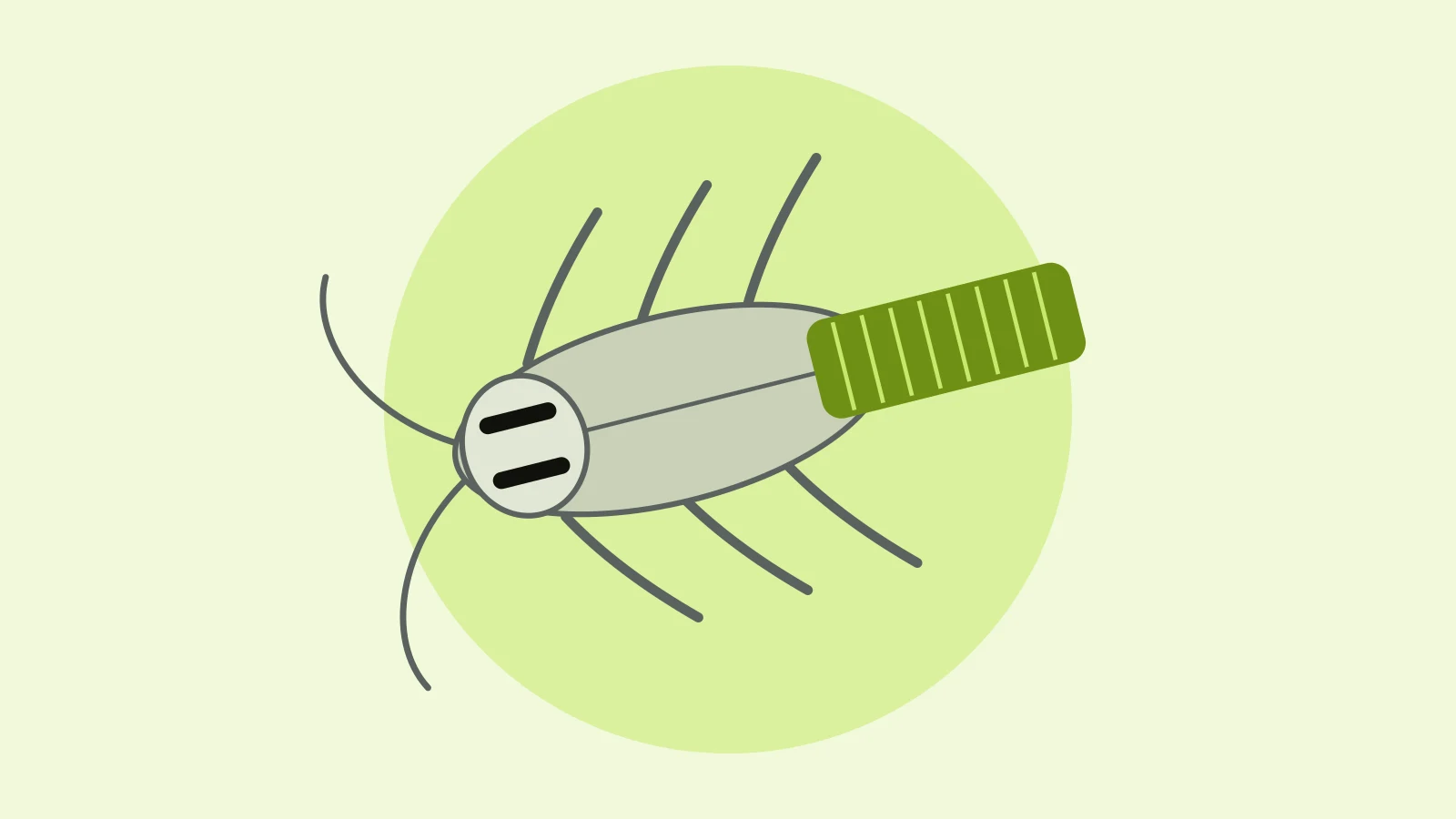
- A German cockroach is 10 to 15 mm long and tan, with two dark stripes behind the head. It breeds indoors, close to warmth and water.
- Its egg cases are brown capsules of about 6 to 8 mm. The female carries each one until it is nearly ready, so eggs hide with her during treatment.
- Do not start with a spray or a fogger. In a 2019 US study, foggers did not reduce numbers, while gel baits did.
- Bait can fail through resistance or bait aversion. If gel sits uneaten or trap counts stop falling, change the product type and do not just add more.
- Our cockroach control starts from £119. A 2-visit package for a 1-bed property is £160 to £190, and we confirm the price in writing before booking.
On this page
- Key takeaways
- German cockroach: the short answer
- Small cockroaches in the kitchen: signs of a German cockroach
- What you found and what it means
- Cockroach eggs: what a German cockroach egg case looks like
- Why the female carries her eggs, and why that matters
- How fast does a German cockroach population grow?
- Why sprays and foggers can make German cockroaches worse
- Bait resistance and bait aversion: why the gel stopped working
- Gel bait rotation: when to change the bait
- Is the bait working? What to change
- Kitchens, appliances and electrical items
- Shared risers: why London flats keep getting them back
- Restaurants, takeaways and food law
- What a cockroach treatment programme looks like
- A typical treatment programme, week by week
- Hygiene and monitoring traps: your half of the job
- Can you do cockroach removal yourself?
- How long does it take to get rid of German cockroaches?
- What we do, and what it costs
- German cockroach treatment prices in London
- Common questions
German cockroach: the short answer
The German cockroach is the small, tan cockroach that lives in warm kitchens, and the British Pest Control Association (BPCA) names it as one of the two most common cockroach pests in the UK. If you are seeing insects of about 10 to 15 mm near the cooker, fridge or sink after dark, with two dark stripes behind the head, assume this is your species and that it is breeding in the room.
The plan is short. Do not spray. Find out where they are with sticky traps. Put bait, in very small amounts, where the traps catch most. Check every week or two, because eggs that were safely inside a case at the first treatment hatch after it. If you live in a flat, find out whether the building is part of the problem before you pay for anything.
Our general guide to cockroaches in the UK compares all the species and covers health risks and landlord duties. This guide stays on one insect and the details that decide whether treatment works: the egg case, how quickly numbers rise, why bait sometimes stops working, and how to tell whether you are winning.
One note on the evidence. Most of the research below comes from US apartment blocks, because that is where it has been done. The biology is the same in a Barking flat, but insecticide resistance varies from place to place, so we treat the American figures as a guide and not as a promise.
Small cockroaches in the kitchen: signs of a German cockroach
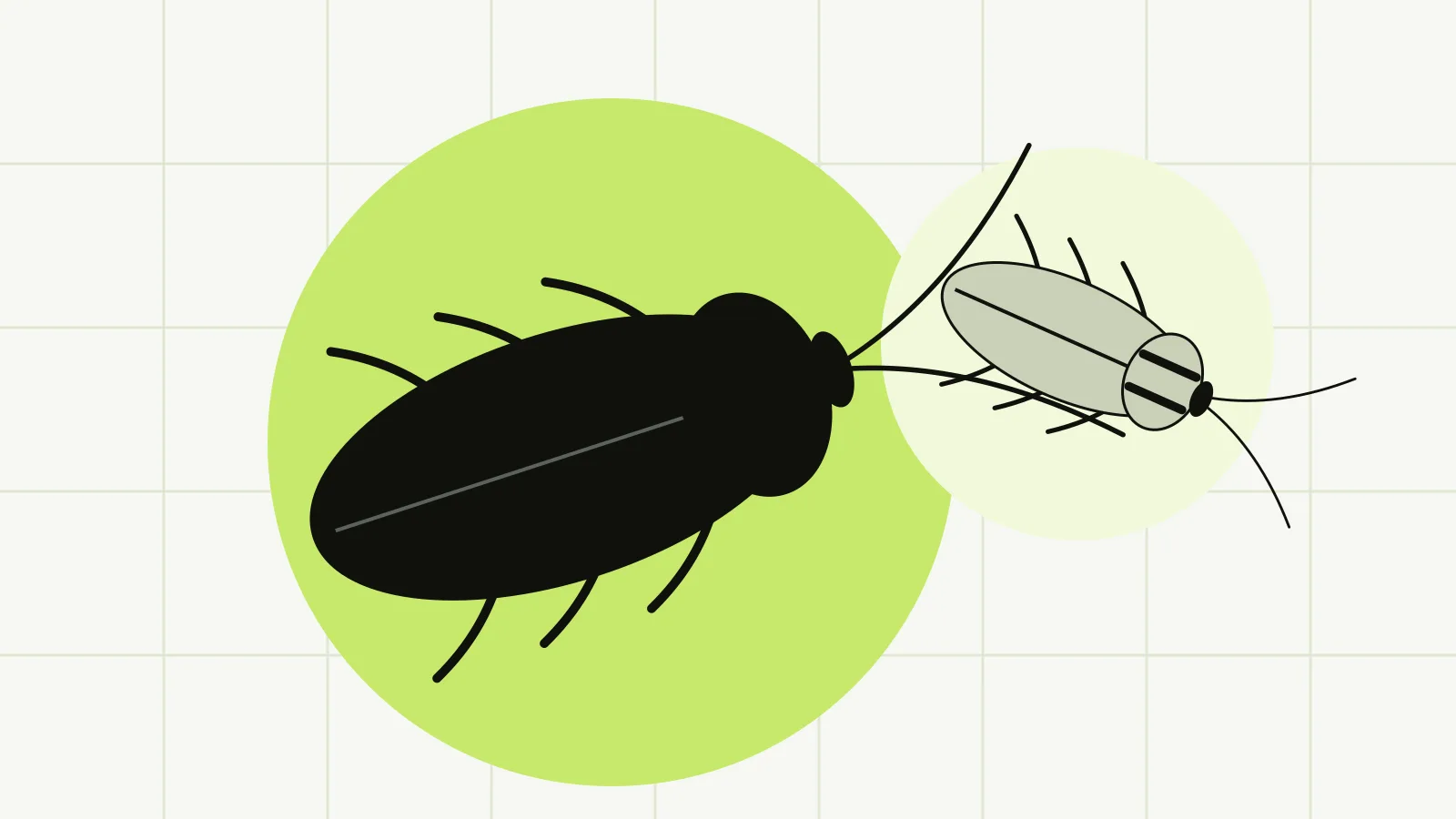
Adults are 10 to 15 mm long according to the BPCA, and Coventry City Council says 12 to 15 mm. They are light yellow-brown, and the two dark stripes run lengthways on the shield behind the head. If yours is dark, shiny and about twice that length, it is more likely to be an Oriental cockroach, which our UK species guide shows side by side. If the insect is round with short antennae, read small brown bugs in the house instead.
Location is a useful clue. The BPCA says this species prefers higher temperatures and humidity, hence its old name of steam fly, and that you should look behind appliances with warm motors. Coventry says it hides around taps, sinks and drains, and that it can climb vertical walls and smooth surfaces to reach food high up. So a small cockroach inside a wall cupboard fits this species well.
The University of Florida notes that cold is the main limit on the German cockroach, and that it could not survive in homes without central heating in northern climates. It lives only alongside people. A 2024 genetic study in PNAS traced its origin to South Asia, not Germany, and linked its recent spread to long-distance transport and temperature-controlled housing. That is why a heated London flat suits it all year round, and why it can still be active in January.
Use the table to work out what you have found and how urgent it is. Young ones are often the first thing people notice. Florida describes nymphs as dark brown to black and wingless, with dark bands behind the head, so they can look like a different insect. If you have only seen tiny dark specks that move, compare our guide to tiny black bugs in the house.
What you found and what it means
| What you found | What it means | What to do |
|---|---|---|
| One tan adult at night | Probably not alone, as they hide by day | Set traps tonight and check after a week |
| Tiny dark wingless insects | Nymphs, so breeding is happening nearby | Treat as an infestation, and do not spray |
| A female with a brown capsule at her tail | A new batch due within about four weeks | Find her hiding place, as others will be close |
| Loose brown capsules of 6 to 8 mm | Egg cases, some possibly already hatched | Photograph them, then seal in a bag and bin outside |
| Small black droppings around tiles, sockets and cracks | Regular hiding place, says Coventry City Council | Put a trap there and tell whoever is treating |
| A strong sour smell | A heavy infestation, says Coventry City Council | Get professional help now |
Based on the BPCA, Coventry City Council, the University of Florida and Penn State Extension. Our recommendations are in the last column.
Cockroach eggs: what a German cockroach egg case looks like
You will not find loose cockroach eggs lying about. The eggs are packed inside a case called an ootheca. Penn State Extension describes it as light brown and purse-shaped, with two rows of eggs inside. It looks like a small ridged capsule, not an egg, which is why so many people sweep them up without knowing what they are.
Sources differ on the size. The University of Florida gives about 8 mm long, 3 mm high and 2 mm wide. City of Westminster says 6 mm, and Penn State says under a quarter of an inch, which is about the same. They also differ on the contents: Westminster says up to 30 eggs, the BPCA around 30 or more, Florida 30 to 40, and Penn State 30 to 48. Whichever is right for your flat, the working number is about 30 young from one case.
If you find one, photograph it next to a ruler, because it helps to confirm the species. An Oriental case is about twice as long, at 12 to 13 mm according to Westminster and the BPCA, and that species behaves differently. Then pick it up with tissue, seal it in a plastic bag and put it in your outside bin. Lambeth Council gives the same advice for dead cockroaches. Clean the spot with detergent, unless bait has been placed there.
Where you find cases matters more than how many. Penn State says the female deposits the case in a crevice or sheltered place close to hatching, so a capsule on a shelf edge or hinge marks a route to a hiding place. Check nearby joints and the gap behind the unit with a torch.
- 1. The female carries the case at her rear until it is nearly ready
- 2. Two dark stripes behind the head identify the species
- 3. The case is light brown, ridged and purse-shaped
- 4. Inside are two rows of eggs, about 30 to 40 in all
Why the female carries her eggs, and why that matters
This is the detail that sets the German cockroach apart from the Oriental. The BPCA says an Oriental female leaves her case in a dark crevice long before it hatches, while a German female keeps hold of hers until the nymphs are ready, an average of 28 days. Florida adds that nymphs will often hatch while she is still carrying it. Her eggs stay with her, in the warmest and safest place she can find.
That has three effects on treatment, and each one explains a common disappointment.
First, carrying females are hard to reach. In a 1993 study from the International Conference on Urban Pests, Kanayama and colleagues found that few gravid females, meaning those carrying a case, left their refuge for the feeding site. Traps in a restaurant told the same story: gravid females were 7 per cent of the catch, compared with 30 per cent for other adult females and 63 per cent for adult males. So the insects you see running about are mostly not the ones producing the next batch, and a kill among visible adults says little about what is left.
Second, killing the mother may not kill the eggs. In a 1999 study by Tanley and Appel, about 90 per cent of gravid females exposed to an imidacloprid bait died within 24 hours, but the attached cases still hatched as normal, with the usual number of nymphs. That was one bait in one test, but it matches what people see: new nymphs after a treatment that seemed to work.
Third, it sets the timing of the follow-up. If a case can take about four weeks, and the first visit misses cases already formed, nymphs can appear for about a month after that visit. The BPCA says treatment should last long enough to kill nymphs from cases that have not yet hatched. That is why bait needs to stay in place and be renewed, and why one visit rarely finishes an established problem. Lambeth Council returns after about two weeks, and Redbridge Council's visits are 7 to 14 days apart.
How fast does a German cockroach population grow?
It looks slow at first, and that is the trap. The BPCA says nymphs take 6 to 12 weeks to mature. Florida gives about 60 days at room temperature, and Penn State gives a much wider range of 6 to 31 weeks, depending on conditions. Adult females live 20 to 30 weeks according to Penn State, and the BPCA gives 100 to 200 days for adults.
Sources disagree on how often a new case appears. City of Westminster says four to eight capsules at monthly intervals, and Penn State says four to eight in a lifetime, about one every six weeks at room temperature. Penn State estimates more than 10,000 descendants in a year from two generations. Purdue University describes a three-month reproductive cycle with up to 50 offspring.
The chart below is our own worked example. We took one mated female, 30 nymphs a case, four cases six weeks apart, nine weeks to adulthood, half the young female, and no deaths. No real kitchen achieves that, because Florida points out that water, food and hiding places limit growth, and young cockroaches die. Treat it as a ceiling that shows the shape of the curve, and not as a forecast for your flat.
The shape is what matters. For the first four months you might see one or two insects a week and decide it has gone away. Then the first daughters begin to breed, and the numbers jump in a few weeks. Florida says actively growing populations are about 80 per cent nymphs and 20 per cent adults, so for every adult you notice, expect several young that you do not. Our recommendation is to act on the first sign of nymphs or egg cases. A problem caught in that quiet period is usually smaller, cheaper and quicker to deal with, and our guide to pest control costs explains why extent drives the price.
- 1. First case hatches at about four weeks: 30 nymphs
- 2. Her third case brings the total to just 90 by week 16
- 3. Her first daughters begin producing cases of their own
- 4. By week 26 the ceiling is 1,470, ten weeks after 90
Why sprays and foggers can make German cockroaches worse
A can of fly and crawling insect spray feels like doing something, and you will see cockroaches die. The problem is what happens to the rest. There are four separate reasons to leave it on the shelf.
Resistance comes first. In a 2019 study in Scientific Reports, Fardisi and colleagues at Purdue University tested cockroaches from apartments in Indiana and Illinois, and more than 80 per cent survived diagnostic doses of pyrethroids, the usual ingredient in household sprays. They called pyrethroid resistance the most widespread they found and suggested restricting its use, including in shop-bought products. These were US populations, and we found no equivalent published survey for London, but we would not assume London cockroaches are any softer.
Spreading comes second. In the same study, a spray combining a pyrethroid with thiamethoxam failed at both sites and appeared to be repellent, pushing cockroaches into apartments that had not been infested. In a block of flats, that is the outcome you least want. Penn State Extension says residual sprays and foggers are of little value against this species and can scatter it.
Third, spray ruins bait. Texas A&M AgriLife's school pest programme warns that liquid insecticide on gel makes the bait unattractive. Coventry City Council asks residents to clear away existing sprays and powders before treatment. If you have already sprayed, say so when you book, and say where.
Fourth, foggers put insecticide everywhere except where the insects are. In the 2019 BMC Public Health study by DeVries and colleagues, four fogger products in 20 infested homes made no significant difference to cockroach numbers, while gel baits in 10 further homes brought them down. Residues on kitchen surfaces averaged 603 times the starting level, with a median of 85 times, and 34 per cent of the surface tests were still significantly raised a month later. Under 38 per cent of cockroaches collected from those apartments died on the treated surfaces. The authors concluded that foggers provide no benefit against this species.
Sources do not all agree. City of Westminster's sheet says shop-bought insecticides with a knockdown and residual effect are best if you treat it yourself, and Lambeth Council still uses spray in heavily infested areas. The BPCA says residual sprays are less used since baits arrived but can help at the edge of an infestation, to catch insects moving out. Those are professional decisions about a small, targeted area. Our recommendation for a householder is simple: no aerosols, no foggers. Our general fogging service exists for other jobs, and it is not a plan for German cockroaches.
Bait resistance and bait aversion: why the gel stopped working
Gel bait is the main tool for good reason, but it is not magic, and there are two different ways it can fail. Resistance means the cockroach eats the bait and survives. Aversion means it will not eat it. The two need different responses, so it is worth knowing which you are looking at.
Aversion was first found with glucose, a sugar used to make baits tasty. NC State University researchers reported in Science in 2013 that glucose-averse cockroaches have a change in their taste system: glucose fires the bitter-sensing nerves as well as the sweet ones and suppresses the sweet response. Normal cockroaches eat it, and these ones flee. Because the trait is inherited, and baits kill the insects that do eat, a population can change within generations.
It may not stop at glucose. A 2021 review in Insects by Gondhalekar and colleagues says German cockroaches can develop aversion to several sugars, and that glucose-averse insects do not eat enough toxic bait to die. A 2022 study in Communications Biology found the trait carries a cost: saliva from glucose-averse females turns the sugary gift offered by males into glucose, so many reject the male. Even so, the trait persists, and the authors suggest that averse males may help to spread it.
Formulas can answer this. Bao and Maçom described field strains in the USA refusing commercial gel baits from late 1999. They found that rotating between the main gels did not solve the problem, but a reformulated bait from their company, Bayer, worked on all the averse strains tested. The lesson for a householder is that a different brand is not automatically a different food, and that the bait matrix counts as much as the poison in it.
Resistance is the other route. Fardisi's team found that resistance to abamectin rose 2.9 to 5.8 times in one generation at one site, and that at the other site survival went from nil to between 50 and 71 per cent. They also found cross-resistance, where exposure to one active ingredient raised resistance to another the insects had never met. Purdue's news release summarises this as a four to six-fold rise. Separately, a study of five North Carolina apartment populations by González-Morales and colleagues measured resistance to fipronil, a common bait ingredient, at 22 to 37 times normal.
None of this means bait no longer works. Starting resistance is what decides the result. In the Purdue study, one abamectin bait all but cleared the site where no resistance was found to begin with, and it did not bring numbers down where about 16 per cent of the cockroaches already survived the test. Wang and colleagues at Rutgers University reported a 99 per cent fall in counts four weeks after one careful gel treatment in eight New Jersey apartments, in a study sponsored by the bait maker. So good bait in the right place still does the job in many homes. You just need to watch for the point at which it stops.
Gel bait rotation: when to change the bait
Rotation means switching between products with different active ingredients, so the insects are not selected by one poison for too long. Advice on it varies. Texas A&M AgriLife suggests monthly rotation between active ingredients, and it says that if cockroaches reject a bait, that may be behavioural resistance and a reason to switch.
The research is more cautious. In Fardisi's study, rotating three products monthly held numbers level but did not bring them down, and the authors said rotation works only when the insecticides have little cross-resistance between them. That rotation included a spray, so it is not a pure test of gels. Their strongest point was that you need to know what the population is resistant to before you choose. A lab test is not practical for a single flat, so in a home the practical test is simple: did they eat it, and did the traps fall?
Our recommendation is to change for a reason and not by the calendar. Keep a product while trap counts are falling. When they stop, or when gel sits untouched, change to a different active ingredient and a different bait matrix, and remove the old gel where you can. Ask your provider to name both products in writing, because a change of label alone may tell you nothing. Texas A&M's advice on placement also holds: many small spots for German cockroaches, in cracks that are not filled, away from heat, dust and draughts, and with old, hardened bait replaced. The Rutgers team used placements of about 0.1 g.
Is the bait working? What to change
| What you see | Likely reason | What to do |
|---|---|---|
| Gel eaten, counts falling | It is working | Leave it alone and keep checking traps |
| Gel gone, counts level | Too little bait for the numbers | Add more small spots near the busiest traps |
| Gel untouched, cockroaches near it | Aversion, or old or spray-tainted bait | Clean the area, then change to a different bait matrix |
| Gel eaten, counts level after two to three weeks | Possible resistance | Change the active ingredient, and do not just add more |
| Traps falling, then a burst of small nymphs | Cases hatching | Normal at first, so renew bait where nymphs are caught |
| Counts fall, then rise after a month | New arrivals or a missed hiding place | Look at pipes, the neighbours and other rooms |
Our guidance, based on Texas A&M AgriLife, Fardisi et al. 2019 and Bao and Maçom 2005. These are the likely reasons, not a diagnosis.
Kitchens, appliances and electrical items
German cockroaches do not spread evenly through a kitchen. In the study of a 188-unit New Jersey high-rise by Zha and colleagues, traps near the stove and fridge caught far more than traps under the sink or in the bathroom. The Gondhalekar review says the same of the areas behind fridges and stoves. Many people check under the sink first, find little and assume they are clear, so check behind the appliances as well.
City of Westminster lists fridge motor compartments among the hiding places, and the BPCA notes that the top of and space beneath a fridge are warm and collect food. Cookers add grease. Coventry City Council asks residents to clean greasy areas such as cookers, microwaves, tiles and cooker hoods before treatment, and it lists plug sockets among the places where droppings show up.
We found no good study on microwaves, routers, kettles or toasters, so what follows is practical advice and not research. Warm, dark, greasy and undisturbed is what this insect looks for, so small appliances on the worktop are worth checking. Lift each one, look underneath and around any vents, and shake crumbs out of toasters over a bag. Droppings or a smell around a vent are a reason to move the item away from the wall and tell whoever is treating.
The safety rules are firm. Never spray insecticide or any liquid into a socket, fuse box, vent or appliance. Never open a sealed appliance or take the back off a fridge, cooker or boiler. Unplug before you clean, and follow the maker's instructions. If you have a gas cooker, do not disconnect it to clean behind it unless the maker's guide allows it. Ask your landlord or a qualified engineer. If you see droppings inside a consumer unit or socket, leave it alone and speak to an electrician.
Do not put bait inside an appliance unless a professional has told you it is suitable, and keep every placement away from food, food surfaces, children and pets. If the oven is the worst spot, a deep clean helps once the bait has had time to work. Our oven cleaning guide shows how, or you can book oven cleaning or appliance cleaning. Agree the timing first, so the clean does not remove fresh bait. Second-hand appliances matter as well: the BPCA warns they can carry cockroaches in, so check and clean them before you bring them indoors.
- 1. Fridge and cooker: traps here usually catch the most
- 2. Put traps in the gaps beside them, against the wall
- 3. Under the sink, look for holes around the pipes
- 4. The riser links your pipework to other flats
Shared risers: why London flats keep getting them back
If a treated flat fills up again within weeks, the cause may be the building and not the treatment. London has a great many purpose-built blocks and converted houses, where pipes and heating serve several homes through a shared riser or boxed-in duct. The BPCA says German and Oriental cockroaches are both often found around the heating ducts and boiler rooms of large, centrally heated buildings, and City of Westminster lists service ducts among the hiding places.
The research supports this. In the New Jersey high-rise, Zha's team found that infestations were linked within and between apartments before treatment. After twelve months of building-wide work, only links across floors remained, and the authors concluded that it reduced cockroaches moving between units as well as clearing individual ones. That finding matters: it suggests a vertical route, such as a riser, is the last link to close.
Whole-building work has a strong record. Wang and Bennett's 2009 study of low-income housing in Indiana covered 442 apartments across two programmes for 12 months. The number of infested apartments fell by 74 per cent, and trap counts fell by more than 98 per cent, at a cost of about $7.50 per apartment per month, excluding education. Those are US costs, and they are not a guide to London prices. Poor maintenance and weak resident cooperation held back both programmes, which will sound familiar to anyone on a London estate.
Hastings Borough Council puts it plainly: where a building has more than one home, the whole building must be treated for it to be effective. In London that does not always happen. Redbridge Council charges per household, and a property split into flats or rooms is booked and charged separately. So someone has to take the lead, and our recommendation depends on who you are.
- Tenant: report it to your landlord or agent in writing, with photos and dates, and ask whether other flats have reported it. Our UK guide sets out who usually pays.
- Leaseholder: check who repairs and pays for risers under your lease, then ask the managing agent to survey the block.
- Managing agent or landlord of several flats: ask for trap monitoring in every flat on the affected stack, and not just the one that complained. See pest control contracts for shared buildings.
- Everyone: seal gaps around pipes on your side. Penn State Extension says to fill holes where pipes pass through walls, and City of Westminster recommends latex or silicone sealant.
- Neighbours: a polite note helps. People are often embarrassed, and a problem on the floor below can last months if nobody says anything.
Restaurants, takeaways and food law
German cockroaches suit commercial kitchens for the same reasons as domestic ones, with more heat and more grease. If you run a food business, the duties are stricter and the records matter. Here we set out only what we have checked, and it is not legal advice. Our guide to commercial pest control goes further.
The core rule is in Annex II of Regulation (EC) No 852/2004, as it stands on legislation.gov.uk. It requires adequate procedures to control pests (Chapter IX), says the layout and design of food premises must allow pest control (Chapter I), and requires refuse stores to be kept clean and, where necessary, free of animals and pests (Chapter VI). The law does not list cockroaches by name or say how a business must control them.
Enforcement in England sits in the Food Safety and Hygiene (England) Regulations 2013. Under regulation 6, an officer can serve a hygiene improvement notice, giving at least 14 days to put a breach right. Under regulation 8, where the health risk condition is met and the risk is imminent, an officer can serve a hygiene emergency prohibition notice, which must then go to a magistrates' court within three days or it lapses. The health risk condition can relate to the state or condition of the premises. Neither regulation mentions pests, so what happens depends on what the officer finds.
Ratings are affected too. The Food Standards Agency says pest control is part of the physical condition assessed under the Food Hygiene Rating Scheme, alongside cleanliness, layout, lighting and ventilation. If you have less than a 5, you can ask for a re-rating once you have made the recommended improvements, with evidence such as receipts or photos. The rating can go up, go down or stay the same.
Practical steps follow from this. The Agency's Safer Food, Better Business pack says to check regularly for pests, leave no food or dirty plates out at closing, and keep a record of any contractor's details, visits and recommendations. It also says to write down what went wrong and what you did about it. The BPCA says environmental health officers can issue enforcement notices where pest management is not adequate, so a dated trail of traps, visits and repairs is worth having. Do not put bait or spray where it can touch food, packaging, equipment or surfaces.
The traps tell you something here as well. Remember the restaurant study above: gravid females were only 7 per cent of the catch. A quiet-looking kitchen with a few males on the traps can still be breeding. Our commercial pest control service can scope a site, and the plan and price are confirmed in writing.
What a cockroach treatment programme looks like
Good cockroach treatment is a short programme, not a single event. The BPCA describes a systematic approach that starts with a survey of hiding places and of how bad the infestation is. Most treatments then rely on bait. Here is what we would expect from a provider in an ordinary London flat, based on council practice and the research above.
Council practice gives a useful benchmark. Lambeth Council usually makes two visits about two weeks apart, with gel under sink cabinets and around door hinges and spray for heavily infested areas, and it requires an adult to be present. Redbridge Council makes three visits, 7 to 14 days apart, and returns free of charge if there is still evidence of live cockroaches three weeks after the final treatment. Wandsworth Council's fee also covers three visits.
Ask four questions before you book. Which rooms will be surveyed? How will you measure progress? What product is going down, and what happens if they will not eat it? What does the follow-up include? A good answer involves traps and a named bait. Be wary of a plan built only on spraying skirting boards. Heavy infestations may also need dust in voids, which the BPCA says a professional may use in ducts and dead spaces.
Preparation is modest. Clean surfaces, take away food, clear what is under the sink, pull out what you safely can, and clear old sprays and powders, as Coventry City Council asks. City of Westminster says you can stay at home during gel and bait station work, should leave for about 20 minutes after a spray, and should cover fish tanks. Keep any paperwork, such as Westminster's Notice to Occupier or Lambeth's advice sheet, which records what was used and where. Follow what your provider tells you, and if someone at home is pregnant, has asthma or is very young, mention it when booking.
A typical treatment programme, week by week
| When | Provider | You |
|---|---|---|
| Before | Confirms species, price, visits and preparation in writing | Clean, clear under the sink, remove sprays, photograph signs |
| Week 0 | Surveys, sets traps, places bait, explains what was used | Keep children and pets away from placements, and leave bait alone |
| Weeks 1 to 2 | Nothing, unless agreed | Expect some activity, keep food sealed, and do not spray |
| About week 2 | Reads traps, renews bait, changes product if needed | Report what you have seen and where |
| Weeks 3 to 4 | Third visit if the plan includes one | Nymphs may still appear as cases hatch |
| Weeks 5 to 8 | Reviews traps if activity remains | Seal gaps, fix drips, and keep traps down |
| After | Proofing and building advice if needed | Check traps every week or two, and report new catches |
A typical plan, not a fixed one. Your written plan comes first. Heavy infestations and shared buildings take longer.
Hygiene and monitoring traps: your half of the job
Evidence on cleaning is mixed, so it helps to be exact about what it does. The Gondhalekar review reports a survey of seven buildings where apartments with a poor sanitation rating were almost three times as likely to have an active infestation. Yet the Rutgers team cut numbers by 99 per cent with no change in residents' housekeeping, and a 2026 study in Insects found a fall of 99 per cent in six months without a significant change in sanitation scores. So a clean kitchen is not a cure, and a less tidy one is not a lost cause. Wang and Bennett's 2006 study suggests what cleaning adds: it was the programme combining traps, education and bait that held up best in the long run. At 16 weeks counts were down 100 per cent, against 94.6 per cent for bait alone, and at 29 weeks only one apartment still had a high infestation, against five.
Cleaning also removes competition for the bait. Grease and crumbs are free food, so less of them means more feeding on gel. It removes water too, which matters most: the BPCA says cockroaches can last several months without food, but no more than a few days without water.
Vacuuming earns a place at the start. The review reports a study where vacuuming alone cut trap catches by 72.5 per cent, and it says vacuuming before treatment removes debris, dead cockroaches, egg cases and dust from bait sites. It warns that vacuuming should not be the only tactic, and recommends a HEPA filter, because allergens can become airborne. Use a crevice tool along kickboards and behind the fridge, then empty the vacuum into a sealed bag outside. Once bait is down, keep away from placements. Redbridge Council says its gel keeps working for up to two months and should not be cleaned off.
Sticky traps are for measuring and not for control. The BPCA says so, and the review reports that trapping 7,500 German cockroaches over two months reduced one population by only 27 per cent. Used for measuring, though, they are the best tool you have. They show where to bait, how much, and whether it is working. Penn State Extension suggests ten or more sites, against walls or in corners, and says one week of trapping usually tells you enough.
- Tonight: fix drips, dry the sink and wipe the draining board. Do this every night.
- Tonight: seal food and pet food, empty the bin, and leave no dishes out.
- This week: pull out what you safely can, then vacuum and clean behind it before bait goes down.
- This week: place traps against walls beside the fridge and cooker, under the sink, in a wall cupboard, near where you eat and behind the toilet. Rutgers used six positions like these.
- Every week: count the catch in each trap and write it down with the date. Separate adults from nymphs if you can.
- Every week: replace full traps, and do not move the others, so the numbers can be compared.
- Before moving out: keep your treatment record, and see our end of tenancy cleaning checklist.
Can you do cockroach removal yourself?
Sometimes, on a small and recent problem. A 2026 study in Insects by Pan and colleagues gave 12 low-income apartments a kit of gel bait, boric acid dust, sticky traps, a flyer and brief instruction. After six months cockroach counts were down 99 per cent, against 51 per cent in 17 comparison apartments, and 58 per cent of the kit homes had no cockroaches detected, against 6 per cent. That is a real result for residents, though the group was small, and they had researchers teaching them.
The opposite result is also on record. Gordon and colleagues reported in 2025 that consumer and professional baits all killed more than 80 per cent in the laboratory, but in homes the consumer products were inconsistent: one bait station never produced a decline. The authors suggested reconsidering them as a recommended DIY option. Placement, quantity and repeat checks count as much as the product. The BPCA says control is seldom easy because it is hard to get insecticide to the insect, and Coventry City Council says treatment should only be done by an experienced pest control worker.
Our rule of thumb is this. You can try if you live in a house with no shared walls, you have seen only a few adults, you have found no nymphs or egg cases, and no one at home is vulnerable. Use a gel or bait station clearly labelled for cockroaches, in small spots beside your busiest traps, out of reach of children and pets, and follow the label. Do not use dusts around children: Penn State calls boric acid a hazard to them. Give it two weeks. If traps still catch insects at that point, stop buying products and ask for an opinion.
Get help straight away if you see nymphs or egg cases, you live in a flat, more than one room is affected, you run a food business, or someone at home is pregnant, has asthma or is a baby. Our health section in the UK cockroach guide explains when to speak to a GP or call 111. A pest inspection is a sensible first step if you are not sure what you have.
How long does it take to get rid of German cockroaches?
Expect weeks, not days, and expect the numbers to fall in stages. Redbridge Council says a reduction within 10 to 14 days is normal, and warns that it may take longer to kill them all because eggs laid before treatment keep hatching. City of Westminster says most infestations take six to twelve weeks to control.
The research gives a best case. In the Rutgers study, one gel treatment cut counts by 72 per cent after one week, 88 per cent after two, 97 per cent after three and 99 per cent after four, but that was with researchers placing a median of 44 g of bait in each small apartment, and two of the eight still had cockroaches at four weeks. It was sponsored by the bait maker. In 1999, Tanley and Appel recorded about a 50 per cent fall in a week and 80 per cent in four weeks with one bait in heavily infested homes. So a fast fall is possible, and a slower one is not a failure.
Three things slow it down: heavy numbers, shared pipework and old spray residues. A flat with a burst of activity for a few days after the first visit is not necessarily getting worse. City of Westminster says some treatments include an attractant, so a short rise around treated areas is normal, and that you should not kill those insects, because that stops the treatment reaching others.
When can you call it finished? We suggest four clear weeks after the last catch, with traps still down. That covers the 28-day period for a case already being carried, and it gives you enough checks to trust the result. Keep one or two traps behind the fridge after that. If new catches appear later, tell your provider early, because the cause may be a new arrival through pipes, a box or a second-hand appliance. A new population can begin with a single gravid female.
What we do, and what it costs
Send us a photo and tell us where and when you see them, which rooms are affected, and whether you live in a flat or shared building. Tell us too if you have used sprays or bait already. Our cockroach control starts from £119, covering inspection and targeted treatment. The treatment method, preparation and number of visits are confirmed with your price, in writing, before booking, and you get a safety report.
German cockroaches normally need follow-up visits, so most homes will want a package. A 2-visit package includes a follow-up in 14 days and a written 1-month guarantee. A 3-visit package includes proofing recommendations and a written 3-month guarantee. The final price depends on the extent of activity, the property, food areas, access around appliances, preparation and the number of visits.
For comparison, Redbridge Council lists cockroach treatment at £230 for three visits, 7 to 14 days apart, and Wandsworth Council charges £214 for three visits, or £107 for people on its concessions. What each price includes differs, so compare the visits and the follow-up terms. Our Ilford pest control page sets Redbridge's figures beside ours, and our prices page has the full list.
We are based on Clements Road in Ilford and cover London, with pest control services for homes, landlords and businesses. We carry public liability insurance, and our phone lines are open Monday to Saturday, 8am to 8pm. If you are not sure of the species, contact us with a photo, or see our short guide on whether cockroaches can fly.
German cockroach treatment prices in London
| Option | Price | What it includes |
|---|---|---|
| Bestone cockroach control | From £119 | Inspection and targeted treatment |
| Bestone 2-visit package, 1 bed | £160 to £190 | Follow-up visit in 14 days, 1-month written guarantee |
| Bestone 3-visit package, 1 bed | £210 to £230 | Three visits, proofing recommendations, 3-month written guarantee |
| Bestone 2-visit package, 2 bed | £180 to £220 | Follow-up inspection, 1-month written guarantee |
| Bestone 3-visit package, 2 bed | £240 to £270 | Three visits, proofing advice, 3-month written guarantee |
| Bestone 2-visit package, 3 bed | £190 to £240 | Follow-up treatment, 1-month written guarantee |
| Bestone 3-visit package, 3 bed | £240 to £299 | Three visits, 3-month written guarantee |
| Redbridge Council | £230 | 3 visits, 7 to 14 days apart, per household |
| Wandsworth Council | £214, or £107 with concessions | 3 visits |
Our prices are starting points, confirmed in writing before booking. Council fees checked on 1 November 2026.
Common questions
What do German cockroach eggs look like?
You will not see single eggs. They sit inside a light brown, purse-shaped case of about 6 to 8 mm, often still attached to the rear of the female. See our scale drawing of the egg case.
How many eggs does a German cockroach lay?
About 30 to 40 in each case, though sources range from up to 30 to as many as 48. Penn State Extension says a female usually makes four to eight cases in her life. Our growth example shows what that can mean.
Why am I seeing more small cockroaches after treatment?
Eggs that were inside a case at the first visit can hatch afterwards, and City of Westminster says some treatments draw cockroaches out for a short time. Do not clean the bait away or spray them. Compare what you see with our week-by-week treatment table.
Why won't cockroaches eat the bait?
The bait may be old or contaminated with spray, or the insects may be bait-averse. Researchers have shown that some German cockroach populations taste glucose as a deterrent. The fix is a different formula, explained in our section on bait aversion.
Should I use a bug bomb for German cockroaches?
No. In a 2019 study in BMC Public Health, foggers did not reduce cockroach numbers and left insecticide residue across kitchen surfaces. Read why sprays and foggers fail.
Can German cockroaches come from a neighbour's flat?
Yes. A study of a 188-unit US high-rise found infestations were linked within and between apartments, and pipe routes give them a way through. Our section on shared risers explains what to ask your managing agent.
Can cockroaches live in a microwave or kettle?
They can hide in warm appliances, and Coventry City Council asks residents to clean greasy microwaves and cookers before treatment. Unplug the item, clean it as the maker advises, and never spray inside. See kitchens, appliances and electrical items.
Do I have to close my restaurant if I find cockroaches?
Not automatically. The law requires adequate procedures to control pests, and an officer can act if there is a risk to health, so get professional help and keep records now. Our guide to commercial pest control covers this in more detail.
How long does it take to get rid of German cockroaches?
City of Westminster says most infestations take six to twelve weeks to control, and Redbridge Council says numbers usually fall within 10 to 14 days. We suggest treating it as finished only after four weeks of empty traps. Our cockroach control page explains how visits are planned.
How much does cockroach treatment cost in London?
Our cockroach control starts from £119, and a 2-visit package for a 1-bed property is £160 to £190. Redbridge Council lists £230 and Wandsworth Council £214 for three visits. See all our prices.
Sources
Figures differ a little between sources, so ranges are given where they do. Sources reviewed on 1 November 2026.
- BPCA: Crawling with cockroaches? PestAware advice sheetbpca.org.uk(opens in a new tab)
- University of Florida IFAS: German cockroach, Blattella germanica (EENY-002)ask.ifas.ufl.edu(opens in a new tab)
- Penn State Extension: German cockroachesextension.psu.edu(opens in a new tab)
- City of Westminster: cockroaches pest informationwestminster.gov.uk(opens in a new tab)
- Coventry City Council: German cockroachescoventry.gov.uk(opens in a new tab)
- Redbridge Council: pest control, cockroachesredbridge.gov.uk(opens in a new tab)
- Lambeth Council: cockroacheslambeth.gov.uk(opens in a new tab)
- Hastings Borough Council: cockroacheshastings.gov.uk(opens in a new tab)
- Wandsworth Borough Council: pest controlwandsworth.gov.uk(opens in a new tab)
- Fardisi et al. 2019, Scientific Reports: rapid evolutionary responses to insecticide resistance managementeuropepmc.org(opens in a new tab)
- Purdue University: rapid cross-resistance in cockroachespurdue.edu(opens in a new tab)
- DeVries et al. 2019, BMC Public Health: total release foggerseuropepmc.org(opens in a new tab)
- Wada-Katsumata et al. 2013, Science: changes in taste neuronsdoi.org(opens in a new tab)
- NC State University release on glucose-averse cockroaches, via EurekAlerteurekalert.org(opens in a new tab)
- Wada-Katsumata et al. 2022, Communications Biology: taste polymorphism and courtshipeuropepmc.org(opens in a new tab)
- Gondhalekar et al. 2021, Insects: review of alternative management tacticseuropepmc.org(opens in a new tab)
- González-Morales et al. 2022, Journal of Medical Entomology: fipronil resistancedoi.org(opens in a new tab)
- Bao and Maçom 2005, ICUP: bait aversion and management strategiesicup.org.uk(opens in a new tab)
- Kanayama et al. 1993, ICUP: behavioural characteristics of the German cockroachicup.org.uk(opens in a new tab)
- Tanley and Appel 1999, ICUP: imidacloprid bait evaluationsicup.org.uk(opens in a new tab)
- Wang et al. 2013, Rutgers University: baiting for successentomology.rutgers.edu(opens in a new tab)
- Wang and Bennett 2006, Journal of Economic Entomology: IPM and baiting in public housingdoi.org(opens in a new tab)
- Wang and Bennett 2009, Journal of Economic Entomology: community-wide IPMdoi.org(opens in a new tab)
- Zha et al. 2019, Journal of Economic Entomology: spatial distribution in a high-risedoi.org(opens in a new tab)
- Pan et al. 2026, Insects: education and a pest management tool kitdoi.org(opens in a new tab)
- Gordon et al. 2025, Journal of Economic Entomology: consumer and professional baitseuropepmc.org(opens in a new tab)
- Tang et al. 2024, PNAS: origin and global spread of the German cockroacheuropepmc.org(opens in a new tab)
- Texas A&M AgriLife Extension: School Pest News, July 2015schoolipm.tamu.edu(opens in a new tab)
- legislation.gov.uk: Regulation (EC) No 852/2004, Annex IIlegislation.gov.uk(opens in a new tab)
- legislation.gov.uk: Food Safety and Hygiene (England) Regulations 2013, regulation 6legislation.gov.uk(opens in a new tab)
- legislation.gov.uk: Food Safety and Hygiene (England) Regulations 2013, regulation 7legislation.gov.uk(opens in a new tab)
- legislation.gov.uk: Food Safety and Hygiene (England) Regulations 2013, regulation 8legislation.gov.uk(opens in a new tab)
- Food Standards Agency: Food Hygiene Rating Scheme guidance for businessesgov.uk(opens in a new tab)
- Food Standards Agency: Safer Food, Better Business for caterersgov.uk(opens in a new tab)
Want it dealt with?
Tell us what you have seen, the rooms and your postcode. You do not need to know which pest it is. We confirm the price in writing before any work is booked.