Pest Control · 15 min read · Updated 1 November 2026
Mice vs rats: how to tell which one you have
Look at the droppings first. Mouse droppings are small rods of 3–6 mm, left scattered; rat droppings are about 20 mm, spindle-shaped and left in groups. Here is how to confirm it, and what to do next in a UK home.
By the Bestone pest control team · Contact us
Key takeaways
- Droppings settle most cases: mouse droppings are 3–6 mm rods left scattered; rat droppings are spindles of about 20 mm left in groups.
- A mouse has large ears, a pointed snout and a long thin tail. A rat has a heavy, blunt head and a thick tail shorter than its body.
- A mouse can get in through a gap of 5–6 mm and a rat through 15 mm, so proofing has to be matched to the animal.
- Rats often point to a drain or outside problem; mice usually point to small gaps and shared voids. That is why the treatment differs.
- Our mice control starts from £99 and rat control from £109, and the price is confirmed in writing before work is booked.
On this page
- Key takeaways
- The quick answer: which one do you have?
- Size, tail, ears and snout: how to tell them apart
- Mice vs rats, side by side
- Mouse droppings vs rat droppings
- Fresh or old: is the problem still active?
- Sounds, smells and damage to look for
- How mice and rats get into a house
- Which is worse, mice or rats?
- What to do first: six steps for tonight
- DIY traps or a pest controller?
- Renting in London: who deals with mice or rats?
- Council or private pest control?
- What we do, and what it costs
- Common questions
The quick answer: which one do you have?
Most people meet this problem as a noise at night or a few droppings in a cupboard, not as an animal in plain sight. That is enough to go on. If the droppings are about the size of a grain of rice and scattered along a route, you almost certainly have mice. If they are much larger, tapered and left in small groups, you have rats.
If you have seen the animal, look at the head and the tail rather than the size alone, because a young rat can be mistaken for a mouse. A mouse has a pointed snout and large ears for its head. A rat has a heavy, blunt head, small ears and a thick tail.
The answer matters because the two get in differently and behave differently around traps. A plan built for mice can fail against rats, and a drain problem will not be solved by anything placed in a kitchen. The rest of this guide takes each sign in turn, then sets out what to do tonight and when to call someone.
Size, tail, ears and snout: how to tell them apart
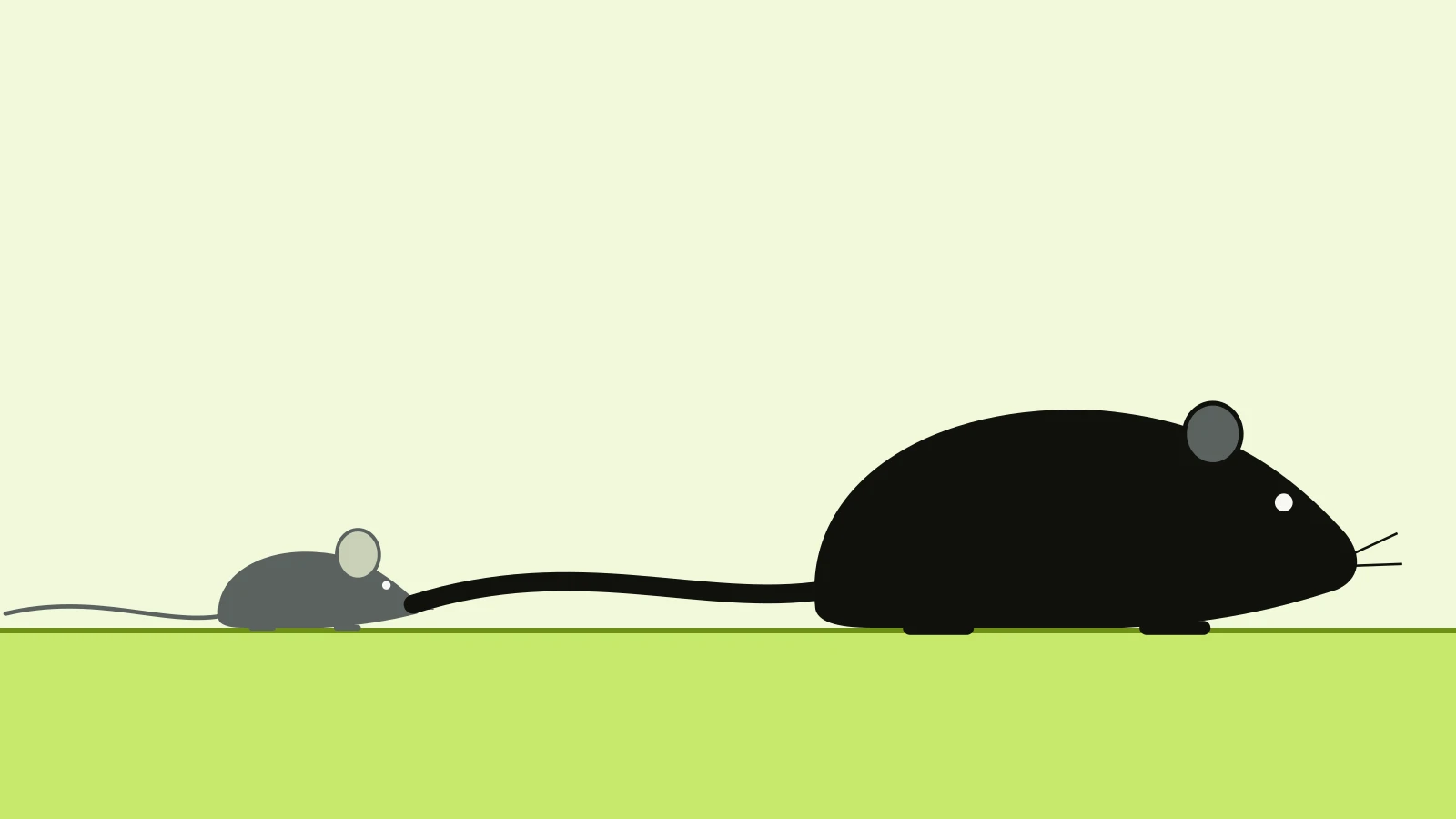
A grown house mouse is small: Oxford City Council gives 140–190 mm from nose to tail tip and about 15 g, and the British Pest Control Association (BPCA) puts the weight at under 25 g. A brown rat is another scale of animal, at 350–450 mm and about 300 g, and the BPCA notes that big adults often pass half a kilo.
Proportions are more reliable than size if you only caught a glimpse. On a mouse the tail is at least as long as the body, thin and lightly haired. On a brown rat the tail is thick and shorter than the body. The brown rat is the one to expect here; the BPCA describes the black rat as now rarely found in the UK.
Mice vs rats, side by side
| Sign | House mouse | Brown rat |
|---|---|---|
| Length, nose to tail | 140–190 mm | 350–450 mm |
| Adult weight | About 15 g, under 25 g | About 300 g, can pass 500 g |
| Head | Pointed snout, large eyes | Heavy, blunt muzzle |
| Ears | Large for the head | Small, hair-covered |
| Tail | Thin, at least as long as the body | Thick, shorter than the body |
| Droppings | 3–6 mm rods, scattered | About 20 mm spindles, grouped |
| Gap it can use | 5–6 mm | 15 mm |
| Usual home | Wall cavities, under floors, near food | Sewers, burrows, roof spaces, under floors |
Figures from Oxford City Council and the BPCA. Where they differ, both are shown.
- 1. Mouse: large ears and eyes for the size of its head
- 2. Mouse: thin tail, at least as long as its body
- 3. Rat: heavy head with a blunt muzzle
- 4. Rat: small ears covered in hair
- 5. Rat: thick tail, shorter than its body
Mouse droppings vs rat droppings
Droppings are the best evidence you are likely to find, because they stay where they fall and you can measure them. Oxford City Council describes rat droppings as grouped, spindle-shaped and about 20 mm long, and mouse droppings as scattered, rod-shaped and 3–6 mm long. Lay a ruler next to one and photograph it without touching it. That photo is also the most useful thing you can send a pest controller.
Pay attention to the pattern as well as the size. Mice leave droppings as they go, so a line of them along the back of a cupboard or under a kitchen plinth is typical. Rats tend to leave theirs together in a few favoured spots. Colour is a poor guide, because droppings fade as they age and vary with diet.
Young rats leave smaller droppings, so a mix of sizes in one place can mean a family of rats and not two species. If you find anything between the two ranges, do not guess. Treat it as rats until someone has looked, because the risks of getting that wrong are higher.
- 1. Mouse droppings fall along the route, spread out
- 2. Rat droppings sit together in a favoured spot
- 3. A mouse dropping is a 3–6 mm rod
- 4. A rat dropping is a spindle of about 20 mm
Fresh or old: is the problem still active?
Old droppings may be left over from a problem that ended years ago, which is common in lofts and under floors in older London houses. Fresh ones are dark and soft; old ones are dull, dry and crumble easily. Before you book anything, find out which you have.
The simplest test is the one the US Centers for Disease Control and Prevention describes: clean the area and check again. If new droppings appear, rodents are still there. Do it in the kitchen first. Wear disposable gloves, use disinfectant, bag the waste, and wash your hands afterwards. Then look again the next morning, and the morning after.
Lay a thin dusting of flour along the skirting behind a suspect cupboard if you want more proof. By morning, small prints and a fine tail line suggest mice; larger prints and a heavier drag suggest a rat. It also shows you the route, which is what a trap or a proofing job needs.
Sounds, smells and damage to look for
After droppings, these signs help you judge where the animals are and how many there may be. None of them proves the species alone, but together they usually point one way.
- Sound: a light, quick scratching in walls or ceilings suggests mice. Heavier movement or gnawing under the floor or in the loft suggests rats.
- Smell: the BPCA describes house mice as having a distinctive, strong smell, which you will notice with a larger infestation.
- Gnawing: both must gnaw to wear their teeth down. Rats leave larger marks and can damage wood, plastic, brick and lead pipe.
- Food: mice nibble a little in many places and nest close to food. A rat eats about 50 g of food a day and mostly feeds at night.
- Outside: a burrow in a grassy bank, under a shed or beside decking points to rats.
- Timing: mice are active all year, so a winter sighting does not mean the problem will end in spring.
How mice and rats get into a house
The gap each one needs is the most practical difference between them. The BPCA says a mouse needs 5 mm, about the width of a pencil's eraser end, and Oxford City Council says 6 mm. The BPCA gives 15 mm for a rat. That means a hole that would stop a rat will not stop a mouse, and any job has to be planned for the smaller animal if mice are the problem.
Rats commonly arrive from below. The BPCA notes that they often live in sewers and can get into a property where those are in disrepair, and Oxford City Council says rats can point to a drainage defect. Outside, they burrow under sheds and into banks, then follow the building line looking for a way in.
Mice tend to use low gaps around pipes, cables, air bricks and doors. They can also arrive inside boxes or laundry baskets. Once in, they run through wall cavities and floor voids, and in terraced houses and converted flats those voids can link one home to the next. That is why a problem in the flat next door can become yours, and why proofing your own kitchen alone may not end it.
- 1. Failed drain or loose cover: the rat's way up from the sewer
- 2. Burrows under sheds and decking
- 3. Low gaps around pipes, cables and air bricks
- 4. Wall cavities and floor voids link rooms and homes
- 5. Kitchen plinths and appliances: shelter close to food
Which is worse, mice or rats?
Rats are generally the harder job and mice the more persistent one. Neither should be left alone. Both gnaw cables and pipes, and the BPCA links both to electrical fires and floods. Oxford City Council makes the same point about mice and cables.
On health, the BPCA says mice can spread Salmonella and Listeria through urine, droppings and bedding, which is why food preparation surfaces matter most. Rats carry the same kinds of risk, and they are also linked to leptospirosis, or Weil's disease. The NHS says that infection is rare in the UK, so a rat in the garden is no reason to panic. If you have flu-like symptoms after contact with rat urine or dirty water, see a GP and mention it.
Numbers are the other reason to act early. Brown rats can breed at about three months old, and the BPCA says a female may have 3 to 12 litters a year, with six to eight young in each. Mice also mature quickly. A problem you can count on one hand in October may not stay that way by Christmas.
What to do first: six steps for tonight
These steps cost little and make any later treatment work better, because rodents go to traps and bait more readily when there is less food around.
- Photograph the droppings beside a ruler and note each place you find them.
- Move food into glass, metal or hard plastic containers, including pet food and bird seed.
- Clean the area with gloves and disinfectant, then check for new droppings each morning.
- Close bin lids and clear anything left around them. Do not overfill a bird feeder.
- Look low down around pipes, under the sink and behind appliances for gaps of 5 mm or more.
- Outside, check drain covers and clear piles of wood or rubbish next to the house.
DIY traps or a pest controller?
One or two mice in a single room is a fair DIY job. Use break-back traps, baited with something like nutty chocolate or raisins, close to the droppings and at right angles to the wall, so an animal running along the skirting has to cross the trap. Keep them away from children and pets, and check them every day.
Be careful with poison, particularly in London. The BPCA says it is common knowledge in the industry that almost all house mouse populations in London are resistant to traditional rodenticides, and that amateur products are restricted. Shop-bought bait can therefore cost you weeks without solving anything, and a poisoned animal can die under the floor or be eaten by something else.
Rats are a different matter. The BPCA says most are wary of new objects and will avoid them for a period, so do not expect traps to work overnight. Call a professional straight away if you see any of these signs:
- You have rat droppings, a burrow, or a rat seen indoors.
- You have seen a live animal in daylight, or found droppings in several rooms.
- Traps have caught nothing after a week, though new droppings keep appearing.
- The problem keeps coming back, or you share walls or voids with other homes.
- You run a food business or manage a let property.
Renting in London: who deals with mice or rats?
Citizens Advice says tenants are usually responsible where they caused the problem, for example by not disposing of rubbish properly. Landlords are usually responsible where the tenancy agreement says so, where the problem comes from a failure to make repairs such as fixing holes in walls, or where it makes the home unsafe, for example by making you ill.
Landlords are generally only responsible once they know, so tell yours straight away, in writing, with dates and your photos. Your council's environmental health team can give advice and may be able to require a landlord to act. You can contact the council about rats or mice even if you do not live in a council home, though private tenants may have to pay for treatment.
Leaving a rental soon? Keep the record of what was treated and when, and read our end of tenancy cleaning checklist too, because droppings left behind cupboards are the sort of thing a final inspection picks up.
Council or private pest control?
Start by checking your own council, because services differ a lot. Some treat rats and mice, some charge a fee and some offer advice only, so check what yours covers and what it costs. Redbridge Council publishes a domestic fee of £200 for rats or mice over three visits for 2026/27, and it does not include proofing in that price.
Compare the same things whoever you ask: the number of visits, whether proofing is included, how soon someone can come and what happens if the problem returns. If you live in or near Ilford, our Ilford pest control page sets our prices beside the council's, line by line.
What we do, and what it costs
You do not need to know which rodent you have before you contact us. Tell us what you have seen and your postcode, send a photo if you can take one safely, and we confirm the treatment price, the number of visits and what is included in writing before any work is booked.
On the visit we find where the animals are active and treat the cause as well as the sighting, then give you a safety report and advice on sealing the entry points. If a drain turns out to be the source, it will need a drainage engineer as well, because treatment alone will not fix it.
Mice control starts from £99 and rat control from £109. For a 1-bed property, a single visit is £90–£120 with no guarantee, a 2-visit package is £160–£190 with a 1-month written guarantee, and a 3-visit package is £210–£230 with proofing recommendations and a 3-month written guarantee. Bigger properties cost more; our prices page has the detail.
We are based on Clements Road in Ilford, cover London, and carry public liability insurance. Our phone lines are open Monday to Saturday, 8am to 8pm. For other signs around the home, see our guide to early signs of pests.
Common questions
How do I know if I have mice or rats?
Measure a dropping. About 3–6 mm and scattered points to mice; about 20 mm and grouped points to rats. The mice vs rats table lists the other signs.
Are rats worse than mice?
Rats are usually harder to deal with, because they are wary of traps and may be coming from a drain. Mice are not a lesser problem: they spread through small gaps, and they carry Salmonella and Listeria. See rat control for what treatment involves.
Can you have mice and rats at the same time?
Yes, nothing stops both using one building, especially where there is a shared void or a failed drain. If the droppings come in two clear sizes, tell us; a pest inspection can check each route.
Do mice go away on their own?
Do not count on it. Mice breed quickly and stay active all year, and a home with food, warmth and a way in gives them no reason to leave. Start with the steps in our guide on how to tell if you have mice.
Can rats come up through the toilet?
It is uncommon, and the more usual route is a failed drain under or beside the house. If you suspect a drain, have it checked by a drainage engineer as well as a pest controller. Our rat control service can tell you when the signs point that way.
Who pays for pest control in a rented flat in London?
It depends on the cause and your tenancy. Landlords are usually responsible where a lack of repair let the pests in, and tenants where their own rubbish or food storage caused it. Report it in writing first; we can give you a written quote to share with your landlord.
How much does mice or rat control cost in London?
Our mice control starts from £99 and rat control from £109. The final price depends on the property and the number of visits, and it is confirmed in writing before work is booked. See all our prices.
Sources
Figures differ a little between sources, so ranges are given where they do. Sources reviewed on 1 November 2026.
- BPCA: pest advice for controlling brown ratsbpca.org.uk(opens in a new tab)
- BPCA: pest advice for controlling house micebpca.org.uk(opens in a new tab)
- Oxford City Council: mice, and how they differ from ratsoxford.gov.uk(opens in a new tab)
- NHS: leptospirosis (Weil's disease)nhs.uk(opens in a new tab)
- Citizens Advice: if there are pests or vermin in your rented homecitizensadvice.org.uk(opens in a new tab)
- Redbridge Council: pest controlredbridge.gov.uk(opens in a new tab)
- CDC: rodent controlcdc.gov(opens in a new tab)
Want it dealt with?
Tell us what you have seen, the rooms and your postcode. You do not need to know which pest it is. We confirm the price in writing before any work is booked.