Pest Control · 31 min read · Updated 1 November 2026
How to Get Rid of Silverfish in Your Home: UK Guide
To learn how to get rid of silverfish, start with the room and not a spray. Find out which species you have, measure the humidity, fix leaks and ventilation, and remove food and hiding places. If they are still there after about a month, targeted treatment makes sense, and for grey silverfish, bait has the better record over time.
By the Bestone pest control team · Contact us
Key takeaways
- Common silverfish point to damp. English Heritage says they only breed rapidly above 70% relative humidity, so fix leaks and ventilation, and aim for 40% to 60% in the affected room.
- Measure before you spend. A cheap hygrometer in the room, plus a few sticky traps counted weekly, shows whether the problem is really shrinking.
- Grey silverfish are different. At 15 to 20 mm they are bigger, and they have been found in dry, heated homes, so drying the air alone may not clear them.
- On the evidence, many tiny droplets of gel bait along walls did better over time than sticky traps, and at least as well as spray. It took months, and it was applied by technicians.
- Silverfish are a nuisance and are not regarded as a significant health risk, but they can damage paper. Our silverfish treatment starts from £99, and the price is confirmed in writing before booking.
On this page
- Key takeaways
- How to get rid of silverfish: the short answer
- Silverfish UK: which of the three have you found?
- Silverfish, grey silverfish and firebrats compared
- Why grey silverfish are spreading in UK buildings
- What silverfish are telling you about damp
- What humidity should you aim for?
- How to get rid of silverfish in the bathroom
- Kitchens, cupboards and what silverfish eat
- Silverfish in books, paper and wallpaper
- Silverfish in a new build or newly plastered home
- Are silverfish harmful?
- Gel baits, sprays, dusts and traps: what the evidence says
- Silverfish control methods compared
- How long does it take to get rid of silverfish?
- When do you need silverfish pest control?
- What you see, and what to do next
- Renting in London: who deals with silverfish and damp?
- What we do, and what it costs
- Silverfish treatment prices in London
- Common questions
How to get rid of silverfish: the short answer
Good silverfish pest control starts with moisture. Small silver insects in a bath, on a bathroom floor or in a kitchen cupboard at night usually mean the room stays damp for longer than it should. Oxford City Council advises dealing with small numbers by finding and reducing the damp, and that is where we would start too.
The order matters, because a spray in a wet room treats the insects you can see and leaves the conditions that suit them. Work through the steps below, and give the changes about a month while you count what you catch. That month is our suggested checkpoint and not a rule from any source, but it is long enough to see a trend.
The exception is the grey silverfish, a larger species now established in UK buildings. It copes with drier air, so if you find big, grey insects in a heated bedroom or living room, go straight to the identification section and then to the evidence on baits.
- Catch one and identify it: size, colour and which room you found it in.
- Put a hygrometer in the room and note the reading morning and evening for a week.
- Fix anything wet: leaks, failed sealant, a weak extractor fan, condensation.
- Seal gaps around pipes once they are dry, and leave vents and air bricks open.
- Clear what feeds and shelters them: dust, spilt flour, cardboard and old paper.
- Set sticky traps, count weekly, and bring in silverfish treatment if the numbers do not fall.
Silverfish UK: which of the three have you found?
Three similar insects turn up in British buildings, and the difference changes what you should do. All three are slim, wingless and scaly, with long antennae and three tail bristles. They run quickly when disturbed and are mainly seen at night, although researchers in Vienna describe the grey silverfish as active by day and able to climb walls.
The common silverfish, Lepisma saccharina, is the one most people mean. English Heritage gives 10 to 15 mm, and Oxford City Council and Rochdale Council both give about 12 mm. It looks bright and silvery, and it is usually found low down in damp rooms such as bathrooms, toilets, kitchens and cellars.
The grey silverfish, Ctenolepisma longicaudata, also goes by long-tailed silverfish or paper fish. English Heritage gives 15 to 20 mm for adults, while the Norwegian team behind the main control trials gives 13 to 18 mm, so anything over about 15 mm deserves a closer look. It is covered in grey, blotchy scales, has a fringe of short bristles on the head and down the sides, and carries antennae longer than its body.
The firebrat, Thermobia domestica, is the heat lover. Rochdale Council says it needs about 32 to 48°C and is often found in bakeries and near ovens and pipes. It is greyish with dark, irregular markings. In a normal home, think of the airing cupboard, boiler space and hot pipes. Researchers in Vienna say firebrats are rarely found in Central European buildings, and we found no UK figure. If you do have them, the fix is about reaching hot voids and not about opening a window.
To check yours, press clear tape over one, or tip it into a clean jar, then photograph it beside a ruler. Scales rub off easily, so an old or squashed specimen can look different from a live one. One more name you may read online is the ghost silverfish, Ctenolepisma calvum. A 2022 European study reports no UK detections, so you are very unlikely to have it. If your insect is dark, hairy and slow, it may be a carpet beetle larva instead, and if it is grey with many legs, look at woodlice control.
Silverfish, grey silverfish and firebrats compared
| Feature | Common silverfish | Grey silverfish | Firebrat |
|---|---|---|---|
| Adult length | 10 to 15 mm | 13 to 20 mm, sources differ | About 14 mm |
| Colour | Bright silver | Grey, often blotchy | Greyish, dark markings |
| Antennae and tails | Long | Longer; antennae beat body length | Longer antennae than silverfish |
| Usual place | Bathrooms, kitchens, cellars | Any heated room, including dry ones | Near ovens, boilers, hot pipes |
| Conditions | Humid; breeds fast above 70% humidity | Tolerates dry indoor air | About 32 to 48°C |
| Time to adult | 6 to 12 months | 1.5 to 3 years | About 40 days above 24°C |
| Drying the room | Often solves it | Helps, but often not enough | Treat cracks around hot pipes |
| Best next step | Fix moisture, then monitor | Identify, then bait | Find the hot harbourage |
From English Heritage, Rochdale Council, Aak and colleagues, Kulma and colleagues, and University of California IPM. Firebrat timing is a US figure.
- 1. Common silverfish: 10 to 15 mm, bright silver, damp rooms
- 2. Firebrat: about 14 mm, mottled, needs high heat
- 3. Grey silverfish: 15 to 20 mm, blotchy grey
- 4. Grey silverfish: bristle fringe, and longer antennae and tails
Why grey silverfish are spreading in UK buildings
This species is new to Britain. A 2021 study in the journal Insects, by Kulma and colleagues, gives the first UK record as a home in Reading in 2014, and the species was reported in the entomological literature in 2016. English Heritage describes it as very common in many European countries and spreading rapidly.
The same study lists UK finds in homes, student housing in Southampton, Manchester, Birmingham and Brighton, warehouses, an office in Ashford, a shopping centre in London, and museums and archives including sites in London and South East London. A small survey in Birmingham found the insect in 6 of 20 households between 2018 and 2019. That is a small sample and not a national rate, but it suggests the species is not rare.
Why now? Kulma and colleagues link the spread to well-insulated, centrally heated buildings. Rukke and colleagues add that small young insects hitch rides on belongings and move through buildings on foot. A Dutch trial was run in well-insulated, double-glazed houses with central heating, which shows this is not a problem of neglected homes.
That has two practical results for London. Flats and shared buildings can pass silverfish between neighbours, so one household's work may not end it. And moving boxes between homes or storage units is a sensible point to check, since a box of old paper is both transport and food. If you are moving, unpack paper and cardboard in a room you can monitor, and read our end of tenancy cleaning checklist if you are leaving a rented flat.
What silverfish are telling you about damp
Common silverfish are one of the more honest pests. English Heritage calls silverfish a useful indicator of damp problems in its pest management guidance, and Oxford City Council says they are a sign of damp conditions that may need repairs. Rather than asking how to kill them, ask why this room stays wet.
Follow the water. GOV.UK guidance on damp and mould names four main types: condensation, which it calls the most common, plus penetrating damp, rising damp and traumatic damp from leaks and floods. Oxford adds some ordinary household causes, such as unvented tumble dryers and cooking, and suggests looking for damp stains and checking pipes and gutters.
The map below shows the places we would check in a typical London flat or terraced house. Silverfish move along pipes and through openings in walls and floors, according to University of California IPM, so a bathroom directly above a kitchen is one connected space to them. Finding them in both rooms often points to the same pipe run.
If you find a stain, a soft patch of plaster or a musty cupboard, deal with that first. A damp wall needs a repair, and no insect treatment will replace it. Do not simply paint over the mark, because GOV.UK guidance is clear that removing surface mould alone does not stop it returning.
- 1. Bath and shower edges: failed sealant keeps a gap wet
- 2. Extractor fan: weak or unused, so steam stays in the room
- 3. Boxed-in pipes: a sheltered route between floors
- 4. Under the sink and behind appliances: slow leaks
- 5. Cardboard and paper in a closed cupboard: food and shelter
What humidity should you aim for?
Aim for 40% to 60% relative humidity in the affected room, and treat 70% as the line you must not sit above. Those two numbers come from different sources, so it helps to see where they come from.
For the insects, English Heritage's pest management guideline says silverfish only breed rapidly and cause serious problems above 70%. Brimblecombe and Querner put the common silverfish's need for high humidity at above 75%, and University of California IPM gives the same 75% figure for warm conditions. These are for the common species. Brimblecombe and Querner also point to humid pockets in small cracks, which is why silverfish can persist in a room that reads fine: the space behind a bath panel may be far wetter than the air you are measuring.
For homes, there is no single official target. The GOV.UK damp guidance lists consistently high relative humidity as a warning sign but gives no number. Dartford Council advises 40% to 60%, Croydon Council calls 45% to 55% ideal, and Epping Forest District Council gives 30% to 60% for cooler months and says mould is likely at 70% or more for long periods. We would use 40% to 60% because it sits inside most of that advice.
A basic hygrometer is enough. Epping Forest suggests a low-cost meter from a hardware shop, and notes that readings vary from morning to night, between rooms and with the weather. Put one in the room where you see silverfish, away from the shower spray and away from a window, and note it twice a day for a week. A brief spike during a shower is normal. What you want to see is the reading falling back within the hour or so after a shower, and not staying high all day. A second meter inside the under-sink cupboard often tells you more than the first.
The grey silverfish breaks these rules. In the Norwegian flats studied by Aak and colleagues, rooms averaged about 23°C and 39% to 40% humidity, and the insects were living there anyway. Rukke and colleagues found them in both dry and humid rooms. So if your hygrometer reads a steady 45% and you still have large grey insects, stop chasing moisture and move on to baits.
- 1. Dartford Council: keep homes at 40% to 60%
- 2. Epping Forest: mould is likely at 70% or more for long periods
- 3. English Heritage: common silverfish breed rapidly above 70%
- 4. Grey silverfish: living in flats that averaged about 40%
How to get rid of silverfish in the bathroom
Bathrooms are where most people first see them, often stuck in the bath. University of California IPM explains that silverfish fall into tubs and sinks and cannot climb the slippery sides, so one in the bath has probably not come up the plughole. Rinse it away, and put your effort into the room.
Start with the fan, because it does more than anything else you can do cheaply. GOV.UK guidance says extractor fans should be fully working and powerful enough to remove moisture, and suggests humidity-controlled fans or ones with an over-run after the light goes off. As a benchmark, Chesterfield Borough Council's housing standard repeats the building regulations figure of 15 litres per second for a bathroom, with at least 15 minutes of over-run where there is no window that opens. A rough home check is to hold a sheet of toilet paper to the running fan. If it does not cling, clean the cover and have the fan looked at.
- Run the fan for the whole shower and at least 15 minutes after, with the door shut so steam goes out and not into the hall.
- Open the window after bathing if you can, and keep any trickle vents open.
- Wipe the shower screen, tiles and bath edge. A squeegee takes about a minute.
- Hang wet towels and bath mats out to dry, and lift any floor mat that stays damp underneath.
- Check the bath panel, shower tray and toilet cistern for drips. Lift the panel if you can and use a torch.
- Rake out failed sealant, let the joint dry fully, then seal it again.
- Fill gaps around pipes, skirting and boxing-in with a suitable filler or sealant once dry.
- Never block a vent or an air brick. Croydon Council warns against blocking air bricks, and they help dry the room.
- Replacing or adding a fan is controlled work, so GOV.UK says it needs a competent person. Tenants should ask the landlord.
Kitchens, cupboards and what silverfish eat
After moisture, food is the next thing to remove, but do not expect to starve them. University of California IPM lists starchy foods such as flour, cereal, pasta and pet food, plus glued paper, wallpaper, clothing starch, dust, dead insects and certain fungi, and says they can go months without eating. Rukke and colleagues found the grey species can live for more than a year on filter paper alone.
So cleaning will not kill them, but it does make other control work better. In laboratory tests by Rukke and colleagues, removing competing food raised deaths from bait, and only the thoroughly cleaned group was wiped out entirely. Keep that in mind if you plan to use bait.
Kitchens need the same check as bathrooms. Dartford Council advises lids on pans, working extractors and a closed door while cooking. The building regulations figure repeated by Chesterfield is 30 litres per second for an extractor next to the hob and 60 elsewhere, and a recirculating hood that does not vent outside does nothing for moisture, in our view. Then pull out what you can and look behind it.
- Move dry food into sealed jars or tubs, including pet food and bird seed.
- Vacuum the crumbs from cupboard corners, drawer runners and the gap under the kickboard.
- Empty the under-sink cupboard, dry it, and check the trap and supply pipes for drips.
- Look behind the washing machine and dishwasher for damp marks on the wall.
- Do not use an unvented tumble dryer in a closed room, a moisture source Oxford City Council names.
- Recycle spare cardboard and old newspapers, and do not store them under the sink.
Silverfish in books, paper and wallpaper
Silverfish are mostly a nuisance in a bathroom, but they are a real pest among paper. English Heritage lists paper, books, prints, drawings, photographs and labels as materials they damage, and occasionally silk and other textiles. They particularly like coatings of starch, gelatine and organic dyes, along with flock wallpaper and wallpaper paste.
The damage has a recognisable look. English Heritage says they scratch the surface and leave bare or translucent patches, then eventually eat through to leave holes with irregular, thinned edges. They may eat organic ink on labels and prints. University of California IPM adds that holes are often unconnected and that you may find scales and droppings nearby. Their droppings are cylindrical, says English Heritage.
Museums and historic houses take this seriously. The Natural History Museum monitors for silverfish because they can damage the paper labels attached to its specimens. The National Trust's 2023 pest report put silverfish at the top of its list, with numbers up 6%, and the Museums Association reported that the Trust connected the rise to wet weather and mould that the insects graze on.
At home, keep paper dry, sealed and disturbed. Move anything you care about out of bathrooms, cellars and damp cupboards, and off cold outside walls. Use sealed plastic boxes in place of cardboard, and do not fill a box with something damp. University of California IPM suggests moving stored books and papers occasionally, which is a simple habit that also lets you spot damage early.
English Heritage's fact sheet shows silverfish damage to wallpaper on a very damp wall, so if yours is peeling, fix the wall before you repaper. For valuable books, deeds or photographs, ask a paper conservator before you use any freezing or heat method. Kulma and colleagues say whole-load heat or cold treatment can work, but that it is costly and hard to organise. Do not spray insecticide on paper. For damage on wool, felt or carpet, the likely culprit is different, so see our guides to carpet beetles and moths.
Silverfish in a new build or newly plastered home
New homes can have silverfish for two separate reasons. The first is water. The NHBC says moisture from construction dries out steadily over time, and housing association SNG says new buildings can take a long time to dry and that walls usually need 9 to 12 months before redecorating. University of California IPM makes the link directly: fresh concrete and green timber add humidity, wallpaper paste adds food, and the insects can arrive in timber or wallboard.
The second reason is that a well-insulated, centrally heated home suits the grey silverfish well, as the Dutch and Norwegian studies show. So do not assume a new build means the problem will fade as the walls dry. If the insects are common silverfish and the home is under a year old, drying out may well do the job. If they are large and grey, plan on baiting.
What to do is largely the same as the advice for preventing mould. The NHBC says to use extractor fans and cooker hoods when steam is produced, keep trickle vents open, open windows when it is safe, and keep the home adequately heated. SNG advises gentle heat for longer periods and not short bursts on high, and avoiding wallpaper for the first year. If your home has mechanical ventilation with heat recovery, keep it switched on, as Cambridge City Council advises.
Take a photo of any insects and readings early on. If your home is still within a builder's defects period, raise leaks or poor fan performance with the builder or managing agent in writing. If you have just had a kitchen or bathroom replaced, or a wall replastered in an older home, the same logic applies on a smaller scale. Leave the wall to dry before you box in, tile or paper it.
Are silverfish harmful?
For people, no serious harm is recorded in the sources we read. Rochdale Council says silverfish and firebrats are not considered a significant public health risk but can be a nuisance. The sources we checked do not list any disease they carry, and University of California IPM describes their jaws as weak, scraping paper and not biting it. None of the UK sources we read says outright that they never bite, but none records them biting people either.
If you are getting bites or itchy marks, look for another cause, because silverfish are an unlikely answer. Our guide to bed bugs and fleas explains how to tell those apart, and a pharmacist can advise on bites.
The health concern is more likely to be the damp itself. GOV.UK guidance says damp and mould mainly affect the airways and lungs, and can also affect the eyes and skin. If there is visible mould, a musty smell or someone at home with breathing problems, treat the damp as the priority, and speak to a GP about any symptoms. A landlord should not wait for medical evidence before acting, the same guidance says.
For the home, the risk is to paper and some fabrics, as the section above describes. None of the sources we read lists structural timber or brickwork among the things they damage, unlike woodworm in wood, although the damp they point to can harm a building in time.
Gel baits, sprays, dusts and traps: what the evidence says
This is where most online advice is out of date. Sources genuinely disagree here. University of California IPM, in a page last updated in 2009, says baits are generally not very effective because the insects tend not to feed on them. Oxford City Council points householders to crawling-insect sprays or dusts. Newer European field trials say almost the opposite, and they are the best evidence available for the grey silverfish.
The key work comes from the Norwegian Institute of Public Health. In the laboratory, Aak, Hage and Rukke found that gel baits containing indoxacarb, clothianidin or fipronil killed about 91% to 97% of grey silverfish in 18 days, even with oat flakes available as other food. Silverfish that ate the dead insects were poisoned too, with over 75% mortality for indoxacarb. Egg laying fell by more than 85% in later tests.
In real flats, the same group compared three methods over 10 weeks. Sticky traps gave a 9.5% fall, permethrin spray 52.6% and indoxacarb bait 71.3%. The paper's summary says bait outcompeted spraying, but its own statistics found no significant difference between bait and spray, and there was no untreated group. So the fair reading is this: traps alone do little, and bait matches spray in the short term. Bait's edge shows over time. In a block of 154 flats, droplets gave more than a 90% reduction after three treatments, 2 to 4 months apart, and Kulma and colleagues report that pyrethroid sprays and smoke cut numbers for only a few months before they returned.
Placement is the part most people get wrong. Rukke and colleagues found that 12 droplets spread along the edges of a test arena worked about four times better than a central cluster, and a house with only a few bait points improved slowly until it was switched to many small droplets along the skirting. Aak's team used tiny droplets of about 10 mg, at about one per square metre, and half that density worked as well. A Dutch trial by Brooks and Gutsmann, one of whom works for Bayer, reached a 93% fall in trap catches after 63 days with a clothianidin cockroach bait in four houses.
Now the cautions. These trials used cockroach gels applied by technicians, and most of the work is on the grey species, with little on common silverfish, which Aak's team says is easier to control by drying its habitat. The HSE says the public should only use products intended for them, labelled amateur or non-professional, and should never use one meant only for professionals. It also says a product must not be used for anything other than the use on its label. So a gel that is labelled for cockroaches only is not one to use against silverfish, however good the research sounds. Keep any product away from children and pets, and do not put it where food is prepared unless the label allows it.
Silverfish control methods compared
| Method | Evidence | Our verdict |
|---|---|---|
| Fixing damp and ventilation | English Heritage: rapid breeding needs over 70% humidity | First step for common silverfish; helps, but not enough alone, for grey |
| Gel bait droplets | 71.3% in 10 weeks; over 90% with repeat treatment | Best long-term option for grey silverfish; label and placement matter |
| Residual spray | 52.6% in 10 weeks; numbers can return in months | Short-term knockdown, in cracks and not on open surfaces |
| Dusts | US advice only; wet dust cakes and stops working | Dry voids only; poor choice for bathrooms |
| Sticky traps | 9.5% in 10 weeks | For counting, not for control |
| Foggers and smoke | University of California IPM advises against foggers | Avoid; smoke cut numbers for only a few months |
| Scent remedies | Not recommended in any source we read | Save your money |
Percentages from Aak and colleagues (2020), 30 Norwegian flats with no untreated group. Spray and bait did not differ significantly.
How long does it take to get rid of silverfish?
Longer than most people expect, and the biology explains why. English Heritage gives a life cycle of 6 to 12 months for the common silverfish, and Oxford City Council says eggs hatch in 2 to 8 weeks. Sources differ on egg numbers: Oxford says a female lays about 100, and University of California IPM says a clutch averages 50.
Grey silverfish are far slower. Rukke and colleagues say they need at least 18 months to start reproducing at normal indoor temperatures, and Kulma and colleagues report a lifespan of up to seven years. In seven treated Norwegian sites, the first significant fall came after about 10 weeks on average, more than 90% reduction took 17 weeks, and six of the seven reached zero counts between weeks 28 and 55.
University of California IPM says proper treatment usually shows results within a few weeks, and that no improvement after 2 or 3 weeks suggests insects are coming from untreated places. That seems a fair guide for common silverfish in a single room. For grey silverfish, measure progress in months.
Do not judge by what you happen to see, because a treated population may scatter and a quiet week can mean nothing. Count instead. University of California IPM says cockroach sticky traps work well for monitoring. Place two to four in each problem room, along edges and in corners, and write the date on each. Check weekly, record the count and replace them when full, keeping them in the same spots and out of reach of children and pets. A clean jar with masking tape around the outside also works, because the insects climb the tape, fall in and cannot get out.
You are looking for a steady fall over four or more weeks. Note the size of what you catch too. Fewer adults and only small young ones suggests that the older insects are going. Keep the bait in place if you are using it, as Rukke and colleagues found that survival was higher when bait was only present for short periods, and they advise against cleaning it away.
When do you need silverfish pest control?
A few silverfish in a bathroom do not need a professional, and we would rather you fixed the fan first. Oxford City Council says as much for small numbers. Call someone in when the numbers hold up after the damp is fixed, when the insects are in several rooms, when something valuable is at risk, or when you are responsible for a building and not only a flat.
Good pest control for silverfish is a search as much as a treatment. Hidden colonies sit in wall voids and behind skirting, which Aak and colleagues say sprays may not reach, and lingering low numbers in their trial were put down to hidden enclaves. A visit should include looking for the moisture source, not only applying a product. For any unknown insect, a pest inspection is a sensible first step.
Businesses and landlords with several units have a different problem, because a single flat treated alone can be reinfested from next door. The Norwegian block work treated flats across the building. If you run offices, storage or archives, see commercial pest control. If what you have turns out to be a fast brown insect near the cooker and not a silver one, read our cockroach guide as it needs a different plan.
What you see, and what to do next
| What you see | Likely cause | What to do |
|---|---|---|
| One or two in the bath, humidity normal | A passing insect | Keep the fan on, set one trap, do nothing else |
| Regular sightings, humidity over 60% | Common silverfish in a damp room | Fix moisture, count for a month |
| Numbers steady after the room is dry | Hidden damp, or the grey species | Identify one, then book treatment |
| Large grey insects in a dry bedroom | Grey silverfish | Skip to bait; dehumidifying is unlikely to clear them |
| Holes or thin patches in books or wallpaper | Active feeding on paper | Move items now, then treat |
| Found near the boiler or hot pipes | Possibly firebrats | Get the insect identified, then treat the hot void |
| Sightings in several flats | A building-wide population | Report to the landlord or managing agent |
Renting in London: who deals with silverfish and damp?
In a rented home, the answer usually follows the cause. Citizens Advice, which covers England, says your landlord is likely to be responsible if the tenancy agreement says so, if the infestation comes from repairs they have not done, or if it makes your home unsafe. You may need to deal with it yourself if your own actions caused it. Silverfish linked to a leaking pipe, a broken fan or a damp wall fall on the repairs side of that line.
Separately, the Homes (Fitness for Human Habitation) Act 2018 requires landlords in England to keep homes fit to live in, and GOV.UK damp guidance lists it among the laws that apply. That guidance also says it is unreasonable to blame damp and mould on lifestyle choices, and that landlords must find the underlying cause and not only clean the surface. Keep this in mind if you are told to simply open a window.
Tell your landlord or agent straight away, because they are usually only responsible once they know. Do it in writing and include dated photos, your hygrometer readings and your trap counts. Dartford Council advises keeping a copy of the letter and contacting the council's housing team if nothing has happened after a reasonable period, which it says is usually 28 days. Your own borough's environmental health team can take up the damp even if it does not treat silverfish.
Council and housing association tenants have stronger rights on damp under Awaab's Law. GOV.UK guidance says significant damp and mould hazards must be investigated within 10 working days of being reported. Once the investigation finishes, the landlord has 3 working days to give you a written summary and 5 working days to make the home safe. The tenant guidance does not mention pests, so report the damp as the hazard and mention the insects as a sign. For private tenants, the law is planned under the Renters' Rights Act, but the government's roadmap still lists the start date as to be confirmed.
Landlords should treat silverfish as a free early warning. A tenant who reports them is telling you where water is getting in or failing to get out, and it is far cheaper to fix a fan now than to deal with mould later. GOV.UK says to inspect at least 6 weeks after remedial work. Keep your treatment and repair records, and our Ilford pest control page covers the licensing points for local landlords.
What we do, and what it costs
Tell us which rooms are affected, when you see the insects, and whether there is damp, and send a photo beside a ruler if you can. Your hygrometer readings and trap counts are useful too. Our silverfish treatment starts from £99. That starting rate covers an initial inspection and targeted treatment, and the final price depends on the number of rooms, the extent of activity, dampness, storage conditions and access. Price, visits and inclusions are confirmed in writing before booking.
Because silverfish can take more than one visit, particularly the grey species, we also offer packages by property size. A 2-visit package includes a follow-up and a written 1-month guarantee. A 3-visit package includes proofing recommendations and a written 3-month guarantee. The studies above show that grey silverfish can take months, so ask us how the visits are spaced, and we will tell you what to expect before you book. You also get a safety report and advice on moisture. If the problem needs a plumber, a builder or your landlord first, we will say so.
Council prices vary a lot, and some councils do not offer this at all. Oxford City Council does not treat silverfish. Redbridge Council's published fee list does not include them, so check before you plan around it. For a wider view of what moves prices, see our UK pest control cost guide, and our prices page has the full list.
We are based on Clements Road in Ilford and cover London, with pest control services for homes, landlords and businesses. We carry public liability insurance, and our phone lines are open Monday to Saturday, 8am to 8pm. If you are not sure what the insect is, contact us with a photo.
Silverfish treatment prices in London
| Option | Price | What it includes |
|---|---|---|
| Bestone silverfish treatment | From £99 | Initial inspection and targeted treatment |
| Bestone 2-visit package, 1 bed | £160 to £190 | Follow-up visit, 1-month written guarantee |
| Bestone 3-visit package, 1 bed | £210 to £230 | Three visits, proofing recommendations, 3-month written guarantee |
| Bestone 2-visit package, 2 bed | £180 to £220 | Follow-up inspection, 1-month written guarantee |
| Bestone 3-visit package, 2 bed | £240 to £270 | Three visits, proofing advice, 3-month written guarantee |
| Bestone 2-visit package, 3 bed | £190 to £240 | Follow-up treatment, 1-month written guarantee |
| Bestone 3-visit package, 3 bed | £240 to £299 | Three visits, 3-month written guarantee |
| Tower Hamlets Council | £81 per visit | For borough residents, including VAT |
| Barking and Dagenham Council | £103.80 | Owner occupiers, 2026 charges, including VAT |
| Lambeth Council | £189.60 | One visit, up to 2 rooms; £75.60 per extra visit or room |
Our prices are starting points, confirmed in writing before booking. Council fees checked on 1 November 2026 and may change; scope differs, so compare inclusions.
Common questions
Do silverfish mean I have damp?
Often, but not always. Common silverfish are a useful sign of damp, and Oxford City Council advises looking for stains and checking pipes and gutters. Grey silverfish can live in much drier rooms, so read our humidity section before you assume the worst.
How do I get rid of silverfish in my bathroom?
Run the extractor fan during and after every shower, keep the door shut, and wipe wet surfaces. Then renew failed sealant, fix any drips and tidy the under-sink cupboard. If you still count them after a month, book a silverfish treatment.
Are silverfish harmful?
Councils treat them as a nuisance and not a health risk. Rochdale Council says neither silverfish nor firebrats are a significant public health risk. The bigger concern is usually the damp behind them, and our pest inspection can help if you are unsure what you have.
What is the difference between silverfish and grey silverfish?
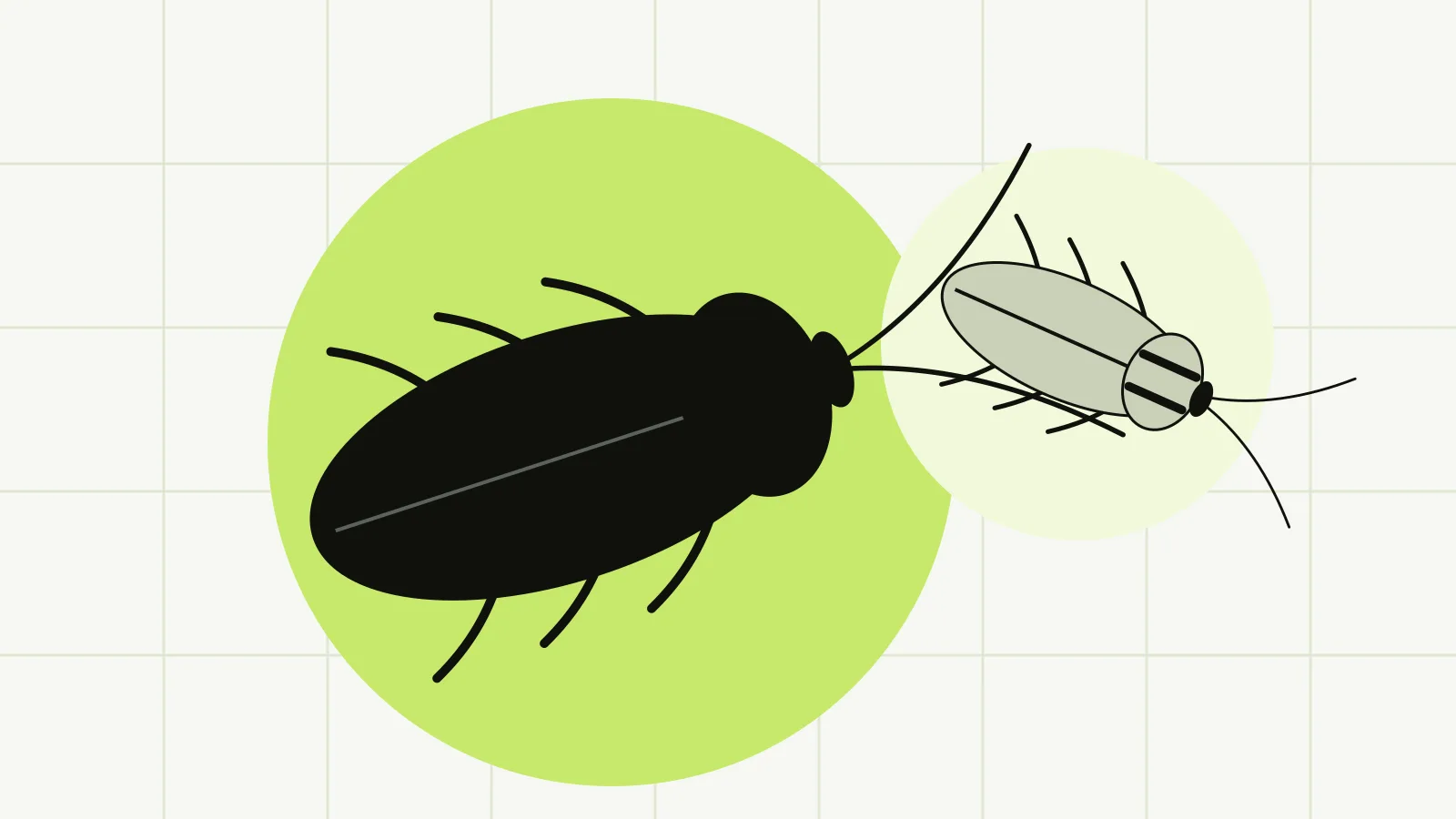
English Heritage gives 10 to 15 mm for the common silverfish and 15 to 20 mm for the grey silverfish, which also has longer antennae and tail bristles and a fringe of short bristles. The grey type can breed in drier rooms. See the scale drawing to compare them.
Why do I have silverfish in a new build?
New walls and plaster release water for months, and silverfish can also arrive in building materials or boxes. Keep trickle vents open and hold off on wallpaper during the first year. Our new-build section covers the rest.
Do silverfish gel baits work?
The best recent trials say yes, for grey silverfish, when many tiny droplets are placed along walls and left in place for months. Older US advice says baits are poor, and most products are made for cockroaches, so check the label. Our evidence table shows the numbers.
Will silverfish eat my books?
They can. English Heritage says they graze the surface of paper, leaving thin patches and then irregular holes, and they favour starch and gelatine coatings. Move paper out of damp rooms and into sealed boxes, and read our guide to carpet beetles if the damage is on wool or fabric.
Is my landlord responsible for silverfish?
It depends on the cause. Citizens Advice says landlords are likely to be responsible if the problem comes from repairs they have not made, if the tenancy agreement says so, or if it makes the home unsafe. Report leaks and damp in writing, and contact us if you need a written treatment record.
How much does silverfish pest control cost in London?
Our silverfish treatment starts from £99, and council fees we checked ranged from £81 a visit in Tower Hamlets to £189.60 in Lambeth. Scope differs, so compare what each price includes. See all our prices.
Sources
Figures differ a little between sources, so ranges are given where they do. Sources reviewed on 1 November 2026.
- English Heritage: silverfish and grey silverfish, pest fact sheet 8english-heritage.org.uk(opens in a new tab)
- English Heritage: guideline for insect pest management in historic propertiesenglish-heritage.org.uk(opens in a new tab)
- Natural History Museum: the museum in lockdownnhm.ac.uk(opens in a new tab)
- Kulma and colleagues (2021): Ctenolepisma longicaudatum became a common pest in Europe, Insectspmc.ncbi.nlm.nih.gov(opens in a new tab)
- Aak and colleagues (2020): development of a poisoned bait strategy against the silverfish, Insectspmc.ncbi.nlm.nih.gov(opens in a new tab)
- Aak, Hage and Rukke (2020): bait choice based on primary and secondary poisoning, Insectspmc.ncbi.nlm.nih.gov(opens in a new tab)
- Rukke, Hage and Aak (2021): spatiotemporal elements in a poisoned bait strategy, PLoS Onepmc.ncbi.nlm.nih.gov(opens in a new tab)
- Brooks and Gutsmann (2022): control of Ctenolepisma longicaudata using bait, International Conference on Urban Pestsicup.org.uk(opens in a new tab)
- Brimblecombe and Querner (2021): silverfish in Austrian museumspmc.ncbi.nlm.nih.gov(opens in a new tab)
- Identification and spread of the ghost silverfish among museums and homes in Europe (2022), Insectspmc.ncbi.nlm.nih.gov(opens in a new tab)
- BioImages: Ctenolepisma longicaudata, UK recordbioimages.org.uk(opens in a new tab)
- University of California IPM: silverfish and firebratsipm.ucanr.edu(opens in a new tab)
- Museums Association: wet winter causes rise in silverfish and woolly bearsmuseumsassociation.org(opens in a new tab)
- Icon: clothes moth numbers tumble according to National Trusticon.org.uk(opens in a new tab)
- NHS: insect bites and stingsnhs.uk(opens in a new tab)
- Oxford City Council: silverfishoxford.gov.uk(opens in a new tab)
- Rochdale Council: how to identify and control silverfish and firebratsrochdale.gov.uk(opens in a new tab)
- HSE: using biocideshse.gov.uk(opens in a new tab)
- GOV.UK: understanding and addressing the health risks of damp and mould in the homegov.uk(opens in a new tab)
- Chesterfield Borough Council: HMO amenities and space standardschesterfield.gov.uk(opens in a new tab)
- Dartford Borough Council: damp, mould and condensationdartford.gov.uk(opens in a new tab)
- Croydon Council: action plan for landlords and property agentscroydon.gov.uk(opens in a new tab)
- Epping Forest District Council: damp and mouldeppingforestdc.gov.uk(opens in a new tab)
- NHBC: top tips to prevent moisture in new-build homesnhbc.co.uk(opens in a new tab)
- SNG: looking after your new homesng.org.uk(opens in a new tab)
- Cambridge City Council: managing damp in new-build homescambridge.gov.uk(opens in a new tab)
- Citizens Advice: if there are pests or vermin in your rented homecitizensadvice.org.uk(opens in a new tab)
- legislation.gov.uk: Homes (Fitness for Human Habitation) Act 2018, section 1legislation.gov.uk(opens in a new tab)
- GOV.UK: Awaab's Law, guidance for tenants in social housinggov.uk(opens in a new tab)
- GOV.UK: Renters' Rights Act 2025 implementation roadmapgov.uk(opens in a new tab)
- Lambeth Council: pest control priceslambeth.gov.uk(opens in a new tab)
- Barking and Dagenham Council: pest control treatments and priceslbbd.gov.uk(opens in a new tab)
- Tower Hamlets Council: book a pest control visittowerhamlets.gov.uk(opens in a new tab)
- Redbridge Council: pest controlredbridge.gov.uk(opens in a new tab)
Want it dealt with?
Tell us what you have seen, the rooms and your postcode. You do not need to know which pest it is. We confirm the price in writing before any work is booked.