Pest Control · 30 min read · Updated 1 November 2026
Carpet Beetles in the UK: Signs, Larvae and How to Get Rid of Them
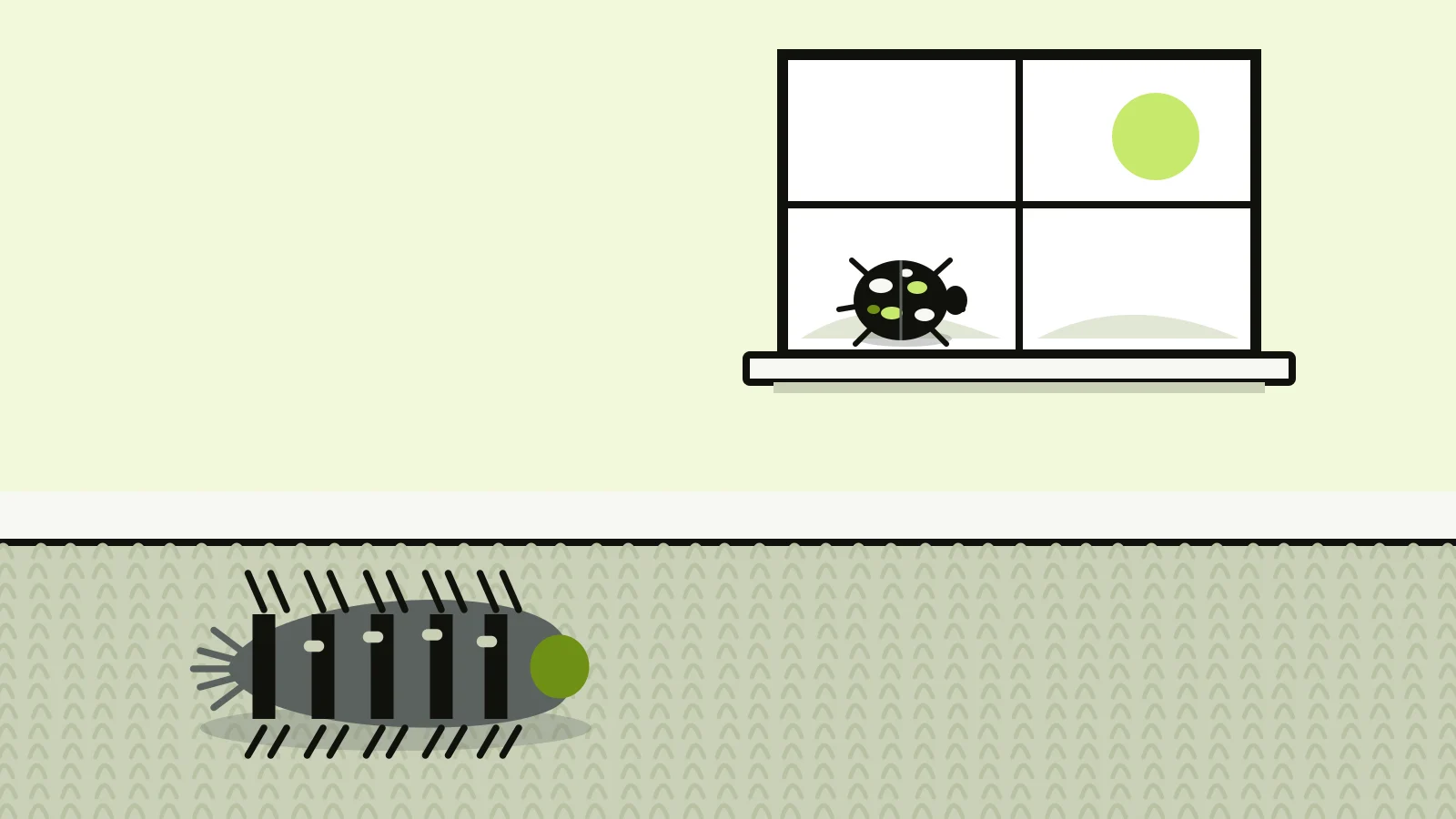
Small round, mottled beetles on a windowsill and short hairy larvae near the carpet are usually carpet beetles. The adults are harmless to fabric, but the larvae eat wool, fur and feathers. Clear the larvae, find the source, which is often an old bird nest, and treat only if they keep coming back.
By the Bestone pest control team · Contact us
Key takeaways
- The adults on your windowsill do no damage. The hairy larvae, called woolly bears, eat wool, fur, feathers and silk in dark corners.
- Clean holes, bristly husks and no silk point to carpet beetles. Silk tunnels or cases on the fabric point to clothes moths.
- Find the source first. Old bird nests in lofts and eaves are a common start, but it is an offence to disturb a nest in use or being built.
- Vacuum edges and crevices, dry clean or wash what you can, and freeze small items for two weeks at -18°C. Do not spray clothing or bedding.
- Our carpet beetle treatment starts from £149 for the first standard visit. Rooms and further visits are quoted, and your price is confirmed in writing before booking.
On this page
- Key takeaways
- Carpet beetles in the UK: the quick answer
- Adult carpet beetle vs larva
- What do carpet beetles look like? The three you are likely to find
- Which carpet beetle is it?
- Carpet beetle larvae in the UK: what woolly bears look like
- Signs of carpet beetles: holes, husks and dust
- Why are there beetles on my windowsill?
- The carpet beetle life cycle: how long it takes
- Carpet beetle or clothes moth? How to tell the damage apart
- Carpet beetle vs clothes moth
- Where are they coming from? Bird nests, lofts and other sources
- Can carpet beetles bite? Itchy skin and rashes
- How to get rid of carpet beetles: the cleaning routine
- Freezing, washing and what to do with each item
- What to do with each affected item
- Carpet beetle sprays and home treatments: what to use
- When do you need professional carpet beetle treatment?
- Can you deal with it yourself?
- Renting in London: who deals with carpet beetles?
- How to stop carpet beetles coming back
- What we do, and what it costs
- Carpet beetle treatment prices compared
- Common questions
Carpet beetles in the UK: the quick answer
A carpet beetle in the UK is most likely the varied carpet beetle, a tiny round insect that the Natural History Museum calls the most common of its group in Britain, and more common in London and the southern counties. You usually meet it in one of two ways: an adult walking up a window, or a short, hairy larva near a carpet edge or in a wardrobe.
The two stages matter very differently. The adult feeds on pollen and nectar and does no harm to your home. It is the larva, known as a woolly bear, that eats natural fibres. So a beetle on the windowsill is a reason to look, not to panic, and a woolly bear in a drawer is a reason to act.
Our recommendation is to spend your first half hour on a search, not on buying sprays. Check carpet edges, wardrobes and anything made of wool, then the loft if you can get into it safely. Most of what follows depends on what that search finds, and our carpet beetle treatment page lists what to tell us if you want help.
Adult carpet beetle vs larva
| Feature | Adult beetle | Larva (woolly bear) |
|---|---|---|
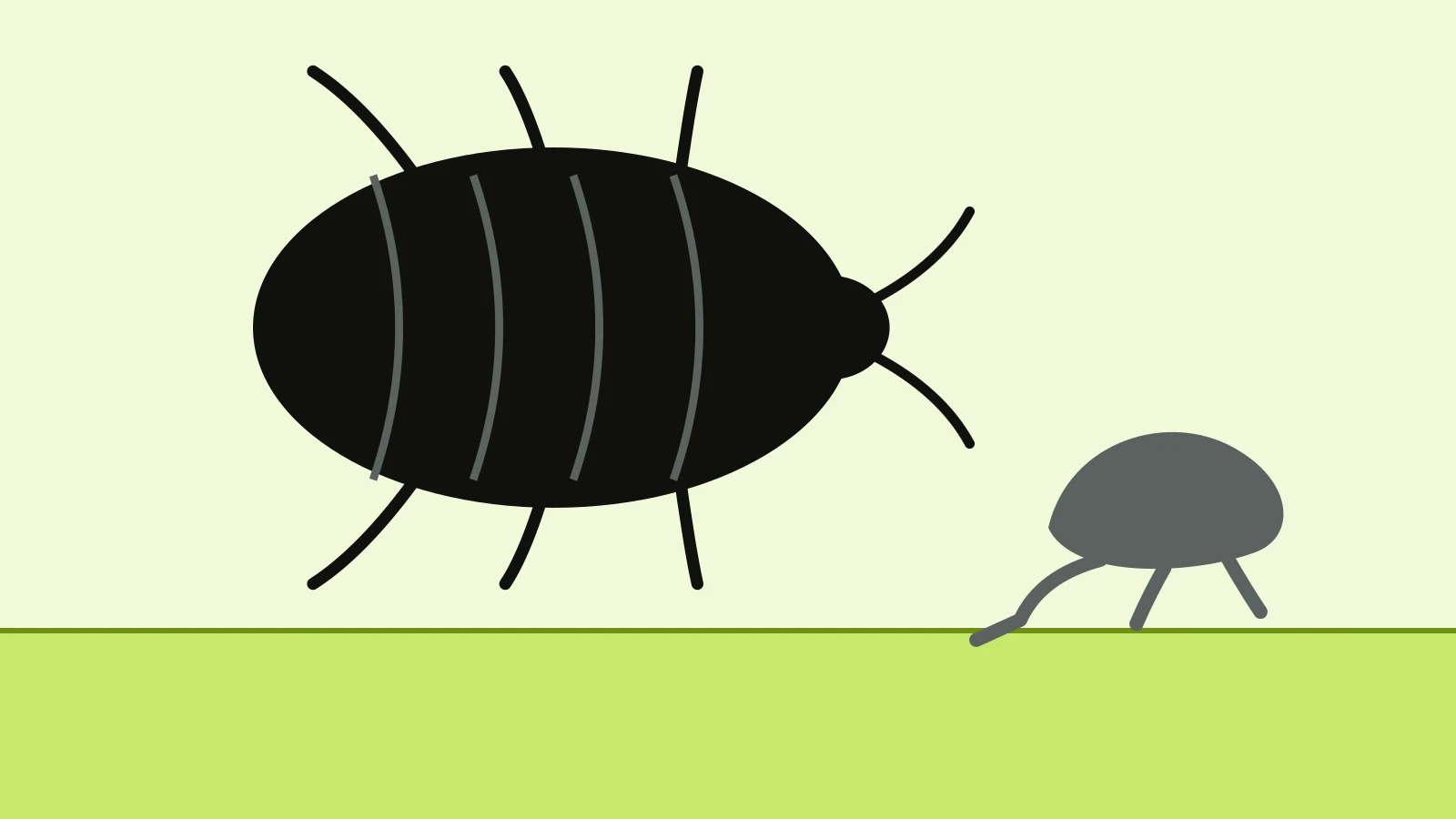
| Looks like | Small, round, with a mottled pattern of white, orange and black | Short, fat and hairy, with darker bands and tufts at the tail |
| Size | About 1.5 to 3.5 mm | Under 0.5 mm at hatching, 4 to 5 mm when grown |
| Where you see it | Windowsills, flowers, walking up glass | Carpet edges, skirting, drawers, wardrobes, under furniture |
| Eats | Pollen and nectar | Wool, fur, feathers, silk, hair and dead insects |
| Damages fabric? | No | Yes. This is the stage that does all the harm |
| Light | Drawn to it | Avoids it |
| What to do | Remove it, then check for larvae | Vacuum, find the source, treat affected items |
Figures for the varied carpet beetle from the Natural History Museum and English Heritage. Fareham Borough Council describes the response to light.
What do carpet beetles look like? The three you are likely to find
The Natural History Museum's guide covers three common household species. You do not need a microscope to separate them at home, and the treatment is the same, but the differences help when you describe what you have found. Size and shape do most of the work. A round beetle the size of a large pinhead is probably varied. A longer, dark beetle with two white spots is a fur beetle.
The brown carpet beetle is worth knowing about in London. The museum says it was first found in a small area around the capital after arriving in the 1970s, and it is now spreading in England. It is a warmth-loving insect that relies on central heating to survive this far north, so in a heated flat you can find it all year.
If you have one in hand, stick it to clear tape, put a ruler beside it and take a photo. A sharp photo with a scale is more useful to anyone helping you than a description. Do not worry about getting the species right. The museum says even larvae are reliably identified only at their final stage.
Which carpet beetle is it?
| Species | Adult | Larva | Worth knowing |
|---|---|---|---|
| Varied carpet beetle (Anthrenus verbasci) | 1.5 to 3.5 mm, round, white, orange and black patches | 4 to 4.5 mm, hairy, thick tufts at the tail | The usual windowsill beetle, common in London |
| Two-spot carpet beetle or fur beetle (Attagenus pellio) | 4.5 to 6 mm, oval, dark, two white spots | Up to 6.5 mm, torpedo-shaped, banded, two long orange tail tufts | Often moves from nests into houses, and damage often starts at seams |
| Brown carpet beetle (Attagenus smirnovi) | 2 to 5 mm, oval, brown to reddish-yellow | Up to 8 mm, torpedo-shaped, bronze-brown, avoids light | Found in carpets and floor fluff, and active all year in heated buildings |
All figures from the Natural History Museum. The two Attagenus larvae can look like very dark silverfish.
Carpet beetle larvae in the UK: what woolly bears look like
Most people searching for carpet beetle larvae have just found something small and furry on a skirting board and want to know what it is. English Heritage describes a varied carpet beetle larva as short and fat with bands of darker hairs, and the Natural History Museum adds thick tufts of backward-growing hairs on the last three segments, with a light brown to orange head. Grown larvae reach about 4 to 5 mm, so one can look like a bit of fluff until it walks.
Newly hatched larvae are under 0.5 mm, and English Heritage notes they can get into cupboards and drawers through very small cracks. That is why a closed wardrobe is not safe. Once larger, they wander and may attack more than one object, so finding one on a wall or ceiling does not mean the source is right there.
There are a few look-alikes. A larva that is long, dark and shiny with long tail tufts is more likely an Attagenus species, and people often mistake those for silverfish. A pale, smooth larva with a brown head in a wardrobe is more likely a clothes moth. Treat any hairy larva gently: pick it up with tape or a tissue rather than bare fingers, for the reasons in the skin section below.
Signs of carpet beetles: holes, husks and dust
Husks are often the first thing you find. As larvae grow, they shed empty, hairy skins, and Waltham Forest Council notes that cast skins may be more plentiful than the larvae themselves. They look like tiny brown, bristly shells. If you sweep a line of them from under a skirting or out of a folded blanket, you have found a feeding site.
The damage itself is tidy. The Natural History Museum describes small, clean holes without silk webbing, along with powdery droppings and see-through cast skins. English Heritage calls them neat holes, and adds that pellets of droppings, called frass, collect under or near the item. On a carpet, look for bare patches where the pile comes away, usually along edges and under furniture that is rarely moved.
- Check carpet edges: fold back a corner if it lifts easily, and run a torch along the gripper and skirting.
- Look under beds, sofas and heavy furniture, where fluff and hair build up undisturbed.
- Open folded wool, cashmere, silk, fur and felt, paying attention to seams, collars and cuffs.
- Squeeze feather pillows, duvets and cushions, and look for larvae, husks or holes around the seams.
- Check suitcases, boxes and storage bags, as Waltham Forest Council advises.
- Look in wall gaps, under floorboards and around pipe cupboards, and note any dead flies, which larvae also eat.
- Check the windows every few days. Adults gathering there can suggest a source indoors.
Why are there beetles on my windowsill?
Adults have two reasons to be at your window. Fareham Borough Council says they are attracted to light, and the Natural History Museum says they are often found on windowsills trying to get outside, where they feed on pollen and nectar. So a beetle on the glass may have just flown in from flowers, or it may have just emerged indoors and be trying to leave.
Timing and numbers tell you which is more likely. English Heritage says adults are often found outdoors in late spring and early summer, mating on flowers such as hogweed and spirea, and Waltham Forest Council says they favour white or cream flowers. One or two in May, in a home with a garden or window boxes nearby, is ordinary. They can come in through small openings, and females lay eggs indoors.
A steady number over several weeks, beetles in rooms without an open window, or beetles out of season in a heated home are stronger signs. Waltham Forest Council says adults flying around windows may indicate an infestation. Our recommendation: count them for a fortnight and search for larvae either way. Fly screens or closing windows near flowering shrubs may help in May and June, but they do nothing about larvae already inside.
The carpet beetle life cycle: how long it takes
All carpet beetles go through four stages: egg, larva, pupa and adult. Waltham Forest Council says a female may lay 40 to 90 eggs depending on species. Eggs go into cracks and lint close to food. Hatching times vary between sources: Waltham Forest says 8 to 15 days, while Cotswold District Council says 10 to 30 days. Plan around the longer figure.
The larval stage is the long one, and sources differ here too. Outdoors, the Natural History Museum says the varied carpet beetle takes two summers, pupating in its second spring, but indoors the cycle can finish in one year. English Heritage says larvae may take one or two years to complete their growth. Fareham Borough Council gives about a year. Larvae need 15 to 25°C to develop and rest during winter, and adults then live for just 2 to 6 weeks.
The practical lesson is that what you see now was started months ago. Beetles at the window in May laid the eggs that become the larvae you find in autumn. It also explains why a single clean rarely finishes the job: eggs that were out of reach hatch later, and a mild, heated home keeps larvae going. Keep checking for at least two months after you first clear an area.
- 1. Adults appear in spring and early summer, and live 2 to 6 weeks
- 2. Eggs sit in cracks and fluff, and hatch in 8 to 30 days
- 3. Larvae feed for months, and this is when the damage happens
- 4. Larvae rest in winter, then pupate in spring
Carpet beetle or clothes moth? How to tell the damage apart
Both pests eat the same things, and both can be in the same wardrobe, so people often treat the wrong one. Look for silk first. Carpet beetles leave none. Clothes moth larvae leave plenty: the Natural History Museum says the common clothes moth spins silk tunnels, sometimes forming dense mats, while the case-bearing moth carries a small silk case as it grows.
Then look at the pattern of damage. The University of California's pest programme says carpet beetles tend to damage a large area in one part of a garment or carpet, whereas moths usually make scattered holes. That is a US source and a rule of thumb, but it matches the museum's descriptions. Moth larvae also leave trails across wool and strip hair from the base of fur.
Size helps as well. A clothes moth larva can reach 12 to 13 mm, nearly three times the length of a woolly bear, and it is white and smooth rather than brown and hairy. If you see small golden moths running across fabric instead of flying, the museum's description of the common clothes moth fits. Our moth treatment page covers those.
If you find signs of both, treat them together. The cleaning, storage and freezing advice in this guide applies to each, and English Heritage notes that clothes moths also live naturally in bird and animal nests, so a loft nest can feed both.
Carpet beetle vs clothes moth
| Clue | Carpet beetle | Clothes moth |
|---|---|---|
| Silk | None | Tunnels, mats or small portable cases |
| Holes | Small, clean, often in one area | Scattered holes and trails over the surface |
| Left behind | Bristly brown husks and powdery droppings | Webbing, cases and droppings |
| Larva | About 4 to 5 mm, hairy and banded | Up to 12 to 13 mm, white, brown head |
| Adult | Round beetle, 1.5 to 3.5 mm, flies to windows | Small moth, 9 to 17 mm wingspan, scrambles over fabric |
| Adult feeding | Pollen and nectar outdoors | Does not feed at all |
| Where to look first | Carpet edges, floor gaps, lofts, windowsills | Dark wardrobes, under furniture, stored wool |
From the Natural History Museum, English Heritage and University of California IPM.
- 1. Woolly bear: short, fat and hairy, about 4.5 mm when grown
- 2. Clothes moth larva: pale and smooth, up to 13 mm, with a brown head
- 3. Beetle damage: clean holes, often in one area, with husks and no silk
- 4. Moth damage: silk tunnels or cases, with scattered holes and trails
Where are they coming from? Bird nests, lofts and other sources
If larvae keep turning up, something is feeding them, and it is often above you. Bird and mammal nests are their natural home, according to the Natural History Museum. Fareham Borough Council describes a route that fits many houses: larvae first infest roof insulation near old nests in the eaves, then spread down pipes into the cylinder cupboard and similar areas. From there it is a short walk to a bedroom carpet.
English Heritage adds wasp nests and animal burrows to the list, along with dead insects, especially flies. Lofts collect all of these. Check for old nests above the eaves, dead flies along the insulation, and any wool lagging, which English Heritage suggests replacing with a synthetic material. Waltham Forest Council also lists stored cereals, pet food and powdered milk as possible food, so check a forgotten bag of pet biscuits as well.
In a flat, you may have no loft of your own. Tell your managing agent if you find larvae near a shared roof void, and check balconies and air bricks for pigeon nesting material. Beetles can also come in on things you bring home: Waltham Forest Council says eggs and larvae may be carried in on items containing wool or other animal fibres, so a second-hand rug needs a good look before it goes down.
Can you remove a bird nest from your loft? Only when it is not in use, and that needs checking first. Under section 1 of the Wildlife and Countryside Act 1981, it is an offence in England and Wales to intentionally take, damage or destroy the nest of any wild bird while it is in use or being built, or to take or destroy an egg. GOV.UK says each offence can carry an unlimited fine and up to six months in prison. A few rare species have further protection, though you are unlikely to find them in a London roof.
Our recommendation: never touch a nest with eggs, chicks or birds coming and going, whatever time of year it is. Wait until the birds have clearly finished, and look again before you remove anything. If you are unsure, leave it and ask. GOV.UK says to time work outside the breeding season where possible, and its page does not spell out when an empty nest can go, so check with Natural England if there is any doubt.
Once a nest is plainly old and empty, the Natural History Museum advises removing it and blocking the cavity, for example with wire netting. Wear gloves and a dust mask, bag the material inside the loft, and seal the bag before you carry it through the house. Take care on the joists too, and do not reach for a nest from a ladder alone.
One serious warning for older homes. HSE says loose-fill asbestos insulation can be found in loft spaces, looks loose and fluffy like candyfloss, and may be blue-grey or whitish. It calls this probably the most dangerous asbestos material. If you see anything like that, stop, leave it alone and get advice. Never vacuum or pull up loft insulation you cannot identify. Some council advice says to remove infested lagging, which is sound only when you know what the material is. Likewise, treat any wasp nest as live unless you know otherwise, and read our wasp nest removal guide first.
- 1. Old bird nests in the eaves or loft
- 2. Loft insulation, wool lagging and dead flies
- 3. Pipe runs and the cylinder cupboard
- 4. Wardrobes and stored wool
- 5. Carpet edges, skirting and under furniture
- 6. Windowsills, where adults gather
Can carpet beetles bite? Itchy skin and rashes
None of the sources we read describes carpet beetles as biting insects, and the NHS page on insect bites does not list them. So if you have marks on your skin, do not assume a beetle or larva caused them. Sources differ on the wider question. Leeds City Council says carpet and fur beetles are not a risk to health. A 2020 scientific review in PeerJ reports something more specific: the fine hairs on these larvae have been linked to dermatitis, or skin inflammation, in case reports, and to breathing problems when inhaled. The authors say this rash may be under-recognised because it looks like other bites, but they do not class the hairs as a major hazard.
We cannot tell you what is causing a rash, and the NHS has no page specifically on carpet beetles. The nearest NHS guidance is on hives and contact dermatitis. The NHS describes hives as an itchy rash of raised bumps or patches, which may sting or burn, and says the colour can be harder to see on brown and black skin. It says contact dermatitis can cause itchy, dry or cracked skin, usually within hours or days of contact with a trigger. Light skin may turn red, and darker skin may turn dark brown, purple or grey.
Other causes are common, so tell the pharmacist or GP what you have found at home. The NHS says scabies causes intense itching, usually worse at night, with a raised rash or spots, often between the fingers or around the wrists. If bites are the main problem, our guide to bed bugs vs fleas will help you check the bedding and pets.
- Keep the area clean, do not scratch, and avoid handling larvae or husks with bare hands.
- Ask a pharmacist about antihistamines or emollients. Tell them about long-term conditions and check before giving anything to a young child.
- See a GP or call NHS 111 if a rash has not improved after 2 days, spreads, keeps coming back, or comes with a high temperature or swelling under the skin.
- Call 999 if lips, mouth, throat or tongue suddenly swell, breathing is fast or difficult, the throat feels tight, skin or lips turn blue, grey or pale, or someone faints or becomes suddenly confused or drowsy.
How to get rid of carpet beetles: the cleaning routine
This is the core of any carpet beetle removal, and the part that treatment cannot replace. Larvae live on fluff, hair and dead insects as well as on your wool, so taking those away removes food, larvae and eggs together. The University of California's guidance goes as far as saying insecticide may be unnecessary if food sources are removed and the area is kept clean. Set aside a morning for each affected room, and work from the top of the room to the floor.
- Do not clean affected textiles yet. Bag them first, as English Heritage advises, so you do not shake eggs and larvae around the room.
- Throw out anything heavily infested. The Natural History Museum recommends this, and it costs less than treating a worn-out rug.
- Pull furniture away from the walls and vacuum behind it, using a narrow nozzle.
- Vacuum along skirting boards, under carpet edges, between floorboards and around any spider webs, as the museum lists.
- Clean out drawers, wardrobe floors, shelf corners and the cylinder cupboard.
- Vacuum both sides of rugs, and under cushions and sofa bases.
- Empty the vacuum at once, as Cotswold District Council says, sealing the contents in a bag and putting it in an outside bin. Bags and cups can hold live eggs and larvae.
- Repeat every few days for two weeks, then weekly for at least six more weeks.
Freezing, washing and what to do with each item
Freezing works, and it avoids chemicals on clothes, but the time needed is not agreed. The Natural History Museum's carpet beetle guide says a deep freezer at -18°C for a day or two, while its clothes moth guide says a week at -20°C. English Heritage, which works with historic textiles, says -18°C to -20°C for 14 days, or -30°C for 3 days, and notes that dense items can take at least 24 hours to get cold in the middle. Use the longer figure: two weeks at -18°C costs nothing extra and leaves no doubt.
Seal items in plastic bags with the air pressed out. Keep them away from food if you can. Afterwards, leave them sealed for at least 24 hours, or 48 for very thick items, so that condensation forms on the bag and not on the fabric. Then shake them out outdoors, brush them and vacuum them. English Heritage also says not to use auto-defrost freezers, and many kitchen freezers are frost-free, so check yours. For anything valuable or fragile, ask a conservator first, as materials can turn brittle when very cold.
Washing is simpler where the care label allows. The University of California's guidance says hot-water laundering or dry cleaning kills all life stages, though it gives no temperature for this, and no UK source we read does either. Use the hottest wash the label allows. Most wool will not take a hot wash, so dry clean it or freeze it. We do not recommend heating items in a home oven. The Natural History Museum gives 49°C for over 30 minutes for clothes moths, but ovens scorch fabric and risk fire.
What to do with each affected item
| Item | Our recommendation | Why |
|---|---|---|
| Wool jumpers, scarves, cashmere | Dry clean, or freeze for 14 days | Hot washing shrinks wool |
| Cotton and washable items | Hottest wash the label allows | Clean cotton is rarely eaten, but stains attract larvae |
| Feather pillows and cushions | Wash if the label allows, or freeze. Replace if holes appear | Larvae bore out through covers |
| Wool rugs | Vacuum both sides, then specialist cleaning or commercial freezing | Too large for a home freezer |
| Fitted carpets | Vacuum edges and gripper, then treat if larvae persist | The larvae sit at the edges and underneath |
| Upholstered furniture | Vacuum seams and base, and get treatment advice | Cannot be frozen at home |
| Fur, felt and leather | Ask a specialist cleaner or conservator | Easily damaged |
| Taxidermy, antiques, heirlooms | Bag it and ask a conservator | English Heritage suggests low-oxygen treatment for sensitive objects |
| Heavily eaten, low-value items | Bag and bin | Costs less than treating them |
Based on English Heritage and the Natural History Museum, plus University of California IPM on laundering.
Carpet beetle sprays and home treatments: what to use
Sprays are the last step, not the first. English Heritage explains why with clothes moths: insecticides kill larvae only if they make contact, and larvae hide where sprays do not reach. Sources also differ on DIY use. Leeds City Council says you can buy insecticide from a DIY or garden centre and follow the instructions, while Cotswold District Council's fact sheet says the final stage should be professional treatment with a residual insecticide.
Our view is that a shop product is reasonable for one small area after a thorough clean, in a home without babies, crawling children, or anyone with breathing problems. Use only a product labelled for carpet beetles or crawling insects. Apply it to carpet edges and floor gaps, not to anything you wear or sleep in. The University of California says not to spray clothing or bedding. If you have pets, follow the label closely: Waltham Forest Council says to keep pets and children away from insecticides. Cats need particular care, as Cats Protection warns that some dog flea products contain a chemical toxic to cats, so do not assume an insect product is safe around them.
HSE says the label is your main guide, and that you should not add extra to make a product stronger. Professional products need trained users and should not be bought for home use. Keep products in the original container, out of reach of children and pets, and never pour them down a sink or drain. Varied carpet beetle treatment does not differ from treatment for the other species, so you do not need a special product for it.
Skip the old remedies. English Heritage says many moth ball formulations are now banned or not recommended, and that lavender and cedar last three months at most and have no effect on larvae inside clothes or carpets. Pheromone traps are a monitoring tool, not a cure: the University of California says they help locate the source and track progress, and that they work only for a given species. A plain sticky trap on a windowsill is a cheap way to see if adults are still appearing.
When do you need professional carpet beetle treatment?
A small, recent problem in one room can usually be handled at home. You should bring someone in when the search does not find a source, when larvae keep appearing after a full clean, or when the items at risk are worth more than the treatment. Use the table below. If you are not sure what you have, a pest inspection answers that before you spend on anything else.
Professional work adds three things: a trained search of the places larvae are hiding, products and application that a householder cannot use, and a plan timed to catch the next hatch. English Heritage notes that repeat treatment may be needed to catch survivors, and Cotswold District Council says a residual treatment will also kill larvae hatching over the following few weeks. That is why two visits are often more useful than one.
Can you deal with it yourself?
| What you have found | Likely meaning | What to do |
|---|---|---|
| One or two beetles at a window in spring | Probably adults from outside | Remove them, check nearby carpet edges, count for two weeks |
| Beetles at windows for weeks, in several rooms | Possibly breeding indoors | Do a full search, including the loft |
| A few larvae or husks in one place | A small, local feeding site | Clean, bag and freeze, then check for two months |
| Larvae in more than one room | Spreading, or a hidden source | Check for nests, and get an inspection |
| Larvae back after a thorough clean | Eggs or a source you have not reached | Book treatment |
| Bare patches along a fitted carpet | Established larvae under the edge | Book treatment, and tell your landlord if you rent |
| Old nest or dead birds in the roof | A likely source | Check it is empty, remove it, then clean. Ask for help if access is unsafe |
| Valuable rugs, fur or antiques affected | Costly to get wrong | Stop, bag items, and ask a specialist or conservator |
| Rash or breathing symptoms | Cause unknown | Speak to a pharmacist, GP or NHS 111 first |
Renting in London: who deals with carpet beetles?
Citizens Advice says responsibility for an infestation depends on the cause and on your tenancy, and its guidance applies to England. Your landlord will probably be responsible if the tenancy says they must keep the home in a good and habitable state, or if the infestation came from repairs they failed to make. You may be responsible if you caused it or failed to prevent it. It does not matter whether the problem was there when you moved in. Landlords usually have to act only once they know, so report it promptly and in writing, with photos.
Carpet beetles tend to raise two practical questions. A nest in the roof, or a gap that lets birds in, is about the building, so raise it with the landlord or freeholder. A wool rug you brought with you is more likely your own job. If you rent from a council or housing association, report it to your housing officer and ask what is covered. Citizens Advice adds that your council can act on infestations that are a statutory nuisance or health hazard.
Landlords should treat early reports as cheap reports. A fitted wool carpet eaten along the edges costs far more to replace than a visit does. If you are moving out, keep any treatment record, and read our end of tenancy cleaning checklist, since dust and fluff left behind are exactly what larvae feed on between tenants.
How to stop carpet beetles coming back
Prevention comes down to food, storage and access, and it takes very little time once you have a routine. Larvae survive in undisturbed places, so the aim is to disturb those places regularly. Waltham Forest Council's list of food includes hair, feathers, wool and even stained fabric, so clean items are safer than worn ones.
- Vacuum under beds, behind sofas and along skirting at least monthly, and move heavy furniture twice a year.
- Clean wool, silk and fur before storing it. Then seal it in polythene bags or airtight boxes, as the Natural History Museum advises.
- Open stored items twice a year, in spring and autumn, and look for husks.
- Check the loft each autumn for empty nests and dead flies. If you have mice or rats up there, their nests matter too: see how to get rid of mice.
- Once a nest is out and the birds have gone, block the gap with wire mesh, and clear any dead birds or animals.
- Inspect second-hand rugs, wool blankets and vintage clothes. Freeze them for two weeks before they join your own things.
- Keep pet food, flour and cereals in sealed containers.
- Keep up with windowsill checks from March to June, when adults are most likely to be seen.
What we do, and what it costs
You do not need to know the species before you contact us. Tell us what you have found, which rooms are affected, what the carpets and furnishings are made of, and whether there is loft access. A photo with a ruler beside it helps. We then confirm the price, the number of visits, the preparation and what is included in writing before any work is booked.
Our carpet beetle treatment starts from £149 for the first standard visit. Rooms and further visits are quoted, because the carpets and access make a real difference. As a guide, our general pest packages for a 1-bed home are £90 to £120 for a single visit with no guarantee, £160 to £190 for two visits with a 1-month written guarantee, and £210 to £230 for three visits with a 3-month written guarantee. Our prices page lists the larger property sizes, and your quote may differ.
With only a small area affected, we would rather you tried the cleaning steps first. If larvae are coming back, a 2-visit package usually makes more sense than a single visit, as the follow-up gives a chance to catch what hatches later. Packages include a safety report, follow-up and proofing advice. We are based on Clements Road in Ilford, cover London through our pest control service including Ilford, and carry public liability insurance. Phone lines are open Monday to Saturday, 8am to 8pm.
Council services are a fair comparison, and we would check yours before booking. Prices below were on the councils' websites on 1 November 2026. For a wider view, read our guide to pest control costs, and contact us if you want a quote to compare.
Carpet beetle treatment prices compared
| Provider | Price | What it covers |
|---|---|---|
| Waltham Forest Council | £115 | One room, two visits. Extra rooms £16.50 each |
| Lambeth Council | £189.60 | One visit, up to two rooms. £75.60 per extra visit or room |
| Leeds City Council (outside London) | £76 | Carpet or fur beetle treatment, including VAT |
| Bestone, first visit | From £149 | First standard visit. Rooms and further visits quoted |
| Bestone, 1-bed guide | £160 to £190 | Two visits, general pest package, 1-month written guarantee |
| Bestone, 2-bed guide | £180 to £220 | Two visits, general pest package, 1-month written guarantee |
| Bestone, 3-bed guide | £190 to £240 | Two visits, general pest package, 1-month written guarantee |
Council prices from each council's website. Bestone figures are package ranges, not a fixed carpet beetle price. Your price is confirmed in writing before booking.
Common questions
Are carpet beetles harmful to humans?
Leeds City Council says they are not a risk to health, and the adults are harmless. However, a 2020 scientific review links the larvae's hairs to skin rashes in case reports, so speak to a pharmacist or GP about any rash. Our section on carpet beetles and itchy skin follows NHS advice.
Why do I keep finding small round beetles on my windowsill?
Adult carpet beetles are drawn to light and, indoors, are often found trying to get outside. A few in spring may have flown in, but a steady stream can mean they are breeding indoors. Check for larvae using our guide to carpet beetle signs.
What kills carpet beetle larvae?
Vacuuming removes them, dry cleaning or hot washing kills them on washable items, and two weeks at -18°C kills them in small sealed items. Insecticide works only where it reaches them. If they keep appearing, look at carpet beetle treatment.
How long does it take to get rid of carpet beetles?
Expect weeks rather than days, because eggs can take up to 30 days to hatch and larvae hide in gaps. Keep cleaning and checking for at least two months, through any new hatch. If you see more larvae after that, book a pest inspection.
Do carpet beetles live in beds?
They do not feed on people or live on you the way bed bugs do, but larvae can feed on feather pillows, wool blankets and fluff under the bed. If you are waking up with new itchy marks and finding dark spots on the mattress, read bed bugs vs fleas too.
Can carpet beetles eat cotton or synthetic carpets?
The Natural History Museum says larvae do not feed on entirely synthetic fabrics, and English Heritage says clean cotton is not normally attacked. Stained cotton is at more risk, and they can feed on the fluff and hair in a synthetic carpet. Keep food and dirt off fabrics, as our moth treatment page also advises.
Does one carpet beetle mean an infestation?
Not on its own, particularly in spring and early summer when adults fly in from flowers. Remove it, then spend ten minutes checking carpet edges, wardrobes and the nearest window. If you find larvae or husks, contact us with a photo.
Are carpet beetles a sign of a dirty house?
No. They live in bird nests, feed on fluff and hair that build up in any home, and can fly in through small gaps. Clean homes get them too, especially near old nests or wool rugs. Our pest control page lists the other insects we treat.
How much does carpet beetle removal cost in London?
Council prices we checked include £115 for one room over two visits in Waltham Forest and £189.60 for one visit in Lambeth. Our carpet beetle price is a property-specific quote, confirmed in writing before booking. See our prices for the package ranges.
Sources
Figures differ a little between sources, so ranges are given where they do. Sources reviewed on 1 November 2026.
- Natural History Museum: carpet beetles identification guidenhm.ac.uk(opens in a new tab)
- Natural History Museum: clothes moths identification guidenhm.ac.uk(opens in a new tab)
- English Heritage: varied carpet beetle fact sheetenglish-heritage.org.uk(opens in a new tab)
- English Heritage: clothes moths, prevention and controlenglish-heritage.org.uk(opens in a new tab)
- English Heritage: freezing guidelines for controlling an insect pest infestationproduction.english-heritage.org.uk(opens in a new tab)
- NHS: insect bites and stingsnhs.uk(opens in a new tab)
- NHS: hivesnhs.uk(opens in a new tab)
- NHS: contact dermatitisnhs.uk(opens in a new tab)
- NHS: scabiesnhs.uk(opens in a new tab)
- Ruzzier, Kadej and Battisti (2020): dermestid beetle hastisetae, PeerJpmc.ncbi.nlm.nih.gov(opens in a new tab)
- Waltham Forest Council: carpet beetle fact sheetwalthamforest.gov.uk(opens in a new tab)
- Waltham Forest Council: pest control serviceswalthamforest.gov.uk(opens in a new tab)
- Lambeth Council: pest control priceslambeth.gov.uk(opens in a new tab)
- Cotswold District Council: carpet beetles fact sheetcotswold.gov.uk(opens in a new tab)
- Fareham Borough Council: carpet beetles or fur beetlesfareham.gov.uk(opens in a new tab)
- Leeds City Council: pest controlleeds.gov.uk(opens in a new tab)
- Wildlife and Countryside Act 1981, section 1legislation.gov.uk(opens in a new tab)
- GOV.UK: wild birds, protection, surveys and licencesgov.uk(opens in a new tab)
- HSE: locations of asbestos and taking the right actionhse.gov.uk(opens in a new tab)
- HSE: using pesticides in your garden, home or allotmenthse.gov.uk(opens in a new tab)
- Citizens Advice: if there are pests or vermin in your rented homecitizensadvice.org.uk(opens in a new tab)
- Cats Protection: fleascats.org.uk(opens in a new tab)
- University of California IPM: carpet beetles (US guidance)ipm.ucanr.edu(opens in a new tab)
Want it dealt with?
Tell us what you have seen, the rooms and your postcode. You do not need to know which pest it is. We confirm the price in writing before any work is booked.