Pest Control · 31 min read · Updated 1 November 2026
Wasp Nest Removal: Costs, Safety and When to Call a Pro
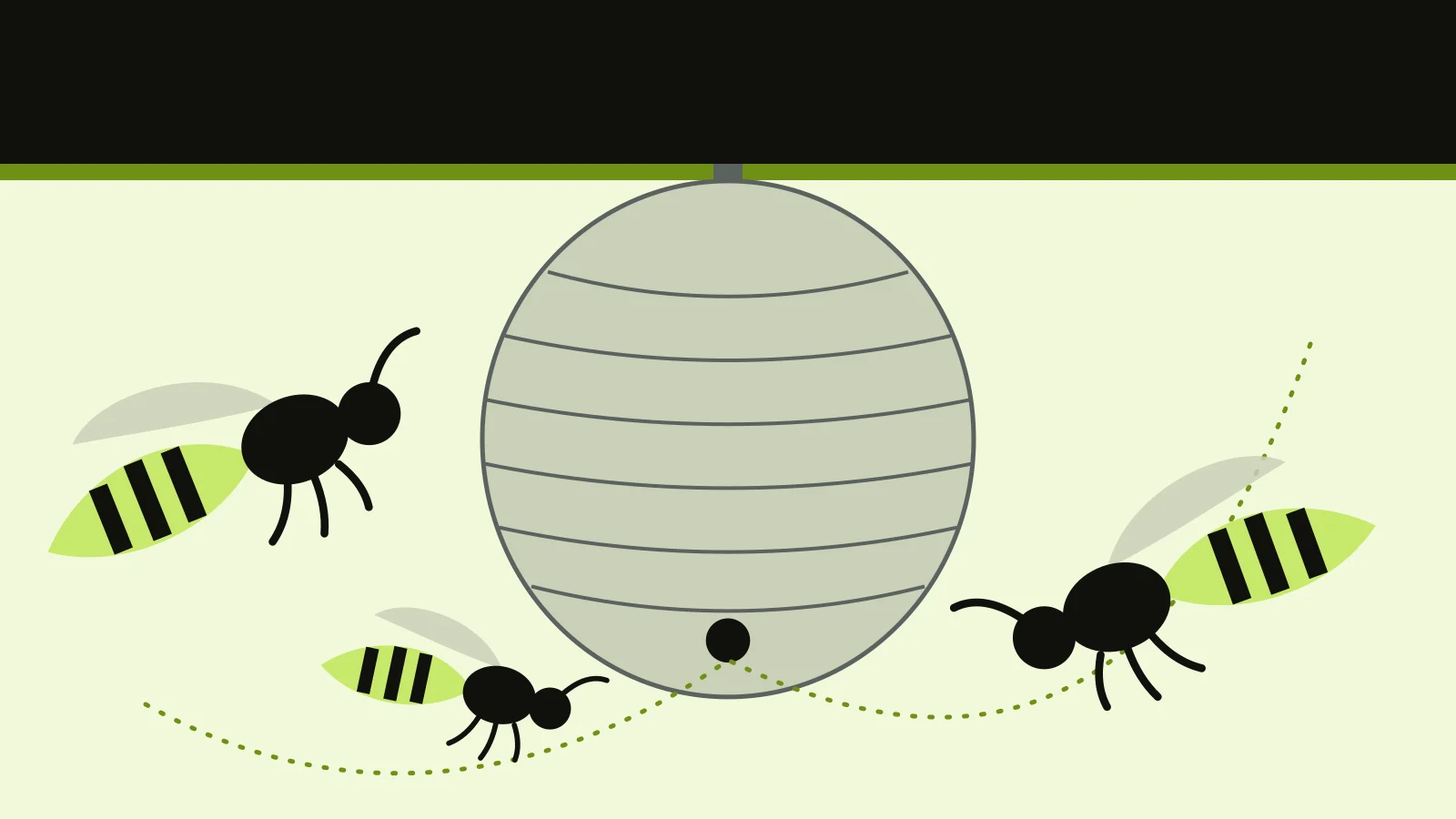
Wasp nest removal is only needed if the nest is causing a problem. If it is out of the way, you can leave it, because the colony dies in autumn and the nest is not reused. If it is near a door, path or play area, or anyone at home has reacted badly to a sting, have it treated by a professional. Do not block it or knock it down, and check it is not bees first.
By the Bestone pest control team · Contact us
Key takeaways
- A wasp nest only needs dealing with if it is causing a problem, such as being near a door, path, play area or someone with a sting allergy. Otherwise it can be left, because the colony dies in autumn and the nest is not reused.
- Check that they are wasps first. Bees need a different response, and insecticide should never be used on them.
- Do not block the entrance, knock the nest down or work on a ladder near it. If a nest is in a loft, wall or roofline, leave it to a professional.
- London council fees we checked run from £86.15 to £95 for one nest. Our wasp nest treatment starts from £90 per nest, and the price is confirmed in writing before booking.
- Call 999 straight away if someone who has been stung has swelling of the lips, mouth, throat or tongue, or is struggling to breathe.
On this page
- Key takeaways
- Wasp nest removal: do you actually need it?
- Wasps or bees? Check before anyone treats it
- Wasps, bees and hornets compared
- Where do wasps nest in UK homes?
- The wasp season from spring to autumn
- Do wasps reuse old nests?
- Can you get rid of a wasp nest yourself?
- DIY or professional? A quick check
- What not to do to a wasp nest
- What happens when a wasp nest is treated?
- How much does wasp nest removal cost in London?
- Wasp nest prices compared
- Council wasp control or a private company?
- Council or private: which fits your nest?
- Wasp sting first aid: what the NHS says
- After a sting: who to contact
- Anaphylaxis: the signs and what to do
- Hornets and Asian hornets
- Renting, flats and neighbours' nests: who deals with it?
- How to keep wasps away next year
- What we do, and what it costs
- Common questions
Wasp nest removal: do you actually need it?
Wasp nest removal is not always necessary, and that surprises most people who have just found one. The RHS advises leaving nests alone where possible. Hastings Borough Council and Maldon District Council say the same if the wasps are not causing a problem. A colony lasts for one season, and in the meantime its workers feed caterpillars and aphids to their grubs, so a nest at the far end of a garden is doing some good.
The question to ask is not whether there is a nest, but whether people will keep crossing its flight path. The RHS points out that nests become a hazard when they are disturbed, and gives compost bin emptying, hedge trimming, mowing rough grass and weeding as examples. A nest becomes a real problem when normal life brings you close to it.
We recommend having a nest treated if any of the points below applies. If none does, keep your distance, tell the household where it is, and let the season finish it off.
- The entrance is beside a door, window, path, gate, bins or a parking space you use every day.
- It is near a play area, a garden seat or anywhere children or pets spend time.
- Anyone at home, or a regular visitor, has had a serious reaction to a sting.
- Wasps are getting into rooms, usually from a loft or through a wall vent.
- Someone needs to work near it, for example a roofer, gardener or window cleaner.
- It is early or mid summer and the nest will keep growing near a place you use.
Wasps or bees? Check before anyone treats it
Do this first, because the right answer for wasps is the wrong answer for bees. Insecticide is for wasps. Rochdale Council tells people not to put chemicals or other products on a honey bee swarm, and the Bumblebee Conservation Trust generally advises leaving bumblebee nests where they are. Councils are strict about the difference: Chelmsford City Council treats wasps but not bees, and it still charges its call-out fee if bees are what the officer finds. West Lothian Council says the same about masonry bees.
You can usually tell from a few metres away, so do not go closer than you need to. Wasps look smooth and shiny. Hastings Borough Council describes black and yellow stripes with a sharply tapered abdomen, and the RHS notes that wasps are slimmer and less hairy than bumblebees. Bees look furry. Rochdale Council describes honey bees as having a furry chest, and their colour ranges from honey to very dark, so do not rely on colour alone.
What they are doing matters as well. Thousands of insects hanging in a cluster from a branch or fence are a honey bee swarm. They are resting while scouts look for a new home, and Rochdale says most swarms are not aggressive. Lots of small insects around a sunny wall in April or May are usually masonry bees, as West Lothian points out. Insects going in and out of a bird box or a hole under long grass may be bumblebees.
If it is bees, keep people and pets away and leave them alone. Torfaen Council and Rochdale Council both point people to the British Beekeepers Association's swarm collector map, and collectors are usually volunteers, though they may ask for expenses. Rochdale warns that they may not be free straight away and may not be able to reach awkward spots, so bees in a wall or roof need a different plan. Our bee removal page explains what to tell us. Send a photo if you are unsure which insect you have.
Wasps, bees and hornets compared
| Insect | How it looks | What you usually see | What to do |
|---|---|---|---|
| Common wasp | About 15 mm, slim, shiny, black and yellow | Steady flight to one gap, roofline or hole; a papery nest | Leave it if it is out of the way; have it treated if it is not |
| Honey bee | Furry chest; honey-coloured to very dark | A cluster on a branch or fence, usually May to July | Keep away, use no chemicals, find a swarm collector |
| Bumblebee | Round, very hairy | Bees using a bird box, roof gap or hole under long grass | Usually leave in place until the nest finishes |
| Masonry bee | Small bees around walls | Numbers around soft mortar in April and May | Not treated as wasps; ask before booking anyone |
| European hornet | Workers up to 25 mm, chestnut-brown and yellow | Tree holes and dark cavities; papery nest | Keep away; treat as a job for a professional |
| Yellow-legged (Asian) hornet | Very dark body, wide orange band, yellow leg ends | Rare; found mostly in Kent and East Sussex | Do not go near it; report it with a photo if safe |
From Redbridge, Hastings, Rochdale and West Lothian councils, the RHS, the Bumblebee Conservation Trust and GOV.UK.
- 1. Wasps look slim, smooth and shiny, with a sharp waist
- 2. A nest that is out of the way can be left until it dies off
- 3. A hanging cluster is a swarm: find a collector
- 4. Bees never get wasp treatment: no insecticide
Where do wasps nest in UK homes?
Common wasps like dark, dry cavities with a small way in. Redbridge Council lists roof spaces, cavity walls and holes in trees or the ground, and Oxford City Council adds airbricks, garden sheds and soil banks. The RHS explains the split: the familiar Vespula wasps usually nest underground or in dark cavities, while Dolichovespula species nest out in the open on buildings, trees and shrubs. That is why some people find a nest hanging under the eaves and others only ever see a stream of wasps vanishing into a wall.
In London the pattern of housing matters. A terrace with a shared roof void, a converted loft or a flat under a pitched roof gives wasps plenty of dark space, and the nest may be some distance from the gap they use. A nest in a garden shed or under decking is often closer to people than one in a roof, because you walk right past it.
You rarely need to see the nest itself. Stand well back on a warm day and watch for a steady line of wasps heading to and from one point. Redbridge says nests are made of chewed wood pulp with a very fragile, paper-like shell, and the RHS says the material comes from wood scraped off fences, sheds and garden furniture, so pale scrape marks on a fence are a harmless clue that wasps are about. Note the spot, take a photo from a distance, and resist the urge to open up a loft hatch or lift a panel to look.
A nest inside the home may also reveal itself by scratching in the ceiling, or by wasps gathering at a window. Oxford City Council suggests keeping windows shut and cutting visible light, using net curtains if needed, because wasps are drawn towards light. If wasps are coming from a loft, keep the loft hatch closed and the room lights off in that area until the nest has been dealt with.
- 1. Loft: the nest can sit far from the gap wasps use
- 2. Eaves: often in the open, and high up
- 3. Wall cavity: reached through an airbrick or gap
- 4. Shed: often close to where you walk
- 5. Soil bank: a hole in the ground is easy to step on
The wasp season from spring to autumn
A wasp nest lasts one year, and the date tells you a lot about what you are dealing with. Oxford City Council sets out a useful month-by-month picture. In April or May, a queen comes out of hibernation and starts a nest the size of a golf ball. By June it is growing slowly and the first adults have appeared, 4 to 6 weeks after the first eggs were laid. In July it grows faster and wasps become noticeable around the house. In August and September it reaches its peak. From October to December it declines and dies off after heavy frosts.
Redbridge Council gives much the same outline. It says a nest starts at about 5 to 8 cm across and can reach the size of a football or larger by late summer, with thousands of grubs and mature wasps. Sources differ on numbers: Oxford gives an average of 2,000 to 5,000 wasps and up to 20,000 at peak, while the RHS says a nest can hold 400 to 500 workers by late summer. Whichever figure is right for your nest, it is many more wasps than a small hole suggests.
Late summer is when wasps feel most troublesome. Redbridge explains that workers switch to foraging for sweet foods such as over-ripe fruit around this time, and are more likely to sting, especially when provoked. It also advises treating a nest as soon as you find it, because wasps become more aggressive later in the year and waiting times are shorter early in the summer.
Our advice follows from that. If a nest near your house appears in June or July, deal with it then, because it will only get bigger. If you find one in September that nobody has to go near, it may be simpler to leave it for the few weeks it has left. From November to March there is normally nothing to treat. Hastings Borough Council does not treat nests in those months, and Oxford says it cannot treat large spring wasps, which are likely to be young queens, until there is an active nest, usually from late May or June.
- 1. April or May: a queen starts a golf ball sized nest
- 2. August and September: peak size, a football or larger
- 3. Autumn: the colony dies and the nest is not reused
- 4. Council service stops in autumn: 31 October in Redbridge
Do wasps reuse old nests?
No. On this the sources agree. The RHS, Redbridge, Oxford, Maldon and Chelmsford all say that wasps do not go back to an old nest. Only the young queens survive the winter, hiding in sheltered spots such as outbuildings or under loose bark, and each one starts again from nothing in spring. Hastings Borough Council adds one useful detail: a new nest may be built next to an old one. So a fresh colony in the same roof does not mean the old nest came back to life. It means the spot suits wasps.
That also answers the common winter question. Oxford City Council says a large nest found in winter or spring is an old one, and Hastings says old nests can be removed. The RHS notes they can last for several years before breaking down. If you have found a big grey nest in the loft in January, it is empty and is not a reason to book a treatment.
Our recommendation is to leave an old nest alone if it is not in the way. If you want it gone, wait until you are certain that nothing has flown in or out for a few weeks, then take it down if you can do so safely, using a stable, safe way into the loft. If you are not sure the nest is dead, or it is in a high or awkward place, ask first. A pest inspection can settle it, and may also pick up other loft problems. If you hear scratching and not buzzing, read our guide to mice vs rats instead.
Can you get rid of a wasp nest yourself?
Sources disagree here, so here is how we read them. Hastings Borough Council explains how a householder can apply insecticidal dust at the entrance, preferably after dusk, using a product labelled for wasps. Oxford City Council says smaller nests can be treated with insecticides in late spring and early summer, following the manufacturer's instructions. Maldon says sprays and powders are sold in shops and garden centres, and stresses following the label. On the other side, Allergy UK says to leave nest removal to a professional, and Anaphylaxis UK says not to try to move a nest yourself. Oxford also warns that stings can be dangerous and suggests professional advice if you are concerned.
Those positions fit together once you consider the size and place of the nest. A small nest with an obvious entrance at ground level, early in the summer, is a very different job from a football-sized nest behind a soffit in August. For almost every nest people find in a London home, the honest answer to how to get rid of a wasp nest is to have it treated. Lofts, cavities and rooflines mean working in a dark or high place, near the wasps' only way home, with nowhere to go if they react.
Use the table below. If any line lands in the right-hand column, do not do it yourself. If you still decide to go ahead with a suitable nest, read the whole product label first, wear full covering, work at dusk from a position you can walk straight away from, and keep everyone else indoors with the windows shut. Treated nests do not need to be taken down, as Hastings points out, so do not touch it afterwards.
DIY or professional? A quick check
| Question | DIY may be reasonable | Do not DIY |
|---|---|---|
| Which insect? | Definitely wasps | Bees, hornets, or you are unsure |
| Who is involved? | Nobody with a history of serious reactions | Anyone with a past serious reaction, or a sting allergy not yet checked |
| Where is it? | Open, low, reachable from the ground | Loft, wall cavity, chimney, under a floor or behind a soffit |
| How high? | No ladder needed | Any ladder, steps or roof access |
| How big? | Small, in late spring or early summer | Large, or August and September |
| Can you see the way in? | Yes, one clear entrance | No, or the wasps use several gaps |
| Is there a safe way out? | Clear path to walk away | Tight space, or children and pets close by |
| Who else is affected? | Only your own property | Shared roof, neighbouring flat or fish pond nearby |
Our judgement, drawing on Hastings and Oxford councils, Allergy UK and Anaphylaxis UK. Always follow the product label.
What not to do to a wasp nest
The quickest way to get stung is a well-meant attempt to deal with a nest in a hurry. The RHS says wasps are mostly defending the nest when they sting, and tend not to be aggressive if left alone. So anything that shakes, floods or blocks the nest is what starts the trouble. Allergy UK also notes that wasps can sting more than once, unlike honey bees.
- Do not block the entrance. West Lothian Council is firm on this and says you would have to unblock it before a visit. Treatment needs that way in, and trapped wasps may look for another way out, which could be into your home.
- Do not hit, burn, drown or hose a nest. Never use petrol or fire. Both are dangerous, especially in or against a building.
- Do not go up a ladder near an active nest. A sudden reaction from the wasps while you are off the ground is a serious risk of a fall.
- Do not use a general flying-insect spray on a nest. Hastings describes those sprays for lone wasps around food, not nests.
- Do not pull a nest down with a vacuum cleaner or a pole, even if it looks quiet during the day.
- Do not seal a gap until you know the colony is dead.
- Do not put your face or bare hands near the entrance to take a closer photo. Use your phone's zoom from a distance.
- Do not rely on jam-jar traps to fix a nest. The RHS says it is unclear whether they lower local numbers or simply draw wasps in from further away.
What happens when a wasp nest is treated?
Treatment is usually quick and much less dramatic than people expect. Chelmsford City Council says its staff use a telescopic pole to put insecticidal dust into the entrance, and that the job takes about 30 minutes. Redbridge Council applies insecticide as a liquid or dust, and says the job can usually be done without going into the loft or greatly disturbing the wasps. West Lothian Council says one visit is usually enough, and that you need not be at home if the entrance can be reached from outside.
The point worth knowing is that wasps carry out the job themselves. They return through the treated entrance, so the nest needs to stay open. Redbridge says the nest then dies slowly over 2 to 4 days. Wasps may be busy and confused around the entrance during that time, so keep doors and windows near it shut and keep people away from it. If large numbers are still going in and out after 7 days, Redbridge asks you to get back in touch. West Lothian says 5 days, and Chelmsford allows up to three weeks to report it, so follow whatever you are told on the day.
This is where the words matter. People search for wasp nest removal, but what they usually need is treatment, which kills the colony. The nest itself is generally left in place. Redbridge states that it does not provide a removal service. West Lothian only takes a nest away if it is blocking vents or flues and creating a health and safety problem. Once the wasps are dead the nest is just old paper, and Hastings says treated nests do not need removing. If you do want it gone, Redbridge says to wait at least 2 weeks for all the wasps to die, then, if it is safe, knock it into a plastic sack. If a nest really must come out, ask for that to be quoted separately.
You can help a visit go smoothly with some simple preparation. Keep the entrance clear, tell us if anyone in the house has a sting allergy, keep pets indoors and let us know about any fish tank or pond close by. Redbridge says its insecticides pose no risk to people or pets but that fish can be affected by contact, and it leaves a sheet explaining the product. Follow the sheet you are given, whoever carries out the work.
How much does wasp nest removal cost in London?
Expect to pay around £85 to £100 for wasp removal from one straightforward nest in the London boroughs we checked, whether you use the council or a private company. Barking and Dagenham lists £86.15 for owner occupiers in 2026. Waltham Forest lists £90 for one nest and £45 for each extra nest. Redbridge charges £95 for a first nest, and says charges may be reduced by 50% for domestic occupiers receiving 85% or more Council Tax benefit. We start from £90 per nest.
The headline price is only part of it, so compare what the fee covers. Height, access and location are what move a price, because a nest above a conservatory or in a hard-to-reach gable takes more than a nest behind an airbrick. Also ask what happens if the nest stays active. Redbridge offers a free repeat visit within 4 weeks if a treatment fails, and Chelmsford re-treats free if you report it within three weeks. A new nest is another matter: Chelmsford and West Lothian both charge for a nest in a different place, because it is a separate colony.
A wider look at pest pricing, including rodents and bed bugs, is in our guide to pest control costs in the UK, and our prices page lists every starting rate.
Wasp nest prices compared
| Provider | One nest | Extra nest | Worth knowing |
|---|---|---|---|
| Bestone | From £90 | Flat rate per nest | Height, access and location confirmed in writing before booking |
| Redbridge Council | £95 | Not listed | 1 June to 31 October; 50% reduction for some Council Tax benefit recipients |
| Waltham Forest Council | £90 | £45 | Page carries no date, so confirm before relying on it |
| Barking and Dagenham Council | £86.15 | Not listed | Owner occupier price for 2026; paid in full before the visit |
| Chelmsford City Council (Essex) | £78 | £15 | £39 on benefits; call-out fee if the nest cannot be treated or turns out to be bees |
Council prices checked on 1 November 2026 on each council's own page. They can change, so check the live page. Chelmsford is shown as a comparison from outside London.
Council wasp control or a private company?
There is no single answer across London, because every council sets its own service. Wasps fall outside the basic duty on councils in pest law. Under the Prevention of Damage by Pests Act 1949, local authorities must take steps to keep their districts free from rats and mice, and wasps are not mentioned. Redbridge states that it has no legal requirement to provide its wasp service. Some councils do not offer one: Maldon District Council in Essex has no pest control service at all and points residents to private firms.
Council services can also come with limits. Redbridge's service runs from 1 June to 31 October. Chelmsford will only treat a nest with a visible external entrance, below the eaves gutter of a two-storey house, and not blocked by an extension or conservatory, and it will not treat for landlords of residential property. Those are its own rules, not London's, but they show why you should ask. If your nest falls outside the limits, you may pay a call-out fee and still need someone else.
We recommend using your council if it offers a service, your nest is simple and reachable, and the waiting time suits you. Redbridge's fee is close to ours, and residents who qualify for its reduction will pay less. Go private if the council cannot treat your nest, is closed for the season, or if you need a written price for a landlord or managing agent. For local details, see our Ilford pest control page, or the full list of pest control services.
Council or private: which fits your nest?
| Your situation | Better first call | Why |
|---|---|---|
| Simple nest, owner occupier, on benefits | Council, if it offers a service | Some councils reduce the fee |
| Nest outside the council's dates or area | Private company | No council visit is available |
| High, awkward or behind an extension | Private company, after checking access | Some councils set height and access limits |
| You are a landlord | Check the council first, then a private company | Some councils exclude landlords |
| Business premises | Ask the council, then a private company | Redbridge charges for commercial premises too |
| Not sure if it is wasps | Send a photo before booking anyone | A wrong call can still cost a call-out fee |
Wasp sting first aid: what the NHS says
Most stings are painful but not dangerous. The NHS says the main symptoms are pain and a small, swollen lump on the skin, usually with a small mark where the stinger went in. On darker skin you may not see the redness, but you should be able to feel the lump. Allergy UK adds that a normal reaction lasts a few hours, and that swelling and itching can spread and last for days. It describes swelling over 10 cm as something that may need treatment from a GP.
First move away from the nest, calmly, so that you are not stung again. If a stinger has stayed in the skin, the NHS says to brush or scrape it out sideways, and not to use tweezers, because they can squeeze in more poison. Wash the area with soap and water.
To ease the symptoms, the NHS suggests a cold pack wrapped in cloth for at least 20 minutes if the area is swollen, and keeping it raised if you can. Paracetamol or ibuprofen can help with pain, and antihistamines or hydrocortisone cream can help with itching and swelling. Try not to scratch, because that can lead to infection, and avoid home remedies such as bicarbonate of soda.
The table below sets out when to get help. It follows the NHS page on insect bites and stings. It is general guidance, not a diagnosis, and if you are worried about someone, call 111, or 999 in an emergency.
After a sting: who to contact
| What is happening | What to do |
|---|---|
| Pain and a small swollen lump, and nothing else | Self-care as above |
| Sting feels hot, looks red, is painful or swollen, or leaks pus or fluid (adult or child aged 1 or over) | See a pharmacist, who can give antibiotics if it is infected |
| A child under 1 has been stung | See a GP |
| Any worry about a child under 5 | Call 111 for advice |
| Symptoms getting worse or not improving | Contact 111 urgently or ask for an urgent GP appointment |
| Sting in the mouth, throat or near the eyes | Contact 111 urgently or ask for an urgent GP appointment |
| Tummy pain with vomiting, dizziness or feeling lightheaded | Contact 111 urgently or ask for an urgent GP appointment |
| High temperature with swollen glands | Contact 111 urgently or ask for an urgent GP appointment |
| Stung more than once, or a serious reaction to a sting before | Contact 111 urgently or ask for an urgent GP appointment |
| Lips, mouth, throat or tongue suddenly swell; breathing very fast or difficult; throat feels tight | Call 999 immediately |
| Skin, lips or tongue turn blue, grey or pale; suddenly confused, drowsy or dizzy; faints and cannot be woken; a child is limp, floppy or not responding normally | Call 999 immediately |
Summarised from the NHS page on insect bites and stings, reviewed on 1 November 2026. Always check the NHS page for the latest advice.
Anaphylaxis: the signs and what to do
Anaphylaxis is a life-threatening allergic reaction. The NHS says symptoms usually start within minutes of contact with the trigger, and Allergy UK says most severe reactions to stings happen within 30 minutes. Signs include swelling of the throat and tongue, difficulty breathing or breathing very fast, wheezing, difficulty swallowing, feeling faint or confused, cold skin, and blue, grey or pale skin or lips. A swollen, raised or itchy rash may appear too, but do not wait for one.
If you think someone is having a reaction, follow these steps from the NHS.
- Call 999 right away and say you think it is anaphylaxis.
- Use an adrenaline auto-injector if the person has one, following the instructions on the device.
- Have them lie down and raise their legs, or sit up slowly if breathing is difficult. Someone who is pregnant should lie on their left side.
- If the sting is still in the skin, try to remove it.
- If symptoms have not improved after 5 minutes, use a second auto-injector.
- Keep them lying or seated, even if they feel better. They still need hospital treatment after adrenaline.
Hornets and Asian hornets
A very large wasp-like insect in a London garden is far more likely to be a queen wasp or a European hornet than anything exotic. The RHS says European hornet workers can reach 25 mm and queens about 30 mm, against about 15 mm for a wasp worker and 20 to 25 mm for a queen. Hastings Borough Council describes them as chestnut-brown and yellow, and says they sting only when threatened. The RHS adds that they use their sting less often than other social wasps, and that they prey on other wasps.
So the same rule applies: if the nest is out of the way, it can be left. Hornet nests are not reused either. If one is close to the house, keep well away and get it assessed. Our hornet nest removal page explains what to tell us, and the price is confirmed before booking.
The yellow-legged or Asian hornet is different, and you should report it rather than treat it. The government describes it as smaller than our native hornet, with a very dark body, a wide orange stripe on the fourth section of the abdomen and yellow leg ends. The RHS says it is not established in Britain and that confirmed sightings in England are mostly in Kent and East Sussex. GOV.UK says to keep your distance, not to disturb a nest, and to report sightings through the Asian Hornet Watch app or the online form, with a photo if you can take one safely. It also says they pose no greater risk to human health than native wasps and hornets.
Renting, flats and neighbours' nests: who deals with it?
If you rent, tell your landlord or agent in writing as soon as you find a nest, with a photo taken from a distance. Citizens Advice says your landlord will probably be responsible if the tenancy agreement says so, or says they will keep the home in a good and habitable state, if the problem comes from their failure to do certain repairs, or if it makes your home unsafe. You may have to deal with it yourself if you caused it. It also says landlords are usually only responsible once they know, which is why the written report matters.
Council and housing association tenants have an extra protection. Citizens Advice explains that if an infestation is an emergency hazard under Awaab's Law, the landlord must make the home safe within 24 hours, or offer somewhere else to stay until the work is done. Private tenants may have to pay for council pest control, so agree who is paying before you book.
In a block of flats, a nest in a roof, shared wall or communal area is normally one for the freeholder or managing agent, so contact them first. For a nest on a neighbour's property, speak to them. We recommend sharing what you have seen and offering a photo, as many people have no idea a nest is there. Treatment normally needs access to the entrance, so it cannot be done from your side if the way in is on theirs. If a nest is in a park or on the street, report it to your council.
Landlords should keep the receipt and any report from the treatment with the property file. If you are at the end of a tenancy, our end of tenancy cleaning checklist covers what else to sort out before the keys go back.
How to keep wasps away next year
You cannot wasp-proof a house completely, but you can make it less attractive and spot trouble early. The aim is to find any nest while it is the size of a golf ball, not a football. Several of the habits below are also good practice against rats and mice.
If someone in the house has had a reaction away from the sting site, plan ahead. Anaphylaxis UK says to see a GP and ask for a referral to an allergy clinic, and also to see a GP about a large local reaction, over 10 cm and growing over 24 to 48 hours. Clinics can test for the allergy and discuss venom immunotherapy, a course of injections that it says works for about 80% of people allergic to bee venom and up to 95% of those allergic to wasp venom. Anyone prescribed adrenaline should carry two in-date devices at all times.
Treat that person's risk as a reason to deal early with any nest near the house, and keep them indoors during a visit and while the colony dies. Anaphylaxis UK also advises covering arms and legs, not walking barefoot or in sandals outdoors, not swatting, and moving away slowly and calmly.
- From April to June, look along the roofline, sheds and fences for wasps going to the same spot.
- Check outbuildings and loose bark in autumn and winter, where the RHS says queens hibernate.
- Fix gaps around soffits, vents and tiles in winter, once any nest is dead. Keep ventilation working.
- Keep bins sealed and food and drinks covered outdoors, as Allergy UK advises.
- Pick up fallen fruit in late summer, since workers go after ripe fruit at that time.
- Take care when trimming hedges, mowing rough grass or emptying compost bins, which the RHS names as the times nests get disturbed.
- Keep an eye on the spot of an old nest. Hastings says a new one may be built beside it.
What we do, and what it costs
Tell us where the wasps are going in, how high it is, how you would reach it, and whether anyone at home has had a bad reaction to a sting. A photo from a distance is ideal. If you think they may be bees, say so, because bees do not get wasp treatment.
Wasp nest treatment starts from £90 per nest. The final price depends on the location, height and access, and we confirm the price, the visit and what is included in writing before booking. A wasp nest is usually one visit. Our written guarantees apply to the 2-visit and 3-visit packages, so ask us what happens if a nest stays active and we will put that in writing as well. Compare that with the free repeat visit Redbridge offers before you decide. If you want the nest physically taken away and not just treated, say so at the start.
We are based on Clements Road in Ilford, cover London, and carry public liability insurance. Our phone lines are open Monday to Saturday, 8am to 8pm. You can reach us through our contact page. If it has been a bad year for pests in general, our guides to cockroaches and bed bugs vs fleas cover the other common London problems.
Common questions
Do I have to remove a wasp nest?
No. If the nest is out of the way and nobody at home has a sting allergy, you can leave it, and the colony will die off in autumn. Have it treated if it sits near a door, path, window or play area. See when a nest needs dealing with.
How much does wasp nest removal cost?
Our wasp nest treatment starts from £90 per nest, confirmed in writing before booking. The London council fees we checked were £86.15 in Barking and Dagenham, £90 in Waltham Forest and £95 in Redbridge. Details are on our wasp treatment page.
Can I get rid of a wasp nest myself?
Only a small, low nest early in the season, with a clear entrance you can reach from the ground, and only if nobody involved has reacted badly to a sting. Lofts, walls, roofs and large late-summer nests are not DIY jobs. Our DIY checklist sets out the limits.
Will wasps come back to the same nest next year?
No. Sources from the RHS to Redbridge Council agree that old nests are not reused, although Hastings Borough Council notes that a new nest may be built beside an old one. Report any fresh activity through our contact page.
Does the council remove wasp nests?
Many councils treat them for a fee, but treatment is not the same as taking the nest away. Redbridge says it does not provide a removal service, and some councils offer no pest service at all. Our Ilford page compares Redbridge fees with ours.
How long do wasps stay around after a nest is treated?
Redbridge Council says a treated nest dies slowly over 2 to 4 days, so seeing wasps straight after a visit is expected. It asks you to get in touch if large numbers are still going in and out after 7 days. Read what the visit involves.
What should I do if it is bees and not wasps?
Do not spray them or block their way in. A hanging cluster is usually a honey bee swarm for a local swarm collector, and bumblebee nests are usually best left in place. Our bee removal page explains the options.
When should I call 999 after a wasp sting?
Call 999 if the lips, mouth, throat or tongue suddenly swell, if breathing is very fast or difficult, or if the person becomes suddenly confused, drowsy or faint. Use an adrenaline auto-injector if they have one. The symptom table follows NHS advice.
Who pays for wasp nest treatment in a rented home?
Check your tenancy agreement and tell your landlord in writing straight away. Citizens Advice says a landlord will probably be responsible if the agreement says so, if a failure to repair caused the problem, or if it makes the home unsafe. Contact us if your landlord or agent wants a written price.
Sources
Figures differ a little between sources, so ranges are given where they do. Sources reviewed on 1 November 2026.
- NHS: insect bites and stingsnhs.uk(opens in a new tab)
- NHS: anaphylaxisnhs.uk(opens in a new tab)
- RHS: wasps including hornetsrhs.org.uk(opens in a new tab)
- Redbridge Council: pest controlredbridge.gov.uk(opens in a new tab)
- Redbridge Council: pest control, waspsredbridge.gov.uk(opens in a new tab)
- Waltham Forest Council: pest control serviceswalthamforest.gov.uk(opens in a new tab)
- Barking and Dagenham Council: pest control treatments and priceslbbd.gov.uk(opens in a new tab)
- Chelmsford City Council: how we treat wasps and hornetschelmsford.gov.uk(opens in a new tab)
- Oxford City Council: waspsoxford.gov.uk(opens in a new tab)
- Hastings Borough Council: waspshastings.gov.uk(opens in a new tab)
- Maldon District Council: waspsmaldon.gov.uk(opens in a new tab)
- West Lothian Council: waspswestlothian.gov.uk(opens in a new tab)
- Rochdale Council: honey beesrochdale.gov.uk(opens in a new tab)
- Torfaen Council: swarming beestorfaen.gov.uk(opens in a new tab)
- Bumblebee Conservation Trust: bumblebee nestsbumblebeeconservation.org(opens in a new tab)
- Bumblebee Conservation Trust: are bumblebees a threat to pets and children?bumblebeeconservation.org(opens in a new tab)
- Allergy UK: wasp and bee sting allergyallergyuk.org(opens in a new tab)
- Anaphylaxis UK: bee and wasp sting allergiesanaphylaxis.org.uk(opens in a new tab)
- GOV.UK: Chief Plant Health Officer urges Asian hornet vigilancegov.uk(opens in a new tab)
- Citizens Advice: pests or vermin in your rented homecitizensadvice.org.uk(opens in a new tab)
- legislation.gov.uk: Prevention of Damage by Pests Act 1949, section 2legislation.gov.uk(opens in a new tab)
Want it dealt with?
Tell us what you have seen, the rooms and your postcode. You do not need to know which pest it is. We confirm the price in writing before any work is booked.