Pest Control · 31 min read · Updated 1 November 2026
How to Get Rid of Ants in the House and Garden: UK Guide
To get rid of ants, identify them first. For black garden ants, clear the food, follow the trail and use bait where they enter, not spray. Tiny yellow-brown pharaoh ants are different: do not spray them, because that can split the colony.
By the Bestone pest control team · Contact us
Key takeaways
- Identify the ant before you buy anything. A black garden ant is 3 to 5 mm and dark; a pharaoh ant is under 2 mm, yellow-brown and usually lives indoors.
- Follow the trail away from the food. The ants you see are workers, and the problem ends at the nest, not on the worktop.
- For garden ants indoors, use a labelled ant bait and do not spray near it. Workers carry bait back to the nest; spray only kills the ants it touches.
- Do not spray suspected pharaoh ants. The BPCA says sprays and dusts scatter them and split the colony, so get them identified first.
- Our ant treatment starts from £69 and pharaoh ant treatment from £179 for two visits, and the price is confirmed in writing before booking.
On this page
- Key takeaways
- How to get rid of ants: the short answer
- What to do first, by situation
- Which ant do you have? Garden black ants vs pharaoh ants
- Black garden ants vs pharaoh ants, side by side
- Why pharaoh ants in flats and hospitals need a different approach
- How to follow an ant trail back to the nest
- How to get rid of ants in the house, step by step
- Ant baits vs sprays: which should you use?
- Ant baits, sprays and powders compared
- Ants in the kitchen: what to do tonight
- Ants in walls, skirting boards and floors
- Ants on the lawn and under paving
- How to get rid of flying ants, and is flying ant day real?
- Home remedies for ants: what the evidence says
- Common ant remedies judged on the evidence
- Do ants bite, and are they a health risk?
- Tenants, landlords and businesses: who deals with ants?
- Who usually acts on ants?
- How to stop ants coming back
- When to call an ant exterminator
- DIY or professional pest control for ants?
- What we do, and what it costs
- Ant treatment prices in London
- Common questions
How to get rid of ants: the short answer
How to get rid of ants depends on which ant you have, so start there. Most trails in UK homes are black garden ants, which nest outside and come in for sweet food. They can be dealt with using good housekeeping and a shop-bought ant bait, and if they stay outdoors the British Pest Control Association (BPCA) says they can usually be left alone.
Pharaoh ants are the exception, and getting this wrong costs you weeks. They are much smaller, pale, live indoors in warm buildings, and react badly to the usual sprays. If your ants are tiny and yellow-brown, stop and read the pharaoh section before you treat anything.
In every other case the order is the same. Find out where they are going, take away what they came for, treat the route with bait, then close the gap once the ants have gone. The table below gives the first move for the situations we are asked about most.
What to do first, by situation
| What you can see | Likely cause | Do this first |
|---|---|---|
| Dark ants on the worktop or by a window | Black garden ants from a nest outside | Clear food, wipe the trail with soapy water, place bait at the entry point |
| Tiny pale ants near warmth, in a flat | Possibly pharaoh ants | Do not spray. Photograph them and get them identified |
| Ants coming out of a skirting board or wall | A route from outside, or a nest against the building | Follow the trail outdoors; bait the route and avoid spraying into the gap |
| Soil heaps on the lawn | A nest under the grass | Leave it if you can. Brush the soil away on a dry day before mowing |
| Sandy soil between paving slabs | A nest under the patio | Leave it unless ants are getting indoors; bait along the joints if they are |
| A swarm of winged ants in summer | A mating flight | Close the windows and wait. It usually passes in hours or a few days |
Based on guidance from the BPCA, the RHS, Redbridge Council and the Natural History Museum.
Which ant do you have? Garden black ants vs pharaoh ants
The Natural History Museum counts about 60 ant species in the UK, but two matter most to a householder. Clackmannanshire Council names the black garden ant and the pharaoh's ant as the most common types it deals with. The black garden ant, Lasius niger, is the one you will most likely meet. Redbridge Council gives it as 3 to 5 mm long and dark brown or black, and the BPCA says it is really a very dark brown.
The pharaoh ant, Monomorium pharaonis, is a small tropical species. Redbridge describes it as yellow-brown and generally under 2 mm, and says the workers often move in long chains across work surfaces, kitchen fittings and food cupboards. It usually lives in indoor colonies, in warm and damp conditions, and is only occasionally found in drains or ducts where it is warm enough to breed.
Size and colour are the quickest check. Put a ruler beside the trail and take a close photo. A dark ant around 4 mm is almost certainly not a pharaoh ant. A pale ant you can barely see might be, or it might be a ghost ant, which the BPCA describes as very small with a dark head and translucent legs and abdomen. The BPCA says to leave both of these to professionals, and to ask for help whenever you are unsure which ant you have.
Food preference gives a second clue. The BPCA says garden ants go for sweet foods, while pharaoh ants prefer protein. If the ants ignore the sugar bowl and gather on a smear of grease or a pet food bowl, take that seriously. It is a clue and not proof, so do not leave food out for days to test the idea.
Black garden ants vs pharaoh ants, side by side
| Feature | Black garden ant | Pharaoh ant |
|---|---|---|
| Worker size | 3 to 5 mm | Generally under 2 mm |
| Colour | Very dark brown or black | Yellow to light brown |
| Where it nests | Soil, under paving, around foundations | Indoors, in warm hidden spaces |
| Typical buildings | Houses with gardens or yards, ground floors | Large heated buildings, such as flats and hospitals |
| Favourite food | Sweet foods | Protein |
| Health risk | No public health risk, says Redbridge Council | A serious public health pest, says the BPCA |
| If you spray | Kills the ants it touches; the nest carries on | Ants scatter and the colony can split |
| Who should treat it | You can try shop-bought bait first | A professional, using a bait programme |
Figures from Redbridge Council and the BPCA.
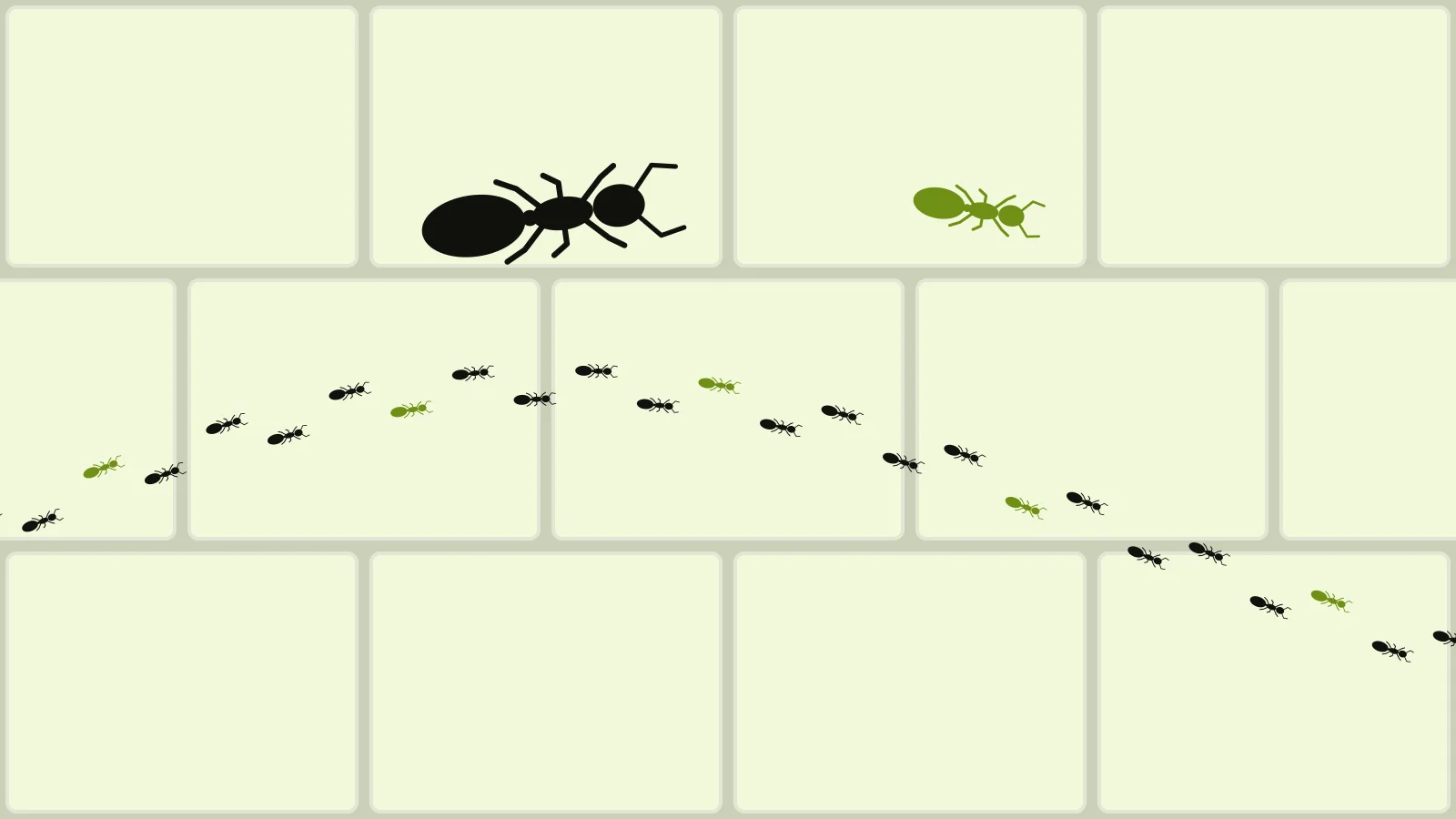
- 1. Black garden ant: 3 to 5 mm, dark brown or black
- 2. All ants have a narrow waist and elbowed antennae
- 3. Pharaoh ant: under 2 mm and yellow-brown
- 4. Pharaoh workers often move in long thin chains
Why pharaoh ants in flats and hospitals need a different approach
A garden ant nest is one place you can often find. Pharaoh ants are built differently. The BPCA says they split their colony and spread over a large area, and that they nest in places that are hard to reach. Redbridge Council adds that a colony under threat can form new colonies, which may hold many thousands of ants. So the normal instinct, to spray what you can see, can turn one problem into several.
The BPCA's advice is direct: insecticidal sprays and dusts are generally found to be ineffective, because they make the ants scatter and the colonies split. Its pest guide says only baiting has proved successful and that residual treatments do not work. This matters even for a quick squirt of kitchen spray, so hold off until you know what you have.
They also breed quickly. Redbridge says a queen can lay up to 350 eggs a week, the eggs hatch after about a week, and adults mature within about a month. The ants are drawn to warmth, which is why the BPCA singles out large centrally heated buildings. In a London block with shared heating pipes and service risers, a trail in one flat may be part of something bigger than that flat.
Professional treatment is usually a slow bait programme. The BPCA names two types: a slow-acting poison, and a juvenile hormone that disrupts how larvae develop. Redbridge uses a hormone bait that stops the ants breeding, and says it keeps working for up to two months, with a follow-up 4 to 6 weeks after the first visit. A reduction is usually noticed within 28 days. You may see one or two larger ants during this time, which Redbridge says is a sign that worker numbers have fallen and queens are leaving the nest to forage.
The one thing you must do is leave the bait alone. Redbridge says not to clean it away until the ants have died off. Our pharaoh ant control page explains what to tell us, and you should keep food sealed and surfaces clean while you wait.
The reason this species gets so much attention is where it lives. The BPCA calls it an increasingly important pest of large heated buildings, especially hospitals and high-rise flats. Redbridge Council says that in hospitals and care homes the ants can invade surgical dressings and may spread infection between patients, and that they can carry germs onto food and preparation surfaces. A paper in the Journal of Hospital Infection looked at the species in NHS hospitals in England as long ago as 1981, so this is a long-standing issue.
If you live in a flat, tell your landlord or managing agent before anyone treats, and ask whether neighbours have seen the same ants. Colonies do not stop at a front door, so treating one flat while the next one has ants may only delay the problem. We recommend agreeing a plan for the affected part of the building first, and asking any contractor how they will decide which flats to include.
If you work in a hospital, care home or other healthcare building, do not treat them yourself. Report the sighting to the estates or facilities team the same day, and note the room and the time. The BPCA also says pharaoh ants may gnaw holes in silk, rayon and rubber, which is worth mentioning if ants are near stored equipment.
How to follow an ant trail back to the nest
The ants on your worktop are workers, and they are not the problem you are trying to solve. The BPCA explains that foragers walk back and forth between food and the nest, carrying food back to the larvae and queen, so watching them can lead you to it. Ten quiet minutes here will save you money on products that go in the wrong place.
Start on a dry, warm day, when ants are active. Do not wipe the trail yet. Put a small dab of something sweet by the trail if it has gone quiet, then watch which way the ants walk when they leave it. Ants carrying food are heading home. Follow them along the skirting or the edge of a cupboard to the point where they vanish, and mark it with a small piece of tape.
Then go outside and find the same spot on the other side of the wall. Look for ants along the foot of the wall and between slabs. The BPCA says nest entrances show as small piles of earth pellets. Redbridge Council says black ants nest around building foundations, under paving slabs and along the edges of flower beds and lawns, and Mid and East Antrim Council says nests are often against the outside of the building.
You will not always find it. If the trail goes into a wall and never comes out, that is still useful, because you now know the route. Bait works along a route without you ever seeing the nest. If the trail is inside and pale, stop following it and do not disturb it.
- 1. Start at the food and watch which way ants leave
- 2. Follow them along skirting and cupboard edges
- 3. Mark the gap where they leave the room
- 4. Look outside for soil pellets between slabs
How to get rid of ants in the house, step by step
This plan is for black garden ants. Take it in order, because the steps depend on each other. If you bait before removing the food, ants have no reason to take the bait. If you seal the gap first, you stop them carrying it home.
- Day 1: check it is not a pharaoh ant. Photograph an ant next to a ruler.
- Day 1: follow the trail and mark the entry point with tape.
- Day 1: put sweet food in sealed containers and clean up spills, as Redbridge Council advises. Empty and wash the bin.
- Day 1: wipe the trail with soapy water, stopping short of where you will put the bait. University of California guidance says this removes the scent trail.
- Day 1: place a labelled ant bait beside the route, near the entry point. Keep it away from children and pets.
- Days 2 to 7: leave it alone. You may see more ants at first, which means they have found it. Do not spray or clean near the bait. Replace it as the label says.
- Days 5 to 14: check for fewer ants. University of California guidance says it may take 5 to 10 days to see numbers fall, and several weeks or longer for full control.
- After the ants stop: clean the area and seal the cracks and gaps they used.
- Still there after three or four weeks: stop buying products and ask for an identification.
Ant baits vs sprays: which should you use?
Use bait. The reason is simple arithmetic. University of California guidance says foragers are usually a small part of a colony, so killing them gives only temporary relief. The Natural History Museum says a black garden ant colony can grow to over 20,000 workers, with a queen that can live for up to 15 years in the wild. The ants on your floor are a very small share of that.
Bait works by using the ants' own habits. The BPCA says sugar-based liquid bait works because workers carry the insecticide back to the larvae and queen. It has to act slowly, because a bait that kills at once never reaches the nest. That is why the wait is normal, and it is why spraying beside bait works against you: University of California guidance says not to spray while baiting.
Not every source agrees. Clackmannanshire Council still suggests household sprays at entry points and says foragers carry insecticide back to the nest, and Mid and East Antrim Council suggests treating cracks along skirting boards to create a barrier. Redbridge Council sprays nests directly, once it knows where they are. Our view is that a spray has a place when you can reach an outdoor nest and the label allows it, or as a barrier product used as directed, but bait is the better first choice inside the home.
Whichever you buy, use a product made for ants in the UK and follow the label every time. HSE says the general public should only use products intended for them, often marked amateur or non-professional, and must never use professional-only products. It treats ant powder as a biocide. HSE also says not to buy online or from abroad until you have checked the product is legal here, and never to pour pesticide down a drain, sink or toilet.
Ant baits, sprays and powders compared
| Product | How it works | Best use | Main drawback |
|---|---|---|---|
| Liquid or gel bait | Workers carry it to the larvae and queen | Garden ants indoors, placed on the route | Slow: days to weeks |
| Bait stations | As above, in a closed station | Homes with pets or children, within label limits | Must be on the route, and replaced when empty |
| Aerosol spray | Kills ants on contact | Rarely needed indoors; never on pharaoh ants | Does not reach the nest |
| Ant powder | Contact insecticide dust | Outdoor nest entrances, as the label allows | Keep pets and children away from treated spots |
| Professional bait | Slow poison or juvenile hormone | Pharaoh ants and hard cases | Needs a trained user and repeat visits |
Based on the BPCA, University of California guidance and HSE. Always follow the label of the product you use.
- 1. Spray kills only the foragers it touches
- 2. The queen and larvae are untouched, so workers return
- 3. Workers carry bait down into the nest
- 4. Bait reaches the queen and larvae, so the colony fails
Ants in the kitchen: what to do tonight
Kitchens are where most people first notice ants, because that is where the sugar is. Redbridge Council says black ants become a nuisance when they come indoors looking for food, especially sweet food. Tonight's job is to make your kitchen less rewarding than the bait.
- Decant jam, honey, syrup and sugar into sealed containers, and wipe the outside of each jar.
- Do not leave overripe fruit out. Put it in the fridge for now.
- Lift pet bowls after meals and do not leave pet food down for long periods.
- Empty the bin and wash the food residue from inside it.
- Pull out the toaster and microwave, and clean the crumbs beneath them.
- Check behind the fridge and under the sink for spills and leaks. University of California guidance says water attracts ants too.
- Check any food the ants have reached. If it has been opened or the ants are inside, throw it away.
Ants in walls, skirting boards and floors
Ants coming out of a wall or from under a skirting board are usually travelling, not living there. Black garden ants use the gaps around pipes, the joints between floor and wall, and cracks at the foot of the building to reach food from a nest outside. Mid and East Antrim Council notes that they can use very small cracks. Follow the route outdoors first, as above.
If the ants come through a gap, bait beside it and leave the gap open until the activity ends, then seal it. Do not spray into the gap: it can push ants to a new exit, and it does nothing about the nest. Do not spray or pour liquids into plug sockets or anywhere near electrics. Keep airbricks and vents clear, because they ventilate the building and should not be blocked.
For an upstairs flat, the picture changes. Black garden ants on a high floor are less common than on the ground, and pale ants in a warm flat should make you think of pharaoh ants. Check the size and colour before going any further, and tell your landlord or managing agent. If what you are finding near the skirting is not ants at all, compare our guides to silverfish and cockroaches, as these need a different plan.
Ants on the lawn and under paving
If the ants are staying outside, the best advice is usually to do nothing. The RHS says ants should generally be tolerated in gardens, that they are an important part of garden biodiversity, and that unless a nest is a real problem they are best left alone. It also warns that destroying a colony often does not help, because incoming queens may take over the territory. The BPCA agrees that black garden ants outdoors can usually be left alone.
For a lawn, the RHS suggests brushing the soil off on a dry day before you mow, so the mower does not smear it across the grass. If long-term ant activity has left the lawn lumpy, lift the turf in the raised areas, remove the excess soil and relay it. Winter is the easier time, as ants are less active then. Do not treat the whole lawn with insecticide to solve what is really a mowing problem.
Pots are the exception. The RHS says ants can disturb the roots in containers, so plants become more likely to wilt, especially when dry. Water pots well and repot them if a nest has taken over. Ants nesting in a compost bin cause no damage there, so leave them. On fruit and roses, watch for aphids. The RHS says ants can protect aphids from ladybirds to get their honeydew, so aphid numbers may rise.
For paving, the same rule applies: leave it unless ants are getting indoors or the patio is becoming a nuisance. If they are, place ant bait along the joints near the activity, and refill the joints with fresh material once the ants have gone. If you want a non-chemical route in a lawn or flower bed, the RHS lists a nematode, Steinernema feltiae, which is watered into soil where ants push it to the surface. The RHS notes it may affect non-target insects as well.
If you use any product near a pond, take extra care. Redbridge Council says its insecticides can harm fish, so keep treatments well away from water.
How to get rid of flying ants, and is flying ant day real?
You do not need to get rid of flying ants, because they will leave on their own. They are the queens and males of an existing colony, out on a mating flight. The BPCA says they can be ignored if they are not causing a nuisance, and Mid and East Antrim Council says the flight lasts only a few days. Spraying a swarm uses up insecticide on ants that are about to disperse or die anyway.
If they are coming indoors, close the windows and doors for a while. Clackmannanshire Council says they can be vacuumed up, or let out through open windows once the swarm has passed. Sweep up wings from the patio afterwards. The Natural History Museum says discarded wings on pavements are a sign of recently mated queens. Males usually die within a day or two of mating.
A swarm does tell you something useful: there is a mature nest nearby. The Natural History Museum notes that soil heaps can appear above nests a few weeks before swarming. If winged ants emerge from the same crack in your patio each year, that is your nest. Leave it if it causes no trouble, and bait it if the workers are coming indoors.
If insects are streaming to and from one hole in the roofline all day, that is not a mating flight. It may be a wasp nest, which needs a different response, so read our wasp nest removal guide before going near it.
Flying ant day is not a single national day. The Natural History Museum describes a flying ant season of several weeks, with a few peaks that last only a few days each. A University of Gloucestershire-led study in Ecography analysed more than 13,000 public sightings over three years and found that flights were not clearly synchronised across the country, with local weather doing most of the work.
The study found winged ants only when the temperature was above 13°C and wind speeds were low, and it recorded sightings on every day with a mean temperature above 25°C. Nests in urban areas and near heat-retaining structures produced winged ants earlier, which fits what the Natural History Museum says about the urban heat island. So a paved London garden can see its swarm before a garden in the countryside.
On timing, sources differ slightly. The BPCA says July or August, the Natural History Museum says usually July or August but any time from June to the start of September, and Redbridge Council says early summer. Plan on a warm, still, humid day in summer, often after poor weather, and do not worry if your neighbours saw theirs a week ago.
Home remedies for ants: what the evidence says
We looked for evidence on the remedies people ask about most. It is thin. We found no UK trials of these remedies on black garden ants, and the best tests are on American fire ants, a different species. Treat the table below as our judgement on limited evidence and not as settled science.
The common problem is that a remedy may kill or deter the ants in front of you but does not reach the queen. Texas A&M AgriLife tests are a useful warning: a cup of used coffee grounds on a fire ant mound left activity the same as untreated mounds, and ground cinnamon left a mound with more activity than the control.
Borax deserves a warning of its own. Boric acid does kill ants, and University of California guidance rates borate baits as an effective consumer option for Argentine ants. But the US National Pesticide Information Center says borax can irritate skin and that swallowing it can cause sickness, and that animals can show signs of poisoning within two hours of eating boric acid. HSE says own-use remedies such as coffee grounds generally fall outside the rules, but that household chemicals used as pesticides still carry risk. Our advice is simple: do not mix your own sweet poison in a home with children or pets. Buy a labelled, closed ant bait instead.
Common ant remedies judged on the evidence
| Remedy | What the evidence says | Our verdict |
|---|---|---|
| Soapy water | Removes the scent trail and kills ants on contact, with no lasting effect (University of California) | Use it. Good for cleaning trails |
| White vinegar | We found no good evidence that it does more than a wipe-down | Harmless on most surfaces; do not rely on it |
| Peppermint or other plant oils | Contact kill with limited lasting effect (University of California) | Short-term only. Keep oils away from pets |
| Ground cinnamon | Did not reduce fire ant activity in a Texas A&M test | Skip it |
| Coffee grounds | No effect on fire ants in a Texas A&M test | Skip it |
| Boiling water | Sources disagree: BPCA calls it first aid; Redbridge Council does not recommend it | Avoid it. Scald risk, and it kills plants |
| Diatomaceous earth | Dries insects out, but only while dry and undisturbed (NPIC). Dust can irritate lungs and eyes | Limited use in dry, hidden spots; follow the label |
| Home-made borax bait | Can work, but it is poisonous to people and pets if eaten | Avoid it. Use a labelled bait |
Texas A&M tests were on US fire ants, and University of California guidance is mainly about Argentine ants, so results may differ for UK species.
Do ants bite, and are they a health risk?
Black garden ants are mainly a nuisance. Redbridge Council says they pose no public health risk, and Mid and East Antrim Council agrees they are not a significant risk, although they can still walk over food. The RHS says Myrmica species, often called red ants, can sting, and that this is usually a minor irritation. You are more likely to meet these outdoors, while gardening or moving a pot.
Pharaoh ants are different, and Redbridge Council says they can contaminate food with germs linked to food poisoning, dysentery and typhoid. If you think ants have reached food in a home with someone who is unwell or vulnerable, throw the food away and clean the surface. For health concerns, ask your GP or NHS 111.
The NHS page on insect bites and stings does not mention ants, but its general advice applies. Wash the area with soap and water, use a cold pack or cold wet cloth for at least 20 minutes if it is swollen, and try not to scratch. A pharmacist can help if the skin looks red or feels hot, or if it is painful or swollen. Call 999 if lips, mouth, throat or tongue suddenly swell, or if someone is struggling to breathe or swallow.
Tenants, landlords and businesses: who deals with ants?
In a rented home, report ants to your landlord or agent in writing, with a photo and the date. Citizens Advice says tenants may have to deal with a problem they caused, while a landlord is probably responsible if the tenancy says so, or if the infestation comes from repairs they have not made, such as holes in walls. Landlords are usually only responsible once they know about it, so tell them early. Pharaoh ants in a block usually belong with the landlord or managing agent, since no single tenant can treat a building.
Council and housing association tenants have stronger rights, and Citizens Advice says an emergency hazard under Awaab's Law must be made safe within 24 hours. It also notes that council environmental health teams have powers over some infestations. If you are moving out, keep the treatment record with your end of tenancy cleaning checklist.
Food businesses have a harder line to meet. GOV.UK guidance says premises must allow for good hygiene, including protection against contamination and pest control, and it says waste should be removed quickly so it does not attract pests. Ants in a café or takeaway need dealing with promptly and recording in your food safety records. Do not use a home spray near open food.
Who usually acts on ants?
| Situation | Who usually acts | First step |
|---|---|---|
| Owner-occupier, garden ants | You | Bait and proof; call us if it fails |
| Private tenant, gaps in the walls let ants in | Usually the landlord, once told | Report in writing with photos |
| Private tenant, food left out | Often the tenant | Clean up and bait |
| Pharaoh ants in a block | Landlord or managing agent | Report and do not spray |
| Café, shop or takeaway | The business | Book treatment and record it |
| Hospital or care home | Estates or facilities team | Report the sighting at once |
A general guide based on Citizens Advice and GOV.UK. Your tenancy agreement and the facts of the case come first.
How to stop ants coming back
Once the trail has gone, make the house harder to enter. New queens will start nests nearby in future summers, so you are reducing the chance of a repeat and not removing every ant from your street. A few small jobs do most of the work, and spring is the best time to check them, before colonies grow.
- Seal cracks and gaps in walls and floors with a suitable filler or sealant, as Redbridge Council advises.
- Fill small gaps around pipes, door thresholds and window frames.
- Keep sweet foods sealed all year, not just when ants appear.
- Fix dripping taps and leaks, since water draws ants in too.
- Keep plants, mulch and branches from touching the house, which University of California guidance says removes easy bridges indoors.
- Rinse bins and recycling, and keep them away from the back door.
- Check the foot of the walls each spring, and bait early if you see a new trail.
When to call an ant exterminator
Most black garden ant problems do not need an ant exterminator, and you should try bait first. Call for pest control for ants when your own efforts have had a fair test and failed, or when the risk of guessing wrong is too high. The BPCA suggests professional help if ants are in a large centrally heated building, if you are unsure which ant it is, or if any species enters in very large numbers.
Good pest control for ants starts with identification, not with a spray can. Ask anyone you are thinking of booking which species they think it is, whether they plan to use bait or spray, how many visits they expect, and what happens if the ants return. If they offer to spray pale ants in a flat without asking any of these questions, ask why. If you are unsure what you have, a pest inspection answers that before you commit to treatment.
DIY or professional pest control for ants?
| Situation | Try it yourself? | Why |
|---|---|---|
| A small trail of dark ants | Yes | Shop-bought bait suits this, and the BPCA says it can be used strictly to the label |
| Bait has failed after three or four weeks | No, get help | The route, the species or the food source may be wrong |
| Tiny pale ants indoors | No | Spraying can split a pharaoh colony |
| Ants in a flat with shared heating | No | The colony may reach beyond your flat |
| Ants in a food business | No | You need a clear record and fast action |
| Ants on a lawn only | No need | The RHS says to leave them if you can |
Based on BPCA and RHS guidance.
What we do, and what it costs
For ant control in London, tell us where you see the ants, where the trail starts and ends, and send a photo with a ruler if you can. We work out which ant it is likely to be, then confirm the price, the visits and what is included in writing before you book. You do not have to identify the ant yourself, but please do not spray it before we arrive.
Ant treatment starts from £69, which covers an initial inspection and targeted treatment. Pharaoh ant control starts from £179 for two treatment visits, with the follow-up timing confirmed at booking. Redbridge Council's 2026/27 list is £150 for garden ants and £260 for pharaoh ants, and it says it may charge more for larger premises. It also offers a free repeat visit within four weeks if a correctly done treatment fails.
If you want more than a single visit, our 2-visit packages carry a 1-month written guarantee and our 3-visit packages a 3-month written guarantee. Packages include a safety report, follow-up and proofing advice as set out in the quote. Our pest control cost guide explains how to compare quotes, our prices page has the full list, and our Ilford pest control page sets out local details.
We are based on Clements Road in Ilford, cover London and carry public liability insurance. Our phone lines are open Monday to Saturday, 8am to 8pm, or you can contact us online. If it turns out to be something other than ants, our pest control services page lists what else we treat.
Ant treatment prices in London
| Service | Bestone starting price | What it covers |
|---|---|---|
| Ant treatment | From £69 | Initial inspection and targeted treatment |
| Pharaoh ant treatment | From £179 | Two treatment visits; follow-up timing confirmed at booking |
| Pest inspection | From £60 | Signs and entry routes reviewed |
| 1-bed, 2-visit package | £160 to £190 | Includes a 1-month written guarantee |
| 1-bed, 3-visit package | £210 to £230 | Includes a 3-month written guarantee |
| 2-bed, 2-visit package | £180 to £220 | Includes a 1-month written guarantee |
| 2-bed, 3-visit package | £240 to £270 | Includes a 3-month written guarantee |
| 3-bed, 2-visit package | £190 to £240 | Includes a 1-month written guarantee |
| 3-bed, 3-visit package | £240 to £299 | Includes a 3-month written guarantee |
Starting prices. The final price depends on where the ants are, the rooms involved and the access, and is confirmed in writing before booking.
Common questions
What is the fastest way to get rid of ants in the house?
Wipe the trail with soapy water, remove the food, then put a labelled ant bait where the ants enter. Bait is not instant: University of California guidance says numbers may take 5 to 10 days to fall. Our step-by-step plan sets out the order.
Why do ants keep coming back to the same place?
Workers follow scent trails to food, so a cleaned spot can be found again if the nest is still active and the gap is still open. Remove the trail, the food and the route, not just the ants you can see. See how to stop ants coming back.
Are ants in the house a sign of a dirty home?
Not necessarily. Black garden ants usually nest outside against the building and come in looking for sweet food, so a single sticky ring in a clean kitchen can bring them in. If the ants are tiny and pale, read about pharaoh ant control instead.
Do flying ants mean I have a nest in my house?
Usually not. The Natural History Museum says black garden ants nest in dry soil, often under paving, in lawns and in patios, so most swarms come from outdoors. If winged ants keep appearing inside from one spot, note it and book a pest inspection.
Will boiling water kill an ant nest?
It may kill the ants it reaches, but it is not a dependable fix. The BPCA calls it a first-aid measure, Mid and East Antrim Council suggests it for ground-floor outdoor nests, and Redbridge Council does not recommend it on safety grounds. Our remedies table compares it with the other options.
How long does it take to get rid of pharaoh ants?
Expect weeks, not days. Redbridge Council says bait works for up to two months, its follow-up comes 4 to 6 weeks later, and a reduction is usually noticed within 28 days. Our pharaoh ant service confirms the timing before booking.
Who pays for ant control in a rented flat?
It depends on the cause and the tenancy. Citizens Advice says a landlord is probably responsible if the agreement says so or if unrepaired gaps let the pests in, and a tenant may have to deal with a problem they caused. Report it in writing, then see who deals with ants.
Can ants damage my lawn or my house?
The RHS says ants do little direct damage to plants, and their main effect is the soil they move, which can bury low plants and make a lawn uneven. Under paving they can leave sandy soil in the joints. If they are coming indoors as well, look at ant treatment.
How much does an ant exterminator cost in London?
Our ant treatment starts from £69 and pharaoh ant treatment from £179 for two visits. For comparison, Redbridge Council lists £150 for garden ants and £260 for pharaoh ants in 2026/27. See all our prices.
Sources
Figures differ a little between sources, so ranges are given where they do. Sources reviewed on 1 November 2026.
- RHS: ants in the gardenrhs.org.uk(opens in a new tab)
- Natural History Museum: when and why winged ants swarmnhm.ac.uk(opens in a new tab)
- Hart et al. (2018), Ecography: the spatial distribution and environmental triggers of ant mating flightseprints.glos.ac.uk(opens in a new tab)
- BPCA, via Pest Control News: ant ID is key if they are found indoorsppconline.org(opens in a new tab)
- BPCA, via Pest Control News: ant controlppconline.org(opens in a new tab)
- BPCA, via Pest Control News: Pharaoh's ant controlppconline.org(opens in a new tab)
- Redbridge Council: pest control, antsredbridge.gov.uk(opens in a new tab)
- Redbridge Council: pest control, pharaoh's antsredbridge.gov.uk(opens in a new tab)
- Redbridge Council: pest control pricesredbridge.gov.uk(opens in a new tab)
- Mid and East Antrim Borough Council: garden antsmidandeastantrim.gov.uk(opens in a new tab)
- Clackmannanshire Council: antsclacks.gov.uk(opens in a new tab)
- University of California IPM: antsipm.ucanr.edu(opens in a new tab)
- Texas A&M: testing home fire ant treatmentsfireant.tamu.edu(opens in a new tab)
- National Pesticide Information Center: diatomaceous earthnpic.orst.edu(opens in a new tab)
- National Pesticide Information Center: boric acidnpic.orst.edu(opens in a new tab)
- HSE: using pesticides in your garden, home or allotmenthse.gov.uk(opens in a new tab)
- HSE: using biocides overviewhse.gov.uk(opens in a new tab)
- NHS: insect bites and stingsnhs.uk(opens in a new tab)
- Citizens Advice: if there are pests or vermin in your rented homecitizensadvice.org.uk(opens in a new tab)
- GOV.UK: starting a food businessgov.uk(opens in a new tab)
- Edwards and Baker (1981), Journal of Hospital Infection: Pharaoh's ant in NHS hospitals in Englandpubmed.ncbi.nlm.nih.gov(opens in a new tab)
Want it dealt with?
Tell us what you have seen, the rooms and your postcode. You do not need to know which pest it is. We confirm the price in writing before any work is booked.