Pest Control · 32 min read · Updated 1 November 2026
How to Get Rid of Woodlice in the House: UK Guide
To get rid of woodlice in the house, sweep them up and put them outside, then deal with why they came: dry the damp spot, seal the gaps and clear pots and leaves from the outside wall. They are harmless, so a pesticide is rarely needed.
By the Bestone pest control team · Contact us

Key takeaways
- Woodlice are harmless land crustaceans. They do not bite, damage wood or spoil furnishings, so most homes need sweeping and sealing, not a pesticide.
- They need damp to live. In a warm, dry room they die within about a day, so regular live woodlice in one spot point to moisture or to a colony just outside.
- Check in this order: leaks under sinks, extractor fans, blocked air bricks, soil or paving too close to the damp-proof course, then gutters.
- Never block an air brick to keep woodlice out. Seal gaps on the room side and keep the vent clear, because the timber floor needs that air.
- If live woodlice keep appearing after the checks, a pest inspection from £60 can find the route in. The price is confirmed in writing before booking, and we will say if you need a builder and not us.
On this page
- Key takeaways
- How to get rid of woodlice: the short answer
- What to do, by what you have found
- Why are there woodlice in my house?
- What woodlice are, and what they eat
- Is it a woodlouse, and is it harmful?
- Woodlice and common lookalikes
- Woodlice in the house: what the room is telling you
- Air bricks, damp-proof courses and woodlice
- How to get rid of woodlice in the house, step by step
- Woodlice in the garden: move their shelter, not the woodlice
- Woodlice in plant pots: what to do
- Do woodlice damage plants, seedlings or greenhouses?
- Woodlice or something else? Reading plant damage
- How to get rid of woodlice naturally: home remedies judged
- Home remedies for woodlice: what the evidence says
- Do you need insecticide for woodlice?
- When does damp need a professional?
- Who to call about damp
- Renting: woodlice, damp and Awaab's Law
- When is a pest visit worth paying for?
- Pest visit or not?
- What we do, and what it costs
- What a woodlice problem can cost with us
- Common questions
How to get rid of woodlice: the short answer
Here is how to get rid of woodlice in most homes. Sweep or vacuum up the ones you can see and put them outside. Find the damp they are using, and fix it. Close the gaps at floor level and around doors. Then move whatever is sheltering them away from the outside wall. Clackmannanshire Council gives the same order, and says that once condensation or dampness is fixed the woodlice should eventually disappear.
Woodlice are harmless, and we do not think most households should pay anyone to spray for them. They are a symptom. Spray a line of them and the next ones walk in over it a week later, because the damp shelter that drew them is still there. The useful question is not what kills woodlice. It is what they are telling you about the house.
Most of the time the message is minor: a heap of pots by the back door, or a worn seal under it. Sometimes it is worth acting on: a slow leak inside a kitchen unit, a blocked air brick, or soil built up against a wall. Use the table below to decide how much effort your situation deserves.
What to do, by what you have found
| What you found | What it usually means | What to do |
|---|---|---|
| One or two in autumn or winter, near a door | Sheltering from the cold | Put them outside and check the door seal |
| Several dead ones on a dry floor | They wandered in and dried out | Sweep up, seal the gap, nothing more |
| Live ones daily in a bathroom or kitchen | Moisture close by | Check for leaks, then the extractor fan |
| Live ones along ground-floor skirting | Damp under the floor or a colony outside | Check air bricks and ground levels |
| Woodlice with a wet wall, mould or a musty smell | A damp problem, with woodlice as the clue | Trace the damp first, and get help if you cannot |
| A crowd under a pot or log in the garden | Normal and useful | Leave them, unless it is against the house |
Our summary, based on advice from Clackmannanshire, Darlington and North Lanarkshire councils and the RHS.
Why are there woodlice in my house?
Woodlice come inside for two reasons: cold outside, or damp inside. Darlington Borough Council says they mostly enter in winter and early spring, while Clackmannanshire Council says cold autumn and winter weather drives them in. Both agree they are looking for shelter. Darlington adds that they are not coming in to breed, but that a colony close to an entrance makes indoor sightings more likely.
That last point explains most repeat cases. A woodlouse does not plan a route into your home. It walks at night, looking for somewhere dark and damp, and if the nearest such place is behind your skirting board, it ends up in your hallway in the morning. Clackmannanshire names vegetation piled up outside as an encouragement. Large numbers indoors, it adds, can also signal high moisture from condensation or dampness.
So think of two separate problems. The source is the colony outside, or the damp pocket that keeps them alive. The route is the gap that lets them through. You need to deal with both, and the source matters more, because no one can seal an older house perfectly. The drawing below shows how the two connect in a typical London terrace with a timber ground floor.
- 1. Pots, leaves and logs at the wall give them shelter
- 2. Soil above the damp-proof course lets damp bypass it
- 3. Air brick: it must stay open, whatever walks through
- 4. The space under the floor stays cool and dark
- 5. Gaps at the skirting are where they reach the room
What woodlice are, and what they eat
Woodlice are not insects. The Wildlife Trusts describe them as land crustaceans, closer to crabs and shrimps, and Clackmannanshire Council gives the same family tree. The Natural History Museum groups them as crustaceans in its classification teaching material, and describes giant ocean isopods as their relatives. That ancestry is the reason they behave as they do. Their bodies never fully adapted to dry air.
This matters for practical reasons. Darlington Borough Council says that in warm, dry rooms they lose too much water and die within about a day, although they can last for several days under kitchen and bathroom sinks if they have food. A 2018 study in ZooKeys shows how much species vary. At about 30% humidity for six hours, one species lost all its test animals while the pill woodlouse lost none, and the authors link survival to a thicker shell and a larger body. The test did not include every UK house visitor, but it suggests that the round, rolling kind copes best in a drier room.
As for food, the RHS calls woodlice detritivores that mainly eat damp, decomposing plant material. Darlington adds dead insects and fungi, and the Wildlife Trusts add dead animals, and mention pill woodlice climbing walls at night to find mildew and rotting plants. Indoors, that means they are not after your food cupboard. They are after mould, rotting timber and the dead leaves that have blown under a door. Bare, clean, dry surfaces give them nothing.
Britain has about 30 species according to the RHS and the Wildlife Trusts, and about 35 according to Clackmannanshire. The RHS names four common garden groups: Armadillidium, Oniscus, Philoscia and Porcellio. You do not need to tell them apart, because the advice is the same for all of them.
Is it a woodlouse, and is it harmful?
A woodlouse is grey or brown, oval and domed, with overlapping plates and seven pairs of legs. Sizes vary by source. The RHS says up to 1 cm, Clackmannanshire about 15 mm, and the Wildlife Trusts 1.1 to 1.8 cm for the pill woodlouse. Use the table to rule out the usual lookalikes, because several of them do need a different response.
Woodlice themselves are harmless. Iowa State University says they do not bite, sting or damage furnishings, and Darlington says they are harmless and do not damage wood, despite the name. No source we read links them with disease. The real health question is the damp. GOV.UK says damp and mould are a particular risk for people with asthma, COPD or other lung or heart conditions, those with weakened immune systems, children, older people and pregnant women. If someone at home is in one of those groups and there is mould alongside the woodlice, treat the damp as a priority, and speak to a GP about any symptoms.
If the table rules out a woodlouse, go to the guide that fits: silverfish, carpet beetles, bed bugs or cockroaches. Still unsure? Try our guide to small brown bugs in the house.
Woodlice and common lookalikes
| Creature | How to tell | What it means | Next step |
|---|---|---|---|
| Woodlouse | Oval, plated, 7 pairs of legs, does not roll | Damp nearby or cold outside | This guide |
| Pill woodlouse | Rolls into a near-perfect ball, 7 pairs of legs | As above | This guide |
| Pill millipede | Also rolls, but about 18 pairs of legs | Garden animal, harmless | Put it outside |
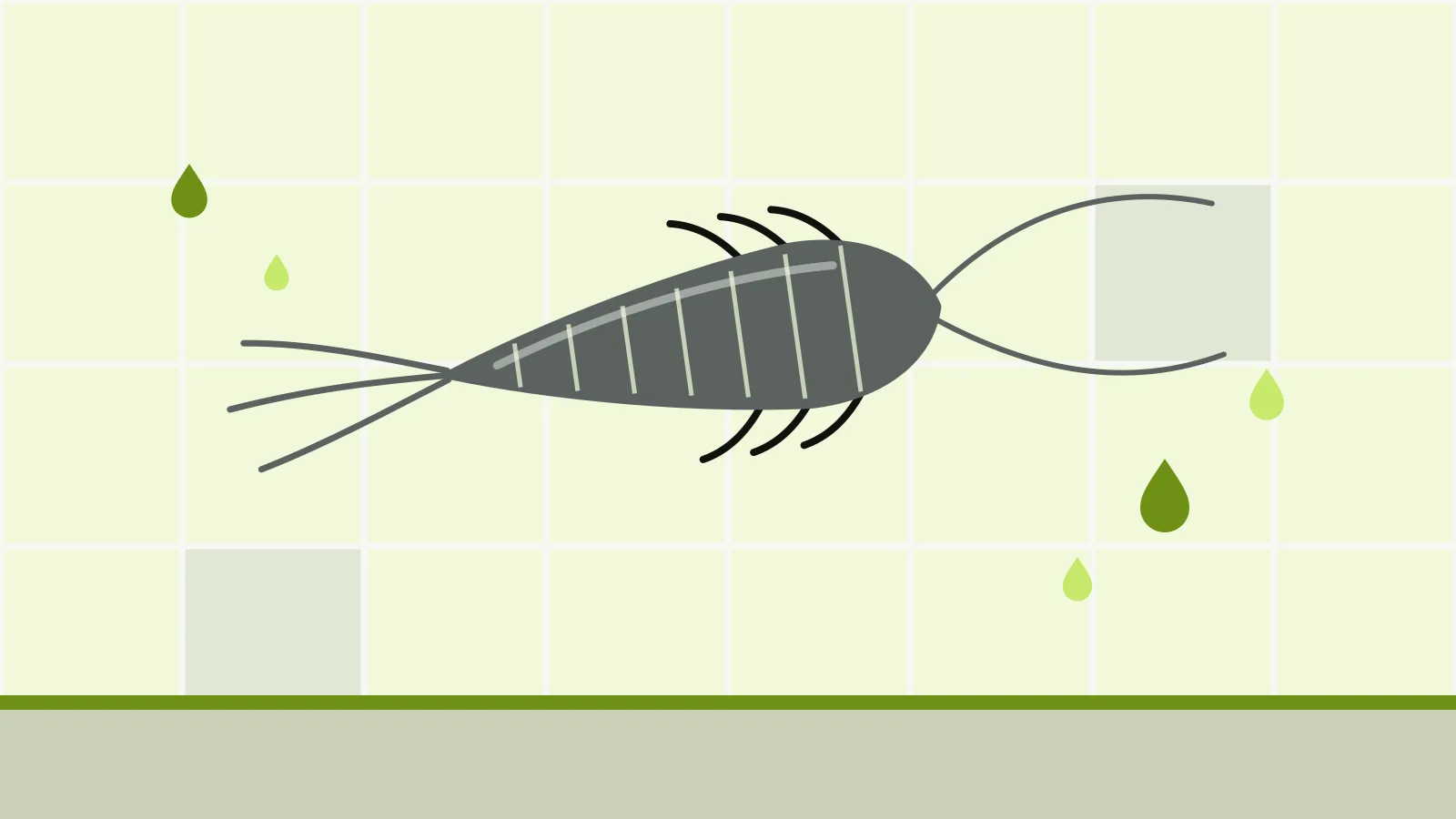
| Silverfish | Slim, silver, tapered, runs fast, 6 legs | Moisture indoors, can damage paper | See our silverfish guide |
| Carpet beetle larva | Hairy, brown, banded, near fabric | Feeds on wool and natural fibres | See our carpet beetle guide |
| Bed bug | Flat, reddish-brown, 6 legs, near beds | Needs treatment | See our bed bug guide |
| Cockroach | Long, fast, 6 legs, long antennae | Needs treatment | See our cockroach guide |
Pill woodlouse and millipede leg counts from the Wildlife Trusts. Other descriptions are our summary.
Woodlice in the house: what the room is telling you
Where you find them is your best clue, so note the spot before you sweep. Write down the room, the wall and the time of day for a week. Look at night with a torch too, because they are active in the dark and hide by day. Then use the route map below, and start with the cheapest check first.
GOV.UK sorts household damp into four kinds, and each leaves a different trail. Condensation forms on cold surfaces such as window frames, wall corners and behind furniture, and it is the most common. Penetrating damp comes in from outside through defects in walls, roofs, windows or floors. Rising damp comes up from the ground and is usually found in older properties, and GOV.UK warns that it is often misdiagnosed. Traumatic damp means leaks: burst or weeping pipes, overflowing baths and sinks.
A week of woodlice records plus a simple look at each of those four will usually tell you what you have. A cheap hygrometer helps if you suspect condensation, and our silverfish guide explains how to read one. If you are seeing silverfish in the same place, take that as a second vote for moisture.
- Empty the cupboard under each sink, then run the taps and feel the waste pipe, the trap and the back of the unit with dry tissue.
- Press the base of the unit and the plinth. Swollen chipboard or a musty smell means water has been there for a while.
- Hold a sheet of toilet paper near the extractor fan while it runs. If the paper does not cling, the fan is not doing much. GOV.UK says kitchens and bathrooms should have working fans.
- Pull furniture a little way off the outside walls and look for mould, damp patches or a tide mark low on the wall.
- Check the wall after heavy rain. Cheshire East Council says penetrating damp shows as patches that get worse after rain and feel damp to the touch.
- Look up from outside. Cheshire East lists blocked gutters as a cause of penetrating damp, and Epping Forest District Council says moss or staining on outside walls is a sign of a defect.
- 1. Sinks and baths: leaks first, ventilation second
- 2. Skirting: think of the floor and the ground outside
- 3. One wall: rainwater getting in from outside
- 4. Doors: a gap and a colony, often with no damp at all
Air bricks, damp-proof courses and woodlice
Many older London houses have suspended timber floors, with a shallow space under the boards. An air brick is the small grid low on the outside wall that feeds that space. GOV.UK's guide to retrofitting these floors says outside air can and should flow beneath them, and that free-flowing air helps keep the floor construction healthy. If you see the same woodlice along the skirting of every ground-floor room, this space is the place to think about.
Check each air brick you can find, on every side of the house. That GOV.UK guide warns that later work such as new pavements, decking, soft landscaping or access ramps can obstruct them. It says raised soil should be carefully reduced to restore the flow, and that where that is not possible, a telescopic vent may solve it. Clear leaves, ivy and dirt from the grid with a stiff brush. Move anything stacked in front. Bath and North East Somerset Council gives the same advice to anyone insulating a floor: keep air bricks unobstructed.
Do not block an air brick to stop woodlice. It feels logical, and it is the one mistake in this guide that can cost real money, because still, damp air under a timber floor raises the risk of rot and decay. The same applies to expanding foam, tape and plastic covers. If you need a barrier against mice as well, the mesh must not choke the airflow, so read our mouse guide and ask for help with the detail.
Next, find the damp-proof course. Epping Forest District Council describes it as usually a black or grey line between the bottom brick courses. RICS says a path should sit at least two bricks, or 150mm, below it, and Cheshire East Council and Epping Forest give the same figure for ground levels. Soil, a raised bed or a patio above that line gives water a way round the barrier, and gives woodlice a damp ladder to the brickwork. RICS also points out that rain splashing off hard paving can wet the wall above the line, and that mortar over the course can bridge it.
That order of checks can save you a large bill. Epping Forest says failure of the damp-proof course itself is rare, and in RICS's bridged example the course has not failed and does not need replacing. So before anyone sells you injection treatment, lower the soil, clear the vents, and fix the gutter.
How to get rid of woodlice in the house, step by step
Once you know the source, this is a weekend job for most homes. Work through these steps in order. There is no point sealing a skirting until the leak behind it has been fixed, because sealing traps the wet in.
- Vacuum or sweep up every woodlouse you can see. Clackmannanshire Council advises returning them outside, and Gardeners' World suggests a damp spot in the garden.
- Fix any leak first, and let the area dry out completely with the cupboard doors open.
- Clean the area. North Lanarkshire Council calls cleaning the main control indoors. Remove dead leaves, wet cardboard and anything mouldy from under sinks and in meter cupboards.
- Warm and air the room. Darlington Borough Council says warming the parts of the house where they are found helps. Unheated porches, utility rooms and under-stair cupboards are the usual cold, damp spots.
- Fit a brush strip or draught excluder to external doors. Which? says draught strips around doors and windows should keep them out, and Clackmannanshire says a worn weather bar at the foot of a door frame may need replacing.
- Seal the room side of the skirting with a flexible decorator's caulk or sealant, after the area is dry. Fill cracks in the floor edge, around pipes and where cables pass through the wall.
- Repoint open brick joints outside near ground level and repair damaged wood. Which? recommends this for removing hiding places too.
- Check again after two weeks. Falling numbers mean it has worked. The same numbers mean that you have not found the source yet.
Woodlice in the garden: move their shelter, not the woodlice
You cannot, and should not, clear woodlice from a garden. The RHS calls them a vital part of garden biodiversity, and says they recycle nutrients. Gardeners' World says there is no need to control them outside because they are not a pest. They also feed shrews, toads, centipedes, some spiders and ground beetles. What you can do is make the strip beside the house less attractive.
Think of it as a dry zone, roughly a metre wide, around the walls. That width is our suggestion, not a rule from any source. North Lanarkshire Council lists what to shift: leaves, grass clippings, mulch, wood, boards and stones near buildings. Move compost bins and log stores to the far end of the garden, where woodlice can do their job. Which? adds that sweeping where pots are kept, and removing old pots and seed trays, helps, and that clearing debris also reduces slugs and snails.
Timing helps. The drawing below shows why autumn is the moment to do this. Adults reach full size by late summer and then look for somewhere to spend the winter, which is exactly when leaf fall builds up against your wall. Clear the strip in October and you remove the shelter just before the indoor season begins. Our gardening team can clear back overgrown beds and borders if the job is too large to do yourself.
One warning on what you plant. Ground cover and climbers against a wall hold moisture and hide air bricks, so cut them back from the brickwork. Gardeners' World points out that removing habitat also removes ladybirds and ground beetles, so only clear the strip by the house and leave the rest of the garden alone.
- 1. A female carries up to about 150 eggs in a pouch
- 2. Young moult several times to grow
- 3. They breed in their second year
- 4. From about 2 mm to about 15 mm
Woodlice in plant pots: what to do
Tip a pot and find woodlice underneath? That is normal. A pot gives them all they want: dark, damp, and bits of rotting leaf. Gardeners' World is clear that a large group under a container is not an infestation and does not mean the plant is being damaged. The RHS lists flower pots with logs and stones as a usual hiding place. For pots out in the garden, the best action is none at all.
Pots against the house are different, because they are also on the doorstep. Darlington Borough Council specifically mentions flower pots when it talks about removing shelter near the home. Move them a short distance from the wall and away from the back door, and stand them on pot feet or a slatted rack, so the base can dry. Sweep the spot where they stood. Empty saucers after rain, and throw out soggy old compost bags and stacked empty pots.
Indoor plants are a smaller version of the same thing. If you bring a pot in for winter, lift it first, and check under the rim and the drainage holes. Woodlice brought in on a tray will not last long in a warm room, but an overwatered plant on a damp saucer can keep a few alive. Water less over winter, empty the saucer and let the top of the compost dry out. If you find tiny pale jumping creatures in the compost, they are a different animal, and our guide to tiny black bugs in the house may help.
If you want to know how many you have, lay a damp piece of cardboard or an upturned pot by the wall overnight, then lift it in the morning. Empty what you find at the far end of the garden. We found no trial showing that this reduces numbers, so treat it as a survey more than a cure.
Do woodlice damage plants, seedlings or greenhouses?
Rarely. The RHS says they seldom harm healthy plants, occasionally taking very soft tissue such as seedlings and sometimes strawberry fruits, and that they often get the blame for damage done by slugs, caterpillars or plain rot. Holes in tougher leaves are not theirs. Gardeners' World says they are far more likely to be on rotting fruit such as windfall apples.
Which? Gardening goes somewhat further. It lists seedlings, bedding plants, peas, beans, carrots, cucumbers, strawberries and tomatoes as things they can harm, and says that problems are more likely in greenhouses, which is where sources differ. The RHS treats them as abundant and largely beneficial in healthy greenhouses. Both can be right. An established tomato plant will not notice them. A tray of newly germinated seedlings on a damp greenhouse floor might.
Which? adds a useful test. They usually enlarge wounds made by slugs or wireworms in potatoes and bulbs, and cannot break into undamaged ones. If you find woodlice inside a hollow, something else got there first. Look for slime trails, which mean slugs or snails, and for damage to firm, older tissue, which points to other pests. If slugs are the real problem at scale, see our slug control page.
To protect seedlings, raise trays off the floor on staging, keep the greenhouse floor swept and clear of old pots and dead leaves, ventilate on mild days, and water in the morning so surfaces dry by night. Our recommendation is not to spray. Young plants can be protected by routine, and the woodlice in the compost below are helping you.
Woodlice or something else? Reading plant damage
| What you see | Likely cause | What to do |
|---|---|---|
| Seedling stems nibbled, no slime | Possibly woodlice | Raise the tray and clear the floor |
| Slime trails and ragged holes | Slugs or snails | Deal with these first |
| Holes in firm, older leaves | Slugs or caterpillars | Leave the woodlice alone |
| Woodlice inside a hollow potato or bulb | They enlarged an existing wound | Find the first pest |
| Woodlice on a dead or rotting plant | They arrived after it died | Find why the plant died |
| Woodlice on a soft strawberry | Could be them, often after other damage | Lift fruit on straw, pick early |
Based on the RHS and Which? Gardening.
How to get rid of woodlice naturally: home remedies judged
The internet recommends a long list of natural deterrents. We looked for evidence on each, and the honest summary is that very little has been tested on woodlice. The best natural method is the dull one: remove the moisture, because woodlice dry out and die without help from you.
The nearest thing to a real test is a 2025 paper in Biosystems Diversity. It put a woodlouse, Porcellio laevis, into a small T-shaped chamber for three minutes with 20 aromatic plant materials. Peppermint and tea tree oils acted as repellents. Coffee gave mixed results, both attracting and deterring. That is useful science, but three minutes in a lab tells you nothing about a wet wall over a winter. A student project at McCook Community College in the US found that the amounts of diatomaceous earth tested did not significantly cut pillbug damage to soybean sprouts, and the author stressed how small the study was.
If you still want to try a home remedy outside, note what HSE says. Some home-made remedies, such as coffee grounds, generally fall outside pesticide rules when used in your own garden, but that does not make them automatically safe or legal in every case. Do not mix your own insecticide. And keep in mind that a remedy which appears to work may just be coinciding with a dry week.
Home remedies for woodlice: what the evidence says
| Method | Evidence | Our verdict |
|---|---|---|
| Drying and warming the area | Strong: Darlington says they die within about a day in warm, dry rooms | Do this first |
| Sweeping or vacuuming them out | Advised by councils and Iowa State University | Do this, and it costs nothing |
| Draught strips and sealing | Advised by Which? and councils | Do this |
| Moving pots, leaves and logs | Advised by councils and Which? | Do this near the walls only |
| Peppermint or tea tree oil | Short lab test on one species only | Harmless to try, but it will not last. Keep oils away from pets |
| Coffee grounds | Mixed: attracted and deterred in the same study | Skip it |
| Diatomaceous earth | One small student project found no significant effect | Not worth it. Dust suits dry places, and woodlice live in damp ones |
| Salt | No trial found | Skip it. It can harm plants and soil |
| Vinegar | No trial found | Skip it. Nothing suggests it lasts |
| Damp cardboard trap | No trial found | Useful to see where they gather, not a cure |
Searches carried out on 1 November 2026. No trial found does not mean a method has been disproved, only that nobody has shown that it works.
Do you need insecticide for woodlice?
Almost never in a house. Iowa State University says insecticides are optional and not always needed. Clackmannanshire Council calls a residual dust or spray barrier a last resort. Darlington Borough Council limits it to cracks where woodlice hide, and to damp areas that cannot be properly dried. That last phrase is the only case we think makes sense: a cellar or sub-floor area that will stay damp however well you maintain it, with woodlice regularly coming up from it.
If you do use one, buy a product labelled for crawling insects and sold for general public use. HSE says everyone who uses a biocide is responsible for using it correctly, that you should first consider non-chemical options such as sealing entry points and keeping the area clean and dry, and that the label decides where, how much and who may use it. Keep it away from children, pets, food surfaces and fish tanks. Never pour the leftovers down a sink or drain.
Do not spray across the whole floor, and do not use products on plants or in pots unless the label says that you can. A garden barrier can also kill the ground beetles and spiders that are eating your woodlice, and will not stop new arrivals for long. Fix the damp, and you will not need any of this. For the wider picture on what treatments can and cannot do, see our pest control services.
When does damp need a professional?
Most of the checks above are safe to do yourself. Stop and get someone qualified when the problem is beyond a clean, a seal or a clear-out. Who you need depends on what you found, and in most of these cases that person is not a pest controller.
If you are told you have rising damp, ask how that was established. GOV.UK says it is often misdiagnosed and that chemical testing is the best way to confirm it. An independent surveyor who is not selling the repair can be worth paying for, particularly in a listed or period home. RICS publishes consumer guides on damp, which are a useful place to start.
Mould needs care too. Treat what caused it, and do not simply paint over it. Keep a dated photo before you clean. Our cleaning services can help with a general clean after repairs, but a clean does not fix the cause.
Who to call about damp
| What you found | Who to call | Why |
|---|---|---|
| Dripping pipe or wet unit base | Plumber | Leaks come first, and they get worse |
| Dead or failed extractor fan | Electrician | Fan wiring is electrical work |
| Overflowing gutter, cracked downpipe | Roofer or gutter firm | Working at height is not a DIY job |
| Soil or patio above the damp course | Landscaper or builder | Lowering ground beside a wall needs care |
| Soft or bouncy floor, or rotten skirting | Builder or surveyor | Possible rot in the floor structure |
| Spreading mould with a health concern | Landlord or surveyor, and a GP for symptoms | Find the cause and protect anyone at risk |
| Cause still unknown after your checks | Independent damp surveyor | You need a diagnosis, not a product |
Our recommendations. If you rent, tell your landlord before arranging any of this.
Renting: woodlice, damp and Awaab's Law
If you rent, do not spend money on damp repairs before you have told your landlord. Woodlice on their own can be left to the tenant. Waverley Borough Council, for example, tells its own council tenants that they must deal with woodlice in the home themselves, so read your tenancy agreement. But damp is a repair and safety issue, and if woodlice are a symptom of it, report the damp.
Citizens Advice, which covers England, says your landlord will probably be responsible if the tenancy agreement says so, if the problem stems from a repair they have not made, or if it makes your home unsafe. They are usually only responsible once they know. So tell them now, in writing, with dated photos and your notes of when and where you saw the woodlice. Separately, the Homes (Fitness for Human Habitation) Act 2018 requires homes in England to be fit to live in, and the GOV.UK tenant guide lists damp and mould among the hazards. It does not cover licences to occupy, such as many lodgers. It sets out the steps, from a written report and reasonable time for repair to a county court claim.
Awaab's Law applies to social housing. GOV.UK guidance says council and housing association landlords must investigate a significant damp or mould hazard within 10 working days, send a written summary within 3 working days of finishing, and make the home safe within 5 working days of finishing. Further work must start or be planned within 5 working days, and begin within 12 weeks at most. Emergency hazards must be investigated and made safe within 24 hours. If the landlord does not comply, use its complaints process, then go to the Housing Ombudsman. The guidance does not mention woodlice, so report the damp as the hazard and mention the woodlice as a sign.
Private tenants do not have those deadlines yet. The Renters' Rights Act 2025 gives the power to extend Awaab's Law, but the government's consultation runs until 18 December 2026, and regulations are still needed. Today private landlords must act within a reasonable time. Your council can inspect, often through environmental health, at no cost to you, and it must act on the most serious category 1 hazards. That consultation also says councils can now penalise landlords up to £7,000 for failing to address them. The GOV.UK guide adds that council enforcement can help protect you from retaliatory eviction.
GOV.UK also calls it totally unreasonable to blame damp and mould on lifestyle choices, and says that the root causes are building defects, poor ventilation, inadequate heating and poor energy efficiency. So if you are told only to open a window, keep your records and ask what has been done about the cause.
Landlords should see a tenant's report of woodlice as a free early warning. Clearing an air brick costs nothing, and a blocked one under a timber floor can end in a repair bill. Keep the repair records, and our Ilford pest control page covers the local points for landlords. If you are moving out, the end of tenancy cleaning checklist helps with the rest.
When is a pest visit worth paying for?
We would rather tell you when not to book. If you have found the leak, cleared the air brick or moved the pots, and numbers are dropping, you are finished. A few woodlice in winter do not need a visit, and no treatment can stop new ones walking in from the garden.
A visit is worth the money in a few cases. If live woodlice keep turning up after you have done the checks, a second pair of eyes on the routes and the outside walls can save you weeks of guessing. If you are not sure what the creature is, an identification can settle whether you need treatment at all, which matters if it turns out to be a pest with a real cost. If you are a landlord, or you are buying a property, a written record of what was seen and where can be useful. And if there is a true large-scale problem, such as a commercial basement or a damp void that cannot be fixed, targeted control can make sense alongside the building work.
Be wary of anyone who wants to spray before they have looked for moisture, sells a long contract for woodlice, or says that they are dangerous. They are not. If you have mixed signs, such as droppings or gnaw marks as well as woodlice, an inspection becomes better value. Our guides to mouse droppings and rat droppings can help you tell what you are looking at. See also how we compare prices across pests before you book anything.
Pest visit or not?
| Situation | Book a visit? | Why |
|---|---|---|
| A few in winter, numbers falling | No | Normal, and no treatment changes it |
| You found and fixed the source | No | Wait two weeks and recheck |
| Live ones daily, no source after your checks | Yes, an inspection | You need the route, not a spray |
| You cannot identify the creature | Yes, or send a photo first | It may be a pest that needs treating |
| Woodlice plus droppings or gnawing | Yes | Rodents use the same gaps |
| Damp you can see, with a clear cause | No, call the trade first | The damp comes first |
| Damp area that cannot be dried, heavy numbers | Yes, ask about control | One of the few fair uses of treatment |
Our recommendations.
What we do, and what it costs
Start with a message, because it may save you a visit. Tell us the rooms, the time of year and what you have checked, and send a photo beside a ruler if you can. If it looks like a simple seal-and-sweep job, we will say so. Our pest inspection has a starting rate of £60 and covers signs and entry routes. The final price depends on property size, the areas to inspect and access to voids or outside spaces, and it is confirmed in writing before booking. Any follow-on work is discussed before it is booked.
Woodlice control is priced for each property, as it depends on how far the activity has spread, the rooms affected, the likely entry points, and the ventilation and moisture work needed alongside it. We will not quote a fixed figure until we know those. Where sealing is the answer, our price list shows entry-point mesh proofing at £45 to £85, and a follow-up proofing and sealing package at £60, confirmed in writing for your property. You get a safety report, and if the job needs a plumber, a builder or your landlord first, we will tell you.
If more than one visit is agreed, our packages by property size come with written guarantees of 1 month on two visits and 3 months on three visits, plus follow-up and proofing advice. Most woodlice cases should never need one. If the creature turns out to be something else, the prices change, and the table below shows the common ones.
Council help is limited. Clackmannanshire Council does not treat woodlice and points people to private firms. Redbridge Council's pest control page, for our home borough, does not list woodlice among the pests it treats or those it refuses, so ask before you rely on it. We are based on Clements Road in Ilford and cover London, with public liability insurance. Our phone lines are open Monday to Saturday, 8am to 8pm. You can contact us with a photo at any time, and our prices page has the full list.
What a woodlice problem can cost with us
| Option | Price | What it covers |
|---|---|---|
| Your own checks and sealing | Often only the cost of sealant and a brush strip | Most homes need nothing else |
| Bestone pest inspection | From £60 | Signs and entry routes reviewed |
| Bestone woodlice control | Quote for your property | Treatment discussed alongside the damp and entry points |
| Entry-point mesh proofing | £45 to £85 | Where mesh suits the gap |
| Follow-up proofing and sealing package | £60 | Sealing after the source is dealt with |
| Silverfish treatment, if that is what you have | From £99 | Initial inspection and targeted treatment |
Prices are starting points, confirmed in writing before booking. Damp repairs by plumbers, roofers and builders are separate and are not priced here.
Common questions
Why do I keep finding woodlice in my house?
Usually because something damp sits close by. Either a colony lives just outside an entrance, under pots or leaves, or there is moisture indoors from a leak, condensation or a damp wall. Start with our room-by-room damp check.
Do woodlice mean I have damp?
Not always. A few in winter near a door can simply be animals sheltering from the cold. Live woodlice in the same indoor spot week after week are a good reason to look for damp, because Darlington Borough Council says they die within about a day in warm, dry rooms. Our silverfish guide covers measuring humidity.
Are woodlice harmful to humans or pets?
No. They do not bite or sting, and councils describe them as harmless. If you are unsure what you have found, send a photo through our contact page.
Do woodlice eat wood or damage houses?
No. Darlington Borough Council says they do not damage wood, despite the name. They feed on material that is already decaying, so soft timber near woodlice has a damp problem of its own. If you can see small round holes in timber, read about woodworm treatment.
Do woodlice breed indoors?
Sources differ. North Lanarkshire and Antrim and Newtownabbey councils say they do not, while Iowa State University says dark, damp areas of a house can become breeding sites. Either way the fix is the same: dry the spot and a pest inspection can help if you cannot find it.
How do I get rid of woodlice naturally?
Sweep them up and put them outside, dry out the damp spot, seal the gaps and move pots and leaves away from the walls. Salt, vinegar and coffee grounds have no good evidence behind them. Our home remedies table rates each one.
Should I get rid of woodlice in my plant pots?
Usually not. Gardeners' World says a group under a container is not an infestation and does not mean the plant is being damaged. Lift pots onto feet if they sit against the house, and see our gardening services if the whole bed needs clearing back.
Will the council get rid of woodlice?
Do not count on it. Clackmannanshire Council does not treat them, and Redbridge Council's pest page does not list them among the pests it treats. Check your own borough, or see our Ilford pest control page for how the council and private options compare locally.
Who pays if my rented home has woodlice and damp?
It follows the cause. If a repair your landlord has not done is letting damp in, they are likely to be responsible, and they usually need to know first, so report it in writing. Our renting section sets out the steps.
How much does woodlice control cost in London?
Woodlice control is quoted for the property, because the price depends on the damp and the rooms involved. A pest inspection starts from £60, and the price is confirmed in writing before booking. See all our prices.
Sources
Figures differ a little between sources, so ranges are given where they do. Sources reviewed on 1 November 2026.
- RHS: woodlicerhs.org.uk(opens in a new tab)
- RHS: woodlice advice profilerhs.org.uk(opens in a new tab)
- Which? Gardening: how to get rid of woodlicewhich.co.uk(opens in a new tab)
- Gardeners' World: how to get rid of woodlicegardenersworld.com(opens in a new tab)
- The Wildlife Trusts: common woodlousewildlifetrusts.org(opens in a new tab)
- The Wildlife Trusts: pill woodlousewildlifetrusts.org(opens in a new tab)
- Natural History Museum: classification exploration, teaching resourcenhm.ac.uk(opens in a new tab)
- Natural History Museum: giant isopods, curious crustaceans on the ocean floornhm.ac.uk(opens in a new tab)
- Clackmannanshire Council: woodliceclacks.gov.uk(opens in a new tab)
- Darlington Borough Council: woodlicedarlington.gov.uk(opens in a new tab)
- North Lanarkshire Council: woodlice (slaters)northlanarkshire.gov.uk(opens in a new tab)
- Antrim and Newtownabbey Borough Council: woodlice (slaters)antrimandnewtownabbey.gov.uk(opens in a new tab)
- Waverley Borough Council: pests and vermin in council homeswaverley.gov.uk(opens in a new tab)
- Iowa State University Extension: sowbugs and pillbugsyardandgarden.extension.iastate.edu(opens in a new tab)
- Csonka and colleagues (2018): morphological traits, desiccation resistance and habitat in woodlice, ZooKeyspmc.ncbi.nlm.nih.gov(opens in a new tab)
- Kolombar and colleagues (2025): spices, essential oils and extracts on Porcellio laevis, Biosystems Diversityagris.fao.org(opens in a new tab)
- McCook Community College: student research on diatomaceous earth and pillbugsmpcc.edu(opens in a new tab)
- GOV.UK: understanding and addressing the health risks of damp and mould in the homegov.uk(opens in a new tab)
- GOV.UK: guide to best practice, retrofit floor insulation, suspended timber floors (2020)assets.publishing.service.gov.uk(opens in a new tab)
- RICS: bridged damp proof course and raised groundrics.org(opens in a new tab)
- Cheshire East Council: damp and mouldcheshireeast.gov.uk(opens in a new tab)
- Epping Forest District Council: damp and mould in council homeseppingforestdc.gov.uk(opens in a new tab)
- Bath and North East Somerset Council: energy efficiency, retrofitting and sustainable construction guidancebathnes.gov.uk(opens in a new tab)
- GOV.UK: Awaab's Law, guidance for tenants in social housinggov.uk(opens in a new tab)
- GOV.UK: extending Awaab's Law to private rented tenancies and to licencesgov.uk(opens in a new tab)
- GOV.UK: guide for tenants, Homes (Fitness for Human Habitation) Act 2018gov.uk(opens in a new tab)
- legislation.gov.uk: Homes (Fitness for Human Habitation) Act 2018, section 1legislation.gov.uk(opens in a new tab)
- Citizens Advice: if there are pests or vermin in your rented homecitizensadvice.org.uk(opens in a new tab)
- HSE: using biocides, overviewhse.gov.uk(opens in a new tab)
- HSE: using pesticides in your garden, home or allotmenthse.gov.uk(opens in a new tab)
- Redbridge Council: pest controlredbridge.gov.uk(opens in a new tab)
Want it dealt with?
Tell us what you have seen, the rooms and your postcode. You do not need to know which pest it is. We confirm the price in writing before any work is booked.