Pest Control · 34 min read · Updated 1 November 2026
Rat Droppings: What They Look Like and What to Do Next
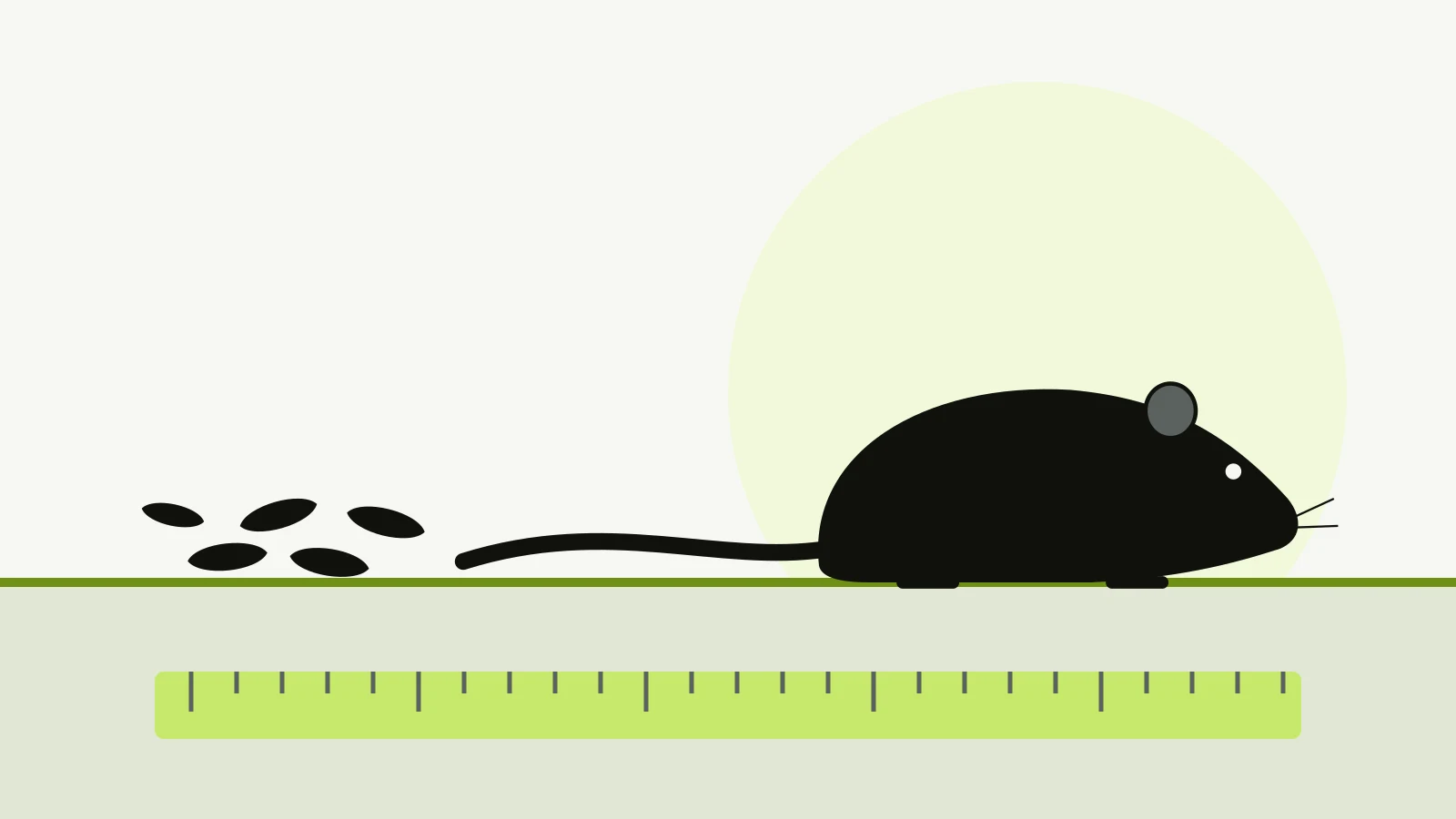
Rat droppings are dark pellets, usually 12 to 20 mm long, thick in the middle and left in groups. Fresh ones are dark, soft and moist, which suggests rats are nearby. Measure one against a ruler without touching it, never sweep or vacuum them, and clean them up wet.
By the Bestone pest control team · Contact us
Key takeaways
- Rat droppings are dark pellets, usually 12 to 20 mm long, thick in the middle and left in groups. Anything longer than a mouse dropping (3 to 6 mm) should be treated as rat until someone has checked.
- Dark, soft, moist droppings suggest rats are active nearby. Old ones prove only that rats were there, so clean up and check the same spot each morning.
- Never sweep or vacuum droppings. UKHSA says this can put infectious material into the air. Wear rubber gloves and ideally an FFP2 mask, wet the droppings, wipe, bag and disinfect.
- If small droppings in a loft crumble to dust, they may be from bats. Do not clean or block anything until you have called the National Bat Helpline.
- Our rat control starts from £109, and the price, visits and what is included are confirmed in writing before booking.
On this page
- Key takeaways
- What do rat droppings look like? The quick answer
- Rat droppings at a glance
- How big are rat droppings? What UK sources say
- Rat dropping sizes: the sources side by side
- Brown rat or black rat droppings?
- Rat droppings or something else? Mouse, squirrel, bat, cockroach and slug
- What else could it be?
- Small droppings in the loft? Check for bats before you clean
- Fresh or old rat droppings: how to tell the difference
- Fresh or old?
- Do rat droppings mean you still have rats?
- How to clean up rat droppings safely
- Food, clothes, carpet and insulation: what to clean and what to throw away
- Keep, clean or throw away
- Are rat droppings dangerous? What the NHS and UKHSA say
- Where rat droppings turn up: loft, kitchen, shed and drain
- What the location suggests
- What do rat droppings look like in the garden?
- What droppings tell you about numbers and routes
- Renting or reporting: who deals with rat droppings?
- What to do next after finding rat droppings
- You found droppings: what next?
- What we do, and what it costs
- Common questions
What do rat droppings look like? The quick answer
Rat droppings are dark brown to black pellets, usually 12 to 20 mm long, thick in the middle and often tapered towards the ends. Lambeth Council says they are about the size of a kidney bean, which is a good picture to carry in your head. They are usually left in groups in a few favoured spots, and Oxford City Council describes them as grouped and spindle-shaped. If what you have found is much smaller than that and spread out along a route, it is more likely to be mice.
This is what people searching for rat poo in the UK nearly always need to know first, so here is the simple order of events. Do not touch or sweep anything. Lay a ruler beside one dropping, photograph it, and note the room. Then work out three things: which animal left it, whether it is fresh, and how to clean it up without stirring up dust.
That order matters because each answer changes the next step. A mouse-sized dropping in a loft might be from a bat, and bats and their roosts are protected by law. A fresh rat dropping in a kitchen means food safety comes first. An old, dry group under a floor may mean no action beyond a safe clean-up and a few days of checking. The table sums up the quick checks.
Rat droppings at a glance
| What to check | Rat droppings | What it tells you |
|---|---|---|
| Length | Usually 12 to 20 mm | Longer than 6 mm rules out an adult mouse |
| Shape | Thick in the middle, often tapered; like a bean or a spindle | Round-ended raisin shapes can suggest a squirrel |
| Colour | Dark brown to black | Colour alone is a poor guide to species |
| Layout | Grouped in favoured spots | Scattered along a run suggests mice |
| Feel, by eye | Fresh: dark, shiny, soft and moist. Old: dull and dry | Fresh suggests rats are active nearby |
| Location | Near food, along walls, in sheds, lofts and voids | Shows where the rats feed and travel |
Based on Oxford, Reading, Lambeth and Mid and East Antrim councils. Do not touch droppings to test them.
How big are rat droppings? What UK sources say
You will see different sizes quoted, and it is not just websites copying each other badly. UK councils and the RHS give different figures, probably because droppings vary with the age of the rat and with what it has eaten. Here is what each source we checked actually says.
Our working range is 12 to 20 mm for an adult brown rat, because most sources fall inside it. Oldham's 5 to 8 mm is the outlier. A young rat will leave smaller droppings than an adult, so a mix of lengths in one group can still be one family of rats. The rule we use is cautious: if a dropping is longer than the 6 mm that Oxford gives for a mouse, treat it as rat until someone has looked at it. Getting that wrong in the other direction costs you more, because rats need a different plan.
The way to settle it is a ruler and a photograph. Put a ruler or a coin beside the droppings, keep your hand away from them, and take the picture straight down, in good light. A 20p coin is 21.4 mm across, so a large rat dropping will reach almost the whole way across it. That photo is also what a pest controller will ask you for, so take it before you clean anything.
Rat dropping sizes: the sources side by side
| Source | Size | Shape |
|---|---|---|
| Oxford City Council | About 20 mm | Spindle-shaped, grouped |
| Reading Borough Council | About 2 cm | Cigar-shaped |
| RHS | About 15 mm long, 5 mm wide | Cylindrical with rounded ends, when fresh |
| Fareham Borough Council | About 12 mm | Tapered |
| Mid and East Antrim Council | Up to 12 mm | Capsule-shaped, tapered at both ends, black |
| Lambeth Council | Kidney bean size | Not described |
| Oldham Council | 5 to 8 mm | Raisin size and shape, black or brown |
Sources disagree. For comparison, Oxford gives 3 to 6 mm for mouse droppings.
Brown rat or black rat droppings?
In a London home, assume brown rat. Redbridge Council says the brown rat is the species most likely to be found, and that you are extremely unlikely to meet a black rat. Hastings Borough Council calls the common or brown rat the most abundant and widespread in the UK, and the ship or black rat rare. The Mammal Society goes further: it says its 2018 study suggests populations have fallen to zero compared with 1995 data, although nobody has declared the black rat extinct in the UK because no exhaustive study has been done.
Redbridge does separate the droppings by shape. Brown rat droppings are spindle-shaped, while black rat droppings are curved, like a banana or sausage. That is a useful detail, but do not lean on it. A single dropping can bend as it lands, and shape alone will not prove a rare species. If you find a group of curved droppings in a warehouse or dockside building, mention it to whoever inspects.
Sources also differ on what rats do indoors. Oldham Council links night-time scratching in lofts to black rats, but Redbridge says brown rats nest in roofs and upper floors too, and they are by far the more likely animal. So a rat in a loft does not point to a black rat. Treatment for both species starts in the same way, with finding out where they are getting in, so you do not need to settle this before you ask for help.
Rat droppings or something else? Mouse, squirrel, bat, cockroach and slug
Most mistakes come from assuming any dark pellet is from a rat. Size separates most of them. The drawing below puts each one on the same ruler, and the table adds where you are likely to find it and what to do. If you have a mixed bag of sizes, go by the largest ones.
Mouse droppings are the most common confusion. Oxford City Council gives 3 to 6 mm, rod-shaped and scattered, or about the size of a grain of rice. Mice leave them as they move, so you tend to find a thin trail in cupboards and along skirting, not a neat group. If that sounds like yours, go to our guide to mouse droppings, and our guide to mice vs rats covers the other signs.
Squirrel droppings are the awkward one, because the sources conflict. Hull City Council says they are raisin-shaped and about 5 mm. Oldham Council says they are larger and more rounded than a rat's. The useful part is the agreement on shape: rounded, not long and tapered. Squirrels are also noisy by day and drag insulation into heaps, so timing helps. Our guide to squirrels in the loft explains how to tell, and what the law says about releasing them.
Cockroach droppings are far smaller. Oxford City Council says they resemble black pepper, and Midlothian Council says pellets are about 2 mm long, brown to black, and look a bit like much smaller mouse droppings. If you see specks behind a cooker or fridge, not pellets, read our cockroach guide.
Slugs are the one we cannot give you a measurement for. Neither the RHS pages we read nor any UK source we could open describes slug droppings. What the RHS does say is that slugs feed at night, so the holes and slime trails they leave are often the only clue. On a damp step or in a shed, look for a silvery trail leading to the mark. No trail, and firm pellets in a group, points away from slugs. Hedgehog Street adds a twist: a hedgehog dropping can look like a dark slug on the lawn.
What else could it be?
| Animal | Droppings | Usually found | What to do |
|---|---|---|---|
| Rat | 12 to 20 mm, thick in the middle, grouped | Near food, along walls, sheds, voids | Clean up wet, then find the route |
| Mouse | 3 to 6 mm, rods, scattered | Cupboards, skirting, behind appliances | Clean up wet, set traps or book treatment |
| Squirrel | About 5 mm, or larger, rounded like a raisin | Lofts, near dragged insulation | Check for daytime noise and roof gaps |
| Bat | Like mouse droppings, dark, grain-shaped, crumble easily | Under a roost, in lofts, near eaves | Leave in place and call the Bat Helpline |
| Cockroach | About 2 mm, or specks like black pepper | Behind cookers and fridges, warm spots | Check for live insects and egg cases |
| Slug | No official description found | Damp paving, sheds, pots | Look for a silvery slime trail |
| Hedgehog | 15 to 50 mm, firm, full of insect parts, often alone | Lawns and paths | Leave it, or lift it with a gloved hand |
Sizes from Oxford, Hull, Midlothian and Oldham councils and Hedgehog Street. Descriptions of bats from the Bat Conservation Trust.
- 1. Rat: the only one in this drawing past 6 mm long
- 2. Mouse: thin rods, scattered along a route
- 3. Squirrel: rounded ends, like a raisin
- 4. Bat: looks like mouse, but crumbles under light pressure
- 5. Cockroach: specks like black pepper
- 6. Slug: look for the silvery slime trail, not a size
Small droppings in the loft? Check for bats before you clean
Please read this before you clear any loft. The Bat Conservation Trust says bat droppings look very much like mouse droppings: dark and shaped like grains of rice. They collect under the roost and below the points bats use to get in, so look in the loft or near the eaves. Because UK bats eat insects, the droppings are made of dried insect remains.
That gives you a simple test. The Trust says to pick up a suspected dropping with a piece of tissue and roll it between your finger and thumb. If it crumbles under a little pressure, it is a bat dropping, and crushed ones can look sparkly in the light. A rodent dropping stays firm. Wear disposable gloves as well, and try this on one dropping only, and only when you have small droppings in a loft or near the eaves. Do not do it on droppings you already believe are from rats.
If it crumbles, stop. GOV.UK says all bat species, their breeding sites and resting places are fully protected by law. It is an offence to damage or destroy a roost, to disturb bats in a place of shelter, or to block access to it, and the penalties reach six months in prison and an unlimited fine. So do not clean, seal gaps or lay anything until you have taken advice. Call the National Bat Helpline on 0345 1300 228, which the Trust says runs Monday to Friday, 9.30am to 4.30pm. GOV.UK says the advice is free and that the helpline can arrange an inspection by a Natural England volunteer bat roost visitor.
The Trust says there is generally nothing to worry about with bat droppings. In very rare cases people develop allergies, and it suggests a dust mask for a large clean-up. Our concern is the law rather than the droppings, and any good pest controller should raise the same question before proofing a roof.
Fresh or old rat droppings: how to tell the difference
Use your eyes, not your fingers. Reading Borough Council says that moist, dark droppings mean rats are likely to be active nearby, and Mid and East Antrim Council says fresh droppings are soft and moist. As they age they dry out and lose their shine. We also treat dull, grey, hard droppings as old, though none of the sources we checked gives a time for how quickly that happens, and we do not think anyone could honestly give you one. A warm kitchen dries things out quite differently from a damp shed.
That is why this check gives you a clue and not an answer. A group of old droppings can have new ones on top of it, and fresh droppings in a damp drain chamber or shed can look wet for longer. Look for the newest ones in the group, not the average. Then look for other signs around them, because the combination is much stronger evidence than a single dropping.
Fresh or old?
| Sign | Probably fresh | Probably old |
|---|---|---|
| Colour | Dark, close to black | Dull, greyer, faded |
| Surface | Shiny and moist | Matt and dry |
| Texture, by eye | Soft-looking, slightly misshapen | Hard, may be cracked or falling apart |
| Dust | Sitting on top of dust, with clean tracks near them | Covered with dust or cobwebs |
| Smell | Strong smell of urine nearby | Musty or none |
| Nearby signs | New gnawing, greasy marks, noises at night | Old gnawing, nothing new |
| What to do | Treat as active today | Clean up, then run the three-morning check |
Dark and moist from Reading Borough Council, soft and moist from Mid and East Antrim Council; the rest is our own guide. No source gives an ageing time.
Do rat droppings mean you still have rats?
Not always. Droppings do not go away by themselves, so a loft or floor void in an older London house can hold droppings from a problem that ended years ago. Building work can uncover them. The question is not whether rats have ever been there. It is whether they are there now.
The best test is the simple one described by the US Centers for Disease Control and Prevention: clean the area safely, then look for droppings. If droppings appear after cleaning, rodents are still active. We call this the three-morning check, because rats do not always use a spot every night. It costs nothing, and the steps are below. Do it before you pay for anything, unless you have other signs that rats are in the home now.
Skip the test and ask for help straight away if droppings are in a kitchen or near food, or you have seen a rat indoors. The same goes if you have fresh gnawing, greasy marks on skirting boards, or scratching at night. Reading lists gnaw damage to pipes, cables and food packets, runways in soil or grass, and black greasy marks on skirting boards as signs of rats. Waiting three days adds nothing if the evidence is already there.
- Photograph the droppings with a ruler in the picture, and note each place you find them.
- Clean up each spot using the steps in the next section.
- Lay a sheet of plain paper or a light dusting of flour on a hard floor at each spot, if it is safe to do so. It will show new droppings and footprints.
- Check each morning for three days, and write down what you find.
- New droppings or prints: rats are active. Move on to treatment.
- Nothing after a week: keep checking now and then, and fix any gaps you found.
- In a loft, take care on joists and do not put your weight on plasterboard.
How to clean up rat droppings safely
UKHSA gives the clearest official advice we could find. It is written for people who keep pet rodents, so we have applied it to wild rats, but it names them directly: 'Do not sweep or vacuum up mouse or rat urine, droppings, or nests.' It explains that doing so can release infectious material into the air. Breathing in dust from dried droppings or urine is one of the ways it lists for infections to spread. So the whole method is about keeping things wet and off your skin.
UKHSA says to wear rubber household-type gloves and, ideally, an FFP1 or FFP2 dust mask. Droppings outside a cage should be picked up with a wet wipe or damp kitchen towel, placed in a plastic bag and put in the rubbish bin, and then the area should be cleaned thoroughly, disinfected and left to air dry. For sheds, it says to open doors and windows for at least 30 minutes before you start. Its method for soiled bedding adds a 5-minute soak in disinfectant, and the US CDC gives the same 5 minutes for droppings, or as the label directs. We combine the two below, and that is the method we recommend for anything more than a dropping or two.
Use a household disinfectant, and follow its label for how long it must stay wet. If you use bleach, dilute it as the bottle says and never mix it with other cleaning products. If the job is large, leave it. UKHSA lists very young children, older adults, people with long-term conditions, those with weakened immune systems and pregnant people as being at higher risk, and it tells pregnant people to ask someone else to clean up after a pet rodent. We would apply that to wild rats too. The CDC says heavy infestations need extra protective equipment, including coveralls, goggles and a respirator, which goes beyond a household job.
- Keep children and pets away, and take your photos first.
- In a shed, loft or closed room, open doors and windows and leave for 30 minutes.
- Cover cuts with waterproof plasters. Put on rubber gloves and an FFP1 or FFP2 mask.
- Spray the droppings and the surrounding area with disinfectant until wet, and leave for 5 minutes or as long as the label says.
- Pick everything up with damp paper towels or wet wipes, and put them in a plastic bag.
- Tie the bag and put it in your rubbish bin. For a nest or a dead rat, the CDC says to double-bag it.
- Clean the area thoroughly, disinfect it again and let it air dry.
- Wash reusable gloves and let them air dry. Wash your hands with soap and water, then take off the mask by the straps only, without touching the front.
- 1. Open up first: 30 minutes of air for sheds and closed spaces
- 2. Cover cuts, then put on gloves and a mask
- 3. Wet the droppings so no dust can lift
- 4. Lift with damp towels, bag and bin
- 5. Clean and disinfect the surface, then air dry
- 6. Wash hands, then remove the mask by its straps
Food, clothes, carpet and insulation: what to clean and what to throw away
Once the droppings are up, deal with what they touched. Throw out anything you cannot clean properly, and do not try to save open food. Plymouth City Council's advice for food businesses is simply to throw away affected food, and a kitchen at home deserves the same standard. The London Borough of Bromley tells food businesses to stop preparing food until the problem is dealt with, possibly contaminated food is gone, and equipment and work areas are cleaned and disinfected. Its leaflet also warns that rat urine can contaminate food and packaging. If you run a food business, you should call a contractor right away, and our guide to commercial pest control sets out your duties.
UKHSA says to wash bedding or clothing with rodent urine or droppings on it, using laundry detergent on the hottest setting the fabric allows. Carpets need more thought, because you cannot vacuum until the droppings are gone. Lift droppings with damp towels, clean the spot with a product the carpet maker allows, and only vacuum once the area is clean. Our guide on how to clean carpet covers spot cleaning, and the soaked areas of an underlay usually need replacing.
Loft insulation is the hardest part, because droppings sink into it. The CDC says to bag contaminated insulation for removal, and to throw away cardboard with urine or droppings on it while disinfecting plastic, glass or metal items. Do not start pulling insulation out with bare arms in a dusty loft. If a nest or a large area is affected, we can quote for loft insulation removal and disinfectant treatment after the rats have been dealt with.
Keep, clean or throw away
| Item | What to do | Why |
|---|---|---|
| Open food, or gnawed or soiled packets | Throw away | Cannot be cleaned, and urine may not be visible |
| Sealed cans and jars | Wash and disinfect the outside before opening | The outside may have been touched |
| Plates, pans and cutlery | Wash in hot soapy water, or run through a dishwasher | These touch food directly |
| Worktops, cupboards, handles | Clean, disinfect, leave to dry | Plymouth says hand-contact surfaces need disinfecting too |
| Bedding and clothes | Wash on the hottest setting the fabric allows | UKHSA advice |
| Cardboard boxes | Throw away if soiled | CDC advice; porous, so it holds urine |
| Plastic, glass and metal items | Disinfect | CDC advice |
| Loft insulation with droppings or a nest | Bag it for removal, or ask us to quote | Cannot be cleaned where it lies |
Food and hygiene rows combine Plymouth and Bromley advice for food businesses with our own advice for homes.
Are rat droppings dangerous? What the NHS and UKHSA say
Treat them with care, but do not panic. UKHSA's guidance on pet rodents says all rodents should be presumed to carry infections even when they look healthy. It lists leptospirosis, hantavirus, rat-bite fever and a virus called LCMV, and says these can spread through bites and scratches, contact with urine, droppings, saliva or bedding, breathing in dust from dried droppings or urine, and contaminated food or drink. Mid and East Antrim Council also names salmonellosis. The serious infections are uncommon, and the steps above are there to make them less likely.
Leptospirosis, whose severe form is Weil's disease, is the one most people ask about. The NHS says it spreads in the pee of infected animals, and that you can catch it if contaminated soil or fresh water gets into your mouth, eyes or a cut. The NHS also says it is rare in the UK. UKHSA counted 154 confirmed and probable cases in England in 2024. Six of the 102 confirmed cases reported contact with a rodent or rodent excreta as a possible exposure, although exposure details were known for only 27 of those 102. Note that urine carries this risk, so a wet floor or surface near droppings matters as much as the droppings themselves.
The NHS says most people with leptospirosis have no symptoms or mild flu-like symptoms, while others become seriously ill. It advises seeing a GP if you may have been exposed and have a fever or chills, headache, sickness, diarrhoea, aches, red eyes or loss of appetite. Ask for an urgent GP appointment or contact NHS 111 if you have yellowing skin or eyes, a rash, cannot pass urine, or have swelling in your ankles, feet or hands, chest pain or breathlessness. UKHSA says leptospirosis usually appears 7 to 21 days after exposure and can be treated with antibiotics.
People also ask about hantavirus, so here are the UK facts. UKHSA says Seoul hantavirus has been found in pet rats, and occasionally in wild rats in restricted parts of the UK, and that UK cases without overseas travel have mostly involved pet rats. It rates the overall risk to the general public as very low. Exposure to infected urine or droppings is the main route, including dust containing them, which is another reason never to sweep. UKHSA says symptoms usually appear 2 to 4 weeks after exposure.
If you feel unwell after contact with droppings, tell the doctor about it, because early symptoms can look like flu and UKHSA says that detail matters. If you are pregnant, UKHSA says to contact a doctor promptly if you develop symptoms after rodent contact. We cannot advise on your own health, so please speak to your GP, a pharmacist or NHS 111 if you are worried.
Where rat droppings turn up: loft, kitchen, shed and drain
Where you find droppings tells you more than how many you find. The RHS says they are often found where rats have been feeding, and Redbridge notes that brown rats can nest in roofs and upper floors. Rats also keep to routes. Hastings Borough Council says established runs become greasy and dirty, and are obvious even in moderate infestations. So think of each group of droppings as a marker on a map: a feeding spot, a resting spot or a stop on the way in.
In the loft, look along joists, around the water tank, under stored boxes and where pipes or cables come up through the ceiling. Remember that Lambeth says loft noises are often squirrels or birds, so confirm by size before you decide. In the kitchen, pull out the plinth under the units if it unclips, and check behind the cooker, around the sink pipes and at the back of the food cupboard. Droppings under the sink usually point towards gaps around pipework.
In a shed or garage, they tend to sit around the edges, behind stored items, near bags of seed or pet food, and in old nesting material. Check the floor for a burrow or a hole in the corner. In a drain, you are unlikely to see droppings at all unless you lift a cover, and we do not recommend that. Reading says rats can enter through broken pipework, so droppings under a bath panel or behind a toilet, with no gap you can find, are a reason to ask about the drains. Our drain and sewer camera surveys page explains what a survey shows.
What the location suggests
| Where | What it suggests | What to do first |
|---|---|---|
| Loft | Rats climbing inside walls or from outside; or squirrels or bats | Check size and do the bat test if small |
| Kitchen cupboards | Rats feeding indoors | Move food into sealed containers today |
| Under the sink or behind appliances | Pipe gaps or a floor void route | Check pipe entries and book an inspection |
| Bathroom, behind a panel | Possible drain route | Ask about a drain survey |
| Under floors or in the wall | A hidden route or nest | Do not seal gaps yet; get advice first |
| Shed or garage | Food stored there, or a burrow beneath | Move food into metal bins and check for holes |
| Around a drain cover | A drain fault, or rats using the cover area | Keep clear and photograph it |
Our recommendations, based on advice from Reading, Lambeth and Redbridge councils.
- 1. Loft: along joists and pipe entries, often the top of a route
- 2. Kitchen: behind units and under the sink, close to food
- 3. Floor void: droppings out of sight below the kitchen
- 4. Drain: a broken joint can start the whole route
- 5. Shed: edges and corners, with a burrow beneath
- 6. Garden: droppings where rats feed, such as under a feeder
What do rat droppings look like in the garden?
They look the same as indoors, but rain and sun change them quickly, so outdoors they may look paler, or broken up. What gives them away is where they are. The RHS says fresh droppings are about 15 mm long and often found where rats have fed. In a garden, that means under a bird feeder, around the compost bin, beside a chicken run or rabbit hutch, along the back of the shed, and near vegetable beds. The RHS also says piles of snail shells can point to rats, and that bitten crops show parallel grooves from a rat's incisors.
Look for the other signs that sit with them. Reading describes smooth runways through soil or grass, often along fence lines, and burrow holes of 5 to 7 cm that look smooth and shiny if they are active. The RHS gives a smaller figure for the entrance, 30 to 40 mm, and Mid and East Antrim gives 70 to 120 mm. So do not rule out a hole on size alone. A burrow beside droppings is strong evidence of rats.
The garden look-alike to know is the hedgehog. Hedgehog Street says hedgehog droppings are 15 to 50 mm long, dark brown-grey or black, firm and roughly cylindrical, usually found alone, and packed with bits of beetle and other invertebrates. So one thick dropping on the lawn with shiny fragments in it is good news, not bad. The Scottish SPCA agrees on the size. A group of smaller pellets near the bird table is more of a concern. Foxes, cats and dogs leave far larger droppings, usually with a strong smell, and do not leave small groups of pellets.
Take care when you clear up outdoors. The RHS says the bacteria that cause leptospirosis spread in rat urine and can survive in wet places, and it warns that compost where rats have lived should not go on crops eaten raw where the edible part touches soil. Wear gloves, cover cuts and wash your hands after gardening. For the steps that remove what is feeding the rats, read our guide on how to get rid of rats.
What droppings tell you about numbers and routes
Droppings can give a rough picture, but only a rough one. Hastings Borough Council says droppings and smears are a good indicator of how large an infestation is and how long it has been there. Mid and East Antrim Council says a rat leaves about 50 droppings a day. It is tempting to do the maths, but a pile of 200 could be one rat over four nights, or four rats in one night, so a count on its own is no use. What you can measure is the rate. Clean a spot, come back the next morning, and count what is new. A handful suggests one or two rats visiting. Dozens in one night, in more than one place, suggests more.
Spread tells you more than number. Droppings in one corner of a shed suggest one spot on a route. Droppings in several rooms, or on two floors, mean rats are moving through the building, usually inside walls or under floors. Mixed sizes in the same group can mean young rats, and young rats mean they are breeding nearby. Then there is the trail. Follow the droppings along the wall, in both directions. One end should lead you to food, and the other towards a gap, a pipe or a hole. That gap is the thing that matters most, because Thames Water says rats can get through 1.5 cm.
Use this to plan rather than to reassure yourself. If you have droppings in only one place, no noises and nothing new after the three-morning check, you probably have an old problem or an occasional visitor. If you have fresh droppings in two or more places, assume you have an active group and act this week. We would rather you called us about a handful of droppings than waited until you can count them by the dozen. Oxford City Council says rats usually stay within 50 m of home, so your source may also be next door.
Renting or reporting: who deals with rat droppings?
If you rent, tell your landlord or agent straight away, in writing, with dated photos of the droppings and a note of where you found them. Citizens Advice says landlords usually only need to act once they know about the problem. It says your landlord will probably be responsible if the tenancy agreement says so, including wording about keeping the home in a good and habitable state, or if repairs they did not make caused it, such as holes in walls. You may be responsible if you caused the problem, for example by not disposing of rubbish properly. Please do not clean everything away before you have taken pictures.
Citizens Advice also says to tell your council about rats or mice, whether or not you live in council housing, and that the council may destroy them or make the landlord or owner deal with them. If you rent privately you may have to pay for the council's pest control. If you rent from a council or housing association, it says that under Awaab's Law an emergency hazard must be made safe within 24 hours, or you must be offered somewhere else to live until the work is done. Redbridge tells its council tenants to contact their Housing Officer. Landlords should treat a report as a repair job: book an inspection, close the route and keep the paperwork. If you are moving out, our end of tenancy cleaning checklist covers what to leave clean.
There is also a duty that surprises people. Under section 3 of the Prevention of Damage by Pests Act 1949, an occupier of land who learns that rats or mice are living on it or visiting it in substantial numbers must tell the council in writing straight away, unless it is agricultural land. Failing to do so can lead to a fine of up to level 1 on the standard scale. A few old droppings do not reach that level, but a clear active infestation may, and a short email to environmental health is an easy way to cover yourself.
If rats seem to be coming from somewhere else, report that too. Redbridge says to use its Environmental Health form for rats from neighbouring land, and it aims to respond within five working days. Thames Water says to contact your council first, and to call Thames Water only once the council or a pest controller has confirmed that the rats are coming from one of its sewers. It may not be able to help without your report reference number. This is general information and not legal advice, so check your own agreement or ask a housing adviser about a dispute.
What to do next after finding rat droppings
Match what you found to the table below, and start today. Most people need only one of these rows. If you have seen two rows that fit, follow the one further down, because it is the more serious. Photos come first in every case, since they help a landlord, a council and a pest controller, and you cannot take them after you have cleaned.
For anything in the bottom half of the table, do not start with shop-bought poison. It can leave a rat dying in a wall, and it does nothing about the gap. Our guide on how to get rid of rats sets out the full order of work, including traps, bait and pets. If you are simply not sure what you have, a pest inspection will look at the signs and likely entry routes, and you can contact us with your photos first.
You found droppings: what next?
| What you found | Most likely meaning | Your next step |
|---|---|---|
| A few old, dry droppings, nothing else | A past problem | Clean up and run the three-morning check |
| One thick dropping on the lawn, full of insect bits | A hedgehog | Nothing needed |
| Small droppings in a loft that crumble | Possibly bats | Stop and call the National Bat Helpline |
| Small rods along a kitchen skirting | Mice | Read our mouse guide and protect food |
| Fresh droppings under a feeder or by compost | Rats feeding outdoors | Remove the food and check for burrows |
| New droppings after you cleaned | Active rats | Book treatment this week |
| Fresh droppings in a kitchen or several rooms | Active rats indoors | Protect food and book treatment now |
| Rats, droppings and no visible way in | Possible drain route | Book treatment and ask about the drains |
Our recommendations. If you are unsure between two rows, take the more cautious one.
What we do, and what it costs
You do not need to work out the species before you contact us. Send a photo of the droppings beside a ruler, tell us where you found them and give us your postcode. Rat control starts from £109 as a starting rate, which covers an initial inspection and targeted treatment. The final figure depends on how far the activity has spread, the rooms and outdoor areas affected, access, entry points and how many visits are needed. We confirm the price, the visits and what is included in writing before you book.
Rats can need more than one visit, so a package may suit you better. For a 1-bed property, a two-visit package is £160 to £190 with a 1-month written guarantee, and a three-visit package is £210 to £230 with a 3-month written guarantee. Packages include a safety report plus follow-up and proofing advice. Larger homes are on our prices page. For comparison, Redbridge Council charges £200 per household for rats in 2026/27, with a repeat visit within four weeks at no charge if treatment fails, and it does not do proofing work. If you need that, see rodent proofing, and our Ilford pest control page sets the fees out in full.
If it turns out to be mice, our mice control page has the details. We are based on Clements Road in Ilford, cover London and carry public liability insurance. Phone lines are open Monday to Saturday, 8am to 8pm. Our guide to pest control costs explains what moves a quote up or down.
Common questions
What do rat droppings look like?
They are dark brown to black pellets, usually 12 to 20 mm long, thick in the middle and often tapered. They tend to sit in groups, not spread out along a route. For a side-by-side with mouse droppings, see our guide to mice vs rats.
Are old rat droppings dangerous?
They still need care. UKHSA says that breathing dust from dried droppings or urine is one way rodent infections spread, so old droppings should be wetted, never swept. If there are a lot of them, ask about disinfectant treatment.
Can I vacuum rat droppings?
No. UKHSA says not to sweep or vacuum rat or mouse urine, droppings or nests, because that can release infectious material into the air. Wet them, wipe them up and bag them, as set out in our rat control advice.
How do I know if droppings are from a rat or a mouse?
Measure one against a ruler without touching it. Oxford City Council gives 3 to 6 mm for mouse droppings, while most sources put rat droppings at 12 to 20 mm. If yours are rice-sized, read our guide to mouse droppings.
Do rat droppings always mean I have rats now?
No. Old droppings can be left from a problem that ended long ago, especially in a loft or under a floor. Clean the area, check each morning for three days, and book a pest inspection if new ones appear.
What should I do if a rat has been on my kitchen worktop?
Throw away any open food, and any packet that has been gnawed or soiled. Clean and disinfect the worktop, cupboards and handles before you prepare food, then look for how the rat got in. Our guide on how to get rid of rats explains the next steps.
Can you get ill from touching rat poo?
UKHSA says infections can spread through contact with droppings or urine, particularly if they then reach your eyes, nose, mouth or broken skin. Wash your hands with soap and water straight away, and tell a doctor about the contact if you become unwell. Our rat control page covers what to do about the source.
Who pays for rat droppings in a rented home?
It depends on the cause. Citizens Advice says your landlord will probably be responsible if the tenancy says so or if unrepaired holes caused the problem, and you may be responsible if you caused it. Tell your landlord in writing, and see pest control across London if you need a quote.
What does rat poo look like in the garden?
The same as indoors, but usually near food or cover: under a bird feeder, in a shed or around compost. Droppings 15 to 50 mm long and packed with shiny insect bits on the lawn are more likely to be from a hedgehog, so check before you act. Our guide on how to get rid of rats covers gardens in detail.
How much does it cost to deal with rat droppings?
Our rat control starts from £109, and a two-visit package for a 1-bed property is £160 to £190. Redbridge Council charges £200 per household. See our prices for the full list.
Sources
Figures differ a little between sources, so ranges are given where they do. Sources reviewed on 1 November 2026.
- UKHSA: reducing the risk of human infection from pet rodentsgov.uk(opens in a new tab)
- UKHSA: hantavirusesgov.uk(opens in a new tab)
- UKHSA: common animal-associated infections (England), annual report 2024gov.uk(opens in a new tab)
- NHS: leptospirosisnhs.uk(opens in a new tab)
- Prevention of Damage by Pests Act 1949, section 3: duty to notifylegislation.gov.uk(opens in a new tab)
- GOV.UK: bats, protection, surveys and licencesgov.uk(opens in a new tab)
- Bat Conservation Trust: identifying bat droppingsbats.org.uk(opens in a new tab)
- Citizens Advice: pests or vermin in your rented homecitizensadvice.org.uk(opens in a new tab)
- RHS: ratsrhs.org.uk(opens in a new tab)
- RHS: slugs and snailsrhs.org.uk(opens in a new tab)
- Oxford City Council: ratsoxford.gov.uk(opens in a new tab)
- Oxford City Council: cockroachesoxford.gov.uk(opens in a new tab)
- Redbridge Council: pest control, ratsredbridge.gov.uk(opens in a new tab)
- Redbridge Council: pest controlredbridge.gov.uk(opens in a new tab)
- Lambeth Council: ratslambeth.gov.uk(opens in a new tab)
- Reading Borough Council: rat preventionreading.gov.uk(opens in a new tab)
- Hastings Borough Council: ratshastings.gov.uk(opens in a new tab)
- Fareham Borough Council: brown ratfareham.gov.uk(opens in a new tab)
- Mid and East Antrim Borough Council: ratsmidandeastantrim.gov.uk(opens in a new tab)
- Oldham Council: ratsoldham.gov.uk(opens in a new tab)
- Oldham Council: squirrelsoldham.gov.uk(opens in a new tab)
- Hull City Council: squirrelshull.gov.uk(opens in a new tab)
- Midlothian Council: pest controlmidlothian.gov.uk(opens in a new tab)
- Thames Water: rats, rodents and pest controlthameswater.co.uk(opens in a new tab)
- Plymouth City Council: pest advice for food businessesplymouth.gov.uk(opens in a new tab)
- London Borough of Bromley: pest control in a food businessbromley.gov.uk(opens in a new tab)
- Mammal Society: black ratmammal.org.uk(opens in a new tab)
- Hedgehog Street: tracks and signshedgehogstreet.org(opens in a new tab)
- Scottish SPCA: what does hedgehog poo look like?scottishspca.org(opens in a new tab)
- US CDC: how to clean up after rodentscdc.gov(opens in a new tab)
- US CDC: rodent controlcdc.gov(opens in a new tab)
Want it dealt with?
Tell us what you have seen, the rooms and your postcode. You do not need to know which pest it is. We confirm the price in writing before any work is booked.